Labour Minister reveals what’ll happen if NLC strike continues

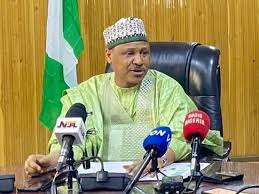
Minister of Labour and Employment, Nkeiruka Onyejeocha, stated the obvious while disclosing that Nigerians will suffer if the Organised Labour continues its nationwide strike. Nkeiruka stated this during an interview on Monday. On Monday, the organized labour embarked on an indefinite nationwide strike after the union failed to reach an agreement with the federal government over minimum wage. The action crippled activities in various sectors, as schools, hospitals and offices were closed. Reacting to the development, the Minister said, “We know what the issues are and we hope they will be resolved, but going to strike will take the matter to the extreme with a lot of negative implications to both our economy and the welfare of the citizens. “If the strike continues, the citizens will suffer and they have started suffering. “Our students who were supposed to be taking exams have been affected because they can’t find means of transportation to exams centres. “There are people who can’t eat until they go to their places of work. Some people who work at the Secretariat live daily on what they get from the officers there.” She lamented the effect of the strike on hospitals, stating that the National grid shutdown will continue to affect a lot of medical procedures. She stressed that hospitals being inaccessible, and doctors not being able to perform their duties might lead to death of patients. “On production side, we know that when activities are shut down, it will affect our economy. Businesses will definitely be affected. Social life has also been affected too”, she said. It was reported that the NLC, despite reaching an agreement with the Federal Government after a meeting on Monday night, has insisted on continuing the nationwide strike.

Strike Stalls Court Hearing On Kano Emirate Tussle

The ongoing nationwide strike action by the Nigeria Labour Congress (NLC) and Trade Union Congress (TUC) has impacted judicial proceedings, leading to a postponement of the much-anticipated hearing on the Kano emirate tussle at the Federal High Court in Kano. The court, which is presided over by Justice A. M. Liman, was scheduled to deliberate on an exparte motion concerning the Kano State Emirate Council’s recent upheaval. This legal action was initiated by Alhaji Aminu Babba Dan’Agundi, the Sarkin Dawaki Babba, challenging the Kano State Emirate Council (Repeal) Law. This law dissolving the five Kano Emirates reinstated Muhammadu Sanusi II as the Emir of Kano. Justice Liman had previously granted an order to maintain the status quo ante, effectively pausing any actions to implement the controversial law until a detailed review could be conducted on the Fundamental Rights application filed by the parties involved. However, the strike has put a temporary halt to this judicial review, affecting not just the parties directly involved but also the broader implications for governance and traditional authority structures within Kano State. As the court awaits the resolution of the labour strike to resume normal operations, the future of the Kano emirate remains uncertain. The legal and social communities eagerly anticipate the next steps in this high-stakes judicial process. The court order reads: “That parties are hereby ordered to maintain status quo ante the passage and assent of the bill pending the hearing of the Fundamental Rights application. “That in view of the constitutional and jurisdictional issues apparent on the face of the application, parties shall address the Court on same at the hearing of the Fundamental Rights application, which is fixed for the 3 of June, 2024. “That in order to maintain the peace and security of the state, an interim injunction of this Honourable Court is granted restraining the 5th 8th Respondents from enforcing, executing, implementing, and operationalizing the Kano State Emirate Council (Repeal) Law. “That parties are hereby ordered to maintain status quo ante the passage and assent of the bill into pending the hearing of the Fundamental Rights application. “That leave is granted to the Plaintiff/Applicant to issue and serve their Concurrent Originating Motion as well as all other court processes on the 6th Defendant in FCT Abuja and outside the jurisdiction of this Honourable Court. “That an Order of this Honourable Court marking the Plaintiff/Applicant’s Concurrent Originating Motion as well as all other court processes to be served on the 6″ Defendant in FCT Abuja and outside the jurisdiction of this Honourable Court is granted,” the court order, however, reads. The court, however, adjourned the case until June 3, 2024, to hear the Fundamental Rights application. However, on the adjourned date of June 3rd, 2024, the court could not hold it as expected due to the strike, as a source at the court informed Vanguard that the matter had been postponed until further notice.

FG invites labour to meeting Tuesday

The Federal Government has through the National Salaries, Incomes and Wages Commission, invited the organised labour to a meeting on Tuesday over the ongoing nationwide strike. The Nigeria Labour Congress and the Trade Union Congress had on Sunday said the strike would go ahead on Monday as scheduled despite an appeal by the leadership of the National Assembly which held a mediation meeting between the unions and representatives of the Federal Government. The two unions and their organs commenced the strike on Monday which paralysed economic and government activities in different states of the federation. Ministries, departments, agencies and offices in critical sectors like the courts, government secretariats, airports, and schools were grounded. Many bank branches did not open although some in Lagos did not shut down. Labour went on strike because it could not accept the N60,000 minimum wage offered by the Federal Government.

Nationwide Strike: kneejerk Reaction to a Serious Governance Challenge

As you read this Nigeria is now under total lockdown, whereby major economic activities in the organized public and private sectors have been completely crippled. Labour has made good its threat to commence an indefinite nationwide strike to protest government insensitivity to its plight and clamour for wage review. This moment has been long coming, taking into account recent federal government economic policies which impacts have been skewed againts the suffering mass of Nigerians. From the withdrawal of fuel subsidy, liberalization of the foreign exchange to the recent hike in electricity tariff and and aborted cybersecurity levy. Most of these reforms are mass focused and have had acute impact on the social and economic wellbeing of poor Nigerians. This has pitched labour unions against the government as organized labour agitate for wage increases and better welfare for their members. But I am one of a few who do not think that the labour is going about its agitations correctly. The protests and strikes so far have been kneejerk reactions that have been largely ineffectual. Put simply, I DO NOT AGREE WITH THIS CALL FOR NATIONWIDE INDEFINITE STRIKE. My reasons are simple. 1. As already stated, this strike and others before it are largely kneejerk reactions to a fundamental error of policy choice, planning and implementation by government. 2. The strikes are one too many and have a tendency of seeming like one repeating a process and expecting a different outcome. 3. Some are of the opinion that most of the recent strike actions have been about bread and butter issues and nothing about the very important subject of better governance of the society. Here are a few alternatives that labour may want to contemplate if they are desirous of thinking outside the box. 1. Formulate proper critical engagement with the government on sincere cost cutting measures that affect the highest echelons of the public service and governmental agencies. 2. Collaborate with the executive to instigate a downward review of the cost of governance. 3. Encourage the president to prune the size of the cabinet or you partner with the mass public to achieve the same purpose. 4. Let you labour strike not be always about your interests but the wellbeing of the Nigerian masses. These strategies shall assist to endear the labour movement to the Nigerian public and win their confidence and trust. Labour can leverage on such goodwill to escalate activities to achieve desired changes in the political arena.

Nationwide Strike to Go on: Negotiations Between NASS and Labour End in Deadlock

Efforts by the leadership of the National Assembly to mediate between the federal government and Labour unions hit a roadblock as the latter insists on continuing the strike. Despite last-minute discussions, the unions remained adamant in their demand for a ₦494,000 minimum wage while negotiations persist. In a bid to resolve the ongoing impasse between the federal government and Labour unions, the leadership of the National Assembly convened a meeting aimed at finding common ground. However, despite extensive deliberations, the parties failed to reach a consensus. Labour unions, represented by their leadership, reiterated their stance that the strike action must continue until their demands are met. Central to their demands is the insistence on a ₦494,000 minimum wage, which they argue is necessary to address the pressing needs of workers across various sectors. Meanwhile, the federal government has expressed its commitment to ongoing negotiations but maintains that any decision regarding the minimum wage must be approached with careful consideration of economic realities and sustainability. The deadlock in negotiations underscores the challenges faced by both parties in finding a balance between addressing the legitimate concerns of workers and ensuring the long-term viability of government policies. As the strike enters its next phase, the impact on essential services and the economy at large is expected to escalate, further underscoring the urgency for a resolution to be reached. With negotiations at an impasse and the strike set to continue, the onus is on both the federal government and Labour unions to redouble their efforts to find a mutually acceptable solution. The welfare of workers and the stability of the economy hang in the balance as stakeholders navigate this challenging period of labor relations.

FG Reacts As Labour Begins Indefinite Nationwide Strike 

The Federal Government has appealed to Organised Labour to reconsider its decision to embark on an indefinite strike from Monday, June 3, 2024. The Nigeria Labour Congress president, Joe Ajaero yesterday announced that the industrial action which would begin by Monday midnight is in protest against the government’s refusal to raise the proposed minimum wage from N60,000. Reacting to the development, Minister of Information and National Orientation, Idris Mohammed in an interview with Punch stated that the interest of the masses should be the top priority of Organised Labour, saying strike was not the solution to the ongoing negotiation for a new minimum wage for workers. His words: “The government is pleading with Labour to reconsider its position. The FG has already made an offer of N60,000, and whatever the government does is in the interest of Nigerians. “We won’t like to do something that will throw the country into another problem. “Even as we do that, we are pleading with Labour. They are partners in this project called ‘Nigeria’ and we expect them to join hands with the FG as it strives to look for solutions that will take Nigeria to the desired prosperity. “Our message is that of an appeal and the need for Labour to see reason with the government. That was even the basis for setting up the tripartite committee that was made up of Organised Labour, the sub-nationals and the FG. This was because the government just didn’t want to make unilateral decisions. In any case, the position on the wage regime is not a one-sided thing. “We expect that they will see reason with the government. That is why we are calling on them to show understanding by not embarking on the strike because we don’t want that at this point. A strike is not the solution to our problem. We are continuing our negotiation with them. The minister and other stakeholders are still talking to them and we believe that we will find a common ground,” he stated.

Nationwide Strike Imminent as Labour Unions Decry Government Inaction

The Nigeria Labour Congress (NLC) and the Trade Union Congress (TUC) have threatened to embark on nationwide strike by Monday in response to the Federal Government’s failure to finalize a new National Minimum Wage Act and reverse the recent surge in electricity tariff to N65/kwh. During a press conference held on Friday, May 31st, 2024, the unions expressed deep concern over what they perceive as the government’s disregard for the welfare of Nigerian workers. The unions were particularly irked by the absence of governors and key ministers, except for the Minister of State for Labour and Employment, during the negotiations as a mark of the government’s lack of commitment to addressing the concerns of workers. Recalling the ultimatums issued during the May Day celebrations on May 1st, 2024, demanding the conclusion of the minimum wage negotiations by the end of the month, the unions emphasized the lack of substantial progress or commitment from the government. In addition to demanding the reversal of the recent electricity tariff hike, which saw rates skyrocket to N225/kwh, the unions reiterated their call for a return to the previous rate of N65/kwh and an end to the categorization of consumers into Bands. Despite widespread protests and public outcry, the unions criticized the government’s response as characterized by “persistent inaction” and the dissemination of propaganda rather than engaging in meaningful dialogue. Consequently, the NLC and TUC announced the initiation of an indefinite nationwide strike, set to commence on Monday, June 3rd, 2024. The unions called upon their affiliates, civil society organizations, market traders, and the general public to lend their support to the industrial action. While acknowledging the potential inconveniences that may arise from the strike, the unions affirmed their unwavering resolve to pursue their objectives until the demands regarding the minimum wage and electricity tariff hike are satisfactorily addressed by the government.

NARTO Calls off Planned Nationwide Strike

The Nigerian Association of Road Transport Owners (NARTO) has suspended its planned nationwide strike. NARTO National President of NARTO, Othman Yusuf, directed members to immediately resume petroleum loading activities after a meeting held in Abuja. It was gathered that the meeting was attended by the Minister of State Petroleum Resources (Oil), Heineken Lokpobiri, with NARTO, oil marketers and the Nigerian Midstream and Downstream Petroleum Regulatory Authority, (NMDPRA). This followed Monday’s meeting with the Federal Government and stakeholders after tanker drivers suspended operations and stopped lifting of petroleum products amid harsh economic realities. NARTO members had threatened shutdown all over the country beginning Monday over the high cost of Automotive Gas Oil also known as diesel which is used to fuel their trucks for the movement of petroleum products across Nigeria. The association explained that the decision to withdraw its operation was due to the high operational costs in the industry. Like Premium Motor Spirit popularly known as petrol which now sells at over N600 per litre, the price of diesel has skyrocketed of late, no thanks to the forex crisis in the country. At the moment, diesel sells above N1,250 per litre in Nigeria.

Nigerian Bakers To Begin Nationwide Strike

Bakers and caterers in Nigeria are set to commence a nationwide strike starting February 27, 2024. This was announced by the Association of Master Bakers and Caterers of Nigeria (AMBCON) on Tuesday February 13. AMBCON’s National President, Mansur Umar, relayed this decision through Gabriel Adeniyi, the Kogi State Chairman, citing the government’s failure to honor a 2020 agreement.  The association highlighted soaring material prices and urged the immediate implementation of promised financial support for bakers post COVID-19.  They also demanded a halt on bakery industry taxation across federal, state, and local levels, attributing the strike to various cost increases and taxation burdens.  AMBCON additionally called for importation liberalization of key baking materials, reduction or removal of import duties, concessional forex exchange, and tariff reduction on imported wheat and sugar.  Other demands included domestic wheat and sugar cane cultivation, removal of multiple taxations, and the establishment of a price control committee to enhance business operations. “We have critically accessed the state of our business operation, consequently demand the liberalisation of flour and sugar importation, reduction or total removal of import duties on major baking materials such as flour, sugar, butter, yeast etc as applicable to other commodities as have recently been done by the federal government and Provision of concessionary forex exchange to flour millers and other stakeholders as well as reduction of tariff on imported wheat and sugar,” the association said.

NLC Declares Nationwide Strike

After an extended vacation in both Lagos and Paris, France, it seems the party is over for President Bola Tinubu as the Trade Union Congress of Nigeria (TUC) and the Nigeria Labour Congress (NLC) have sent a notice of a 14-day national strike to the federal government. The unions said that the 16-point agreement that was reached on October 2, 2023, between them and the federal government, has not been implemented. The national leadership of the TUC and NLC expressed sadness that the government appears indifferent to the widespread suffering and adversity in the nation, despite their attempts to maintain industrial peace. The unions in a statement said: “The October 2nd agreement was focused on addressing the massive suffering and the general harsh socioeconomic consequences of the ill-conceived and ill-executed IMF/World Bank-induced hike in the price of PMS and the devaluation of the naira. These dual policies have had, as we predicted, dire economic consequences for the masses and workers of Nigeria.” They further lamented: “It is regrettable that we are compelled to resort to such measures, but the persistent neglect of the welfare of citizens and Nigerian workers and the massive hardship leave us with no choice. “Constrained by this development and recognising the urgency of the situation and the imperative of ensuring the protection and defence of the rights and dignity of Nigerian workers and citizens, the NLC and TUC hereby issue a stern ultimatum to the Federal Government to honour their part of the understanding within 14 days from tomorrow, the 9th day of February 2024.”