Insecurity: Nigerians Paid N2.3trn As Ransom In One Year — NBS Report

“Perhaps the most depressing aspect of the survey was the discovery that most Nigerians lack confidence in law enforcement agents as many are of the belief that police intervention would not result in meaningful action.” Further sign of the failing status of Nigeria as a nation state emerged yesterday as a report by the National Bureau of Statistics revealed the chronic lack of capacity of Nigeria to protect the life and property of its citizens. Meanwhile, Sect 14(2)(b) of the 1999 Constitution of Nigeria,as amended, declares that the security and welfare of the people shall be the primary purpose of government. According to the NBS report, Nigerians paid an estimated N2.3 trillion as ransom in 12 months to secure their freedom from kidnappers. It was also revealed in the survey that households nationwide had an estimated 51,887,032 criminal incidents within the period under review. Perhaps the most depressing aspect of the survey was the discovery that most Nigerians lack confidence in law enforcement agents as many are of the belief that police intervention would not result in meaningful action. The federal government agency reports that these figures were realised from its 2024 Crime Experience and Security Perception Survey (CESPS), and it underscores the dangerous rate and extreme financial burden which Nigerians have to bear just to ensure their personal safety in their own country. The survey also revealed close correlation between poverty and violent crimes. PLEASE READ: Police Dismiss Allegations of Mistrust in August Protests For instance, it was discovered that, with roughly 14,402,254 households, the North-West, where poverty is most prevalent in Nigeria, reported the highest household crime rates, followed by the North-Central (8,771,400) and the South-East (6,176,031). The survey also showed that these type of crimes were more prevalent in the rural than urban areas. While the crime rate in the rural areas stood at 26,526,069 discovered that the figure for the ur­ban area stood at 25,360,963 incidents. “In Nigeria, 4,142,174 households experienced home robbery. Less than half (36.3%) of the households who were victims of home robbery reported their experience to the police,” it was stated in the report. “At the individual level, 21.4 percent of Nigerians reported being victims of crime, and the most common crime was phone theft (13.8%).” In the robust survey that covered wide ranging aspects of crime and criminality, it was also found that about 90 percent of the victims of phone thefts reported to the police, and only 50 percent of the victims expressed satisfaction with police responses. “Nationwide, an estimated 1.4 million experienced sexual offences, which occurred mostly in someone else’s home (27.7%), followed by the victim’s home (22.2%). “Sexual offences are less likely to occur at a public transport station (0.9%), and only 22.7 percent of victims reported to the police. Public perception on safety shows that 9.6 percent of Nigerians believed they might be a victim of crime in the next 12 months.”

Nigeria inflate rate surges higher, hits 34.60%

The most realistic sign that the Federal Government’s economic policies are not yielding the desired result emerged again today as figures released by the National Bureau of Statistics (NBS) show a relentless rise in the rate of inflation from 33.88% in October to 34.60% in November. The Central Bank of Nigeria’s (CBN) in furtherance of efforts to curtail the rise in inflation took the following measures during 298th Monetary Policy Committee (MPC) meeting on November 25–26, 2024. Despite these measures which the current management of the CBN had embarked upon since assuming office, the rate of inflation continues to soar, thereby confirming the contrary opinion of analyst who think the apex bank is not only prescribing the wrong medication but has missed the diagnosis. Further, the NBS figure indicates that on a year-on-year basis, the Headline inflation rate was 6.40% points higher than the rate recorded in November 2023 (28.20%). This shows that the Headline inflation rate (year-on-year basis) increased in November 2024 compared to the same month in the preceding year (i.e., November 2023). ALSO READ: Sanusi Speaks on Sealing of Kano Palace by Security Operatives It is noteworthy to observe however, that on a month-on-month basis, the “Headline inflation rate in November 2024 was 2.638%, which was 0.002% points lower than the rate recorded in October 2024 (2.640%). This means that in November 2024, the rate of increase in the average price level is slightly lower than the rate of increase in the average price level in October 2024,” it was stated in the report. Food inflation after easing at the peak of the harvest period between July and September has spiked, rising, year on year from 39.16% in November 2023 to 39.93% at the end of November 2024. Month on month, the rate rose gently from 2.94% at the end of October to 2.98% in November.2.98 39.93 The NBS stated in the report that, “Every month, 10,534 informants spread across the country provide price data for the computation of the CPI. The market items currently comprise 740 goods and services regularly priced.”

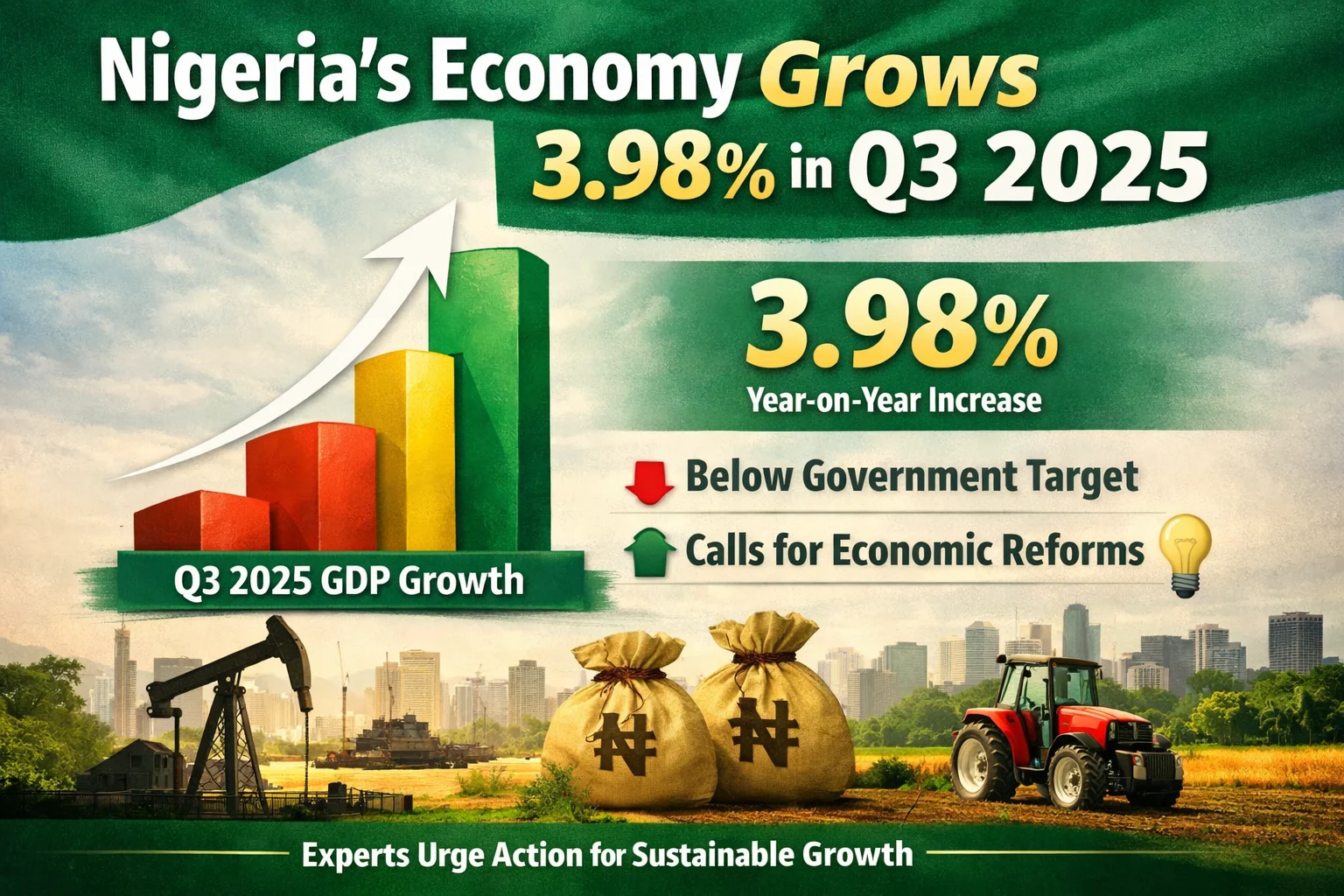
NBS Q3 GDP Growth Report Excites President Tinubu

President Bola Tinubu has reacted positively to Nigeria’s economic growth report for the third quarter of 2024, released by the National Bureau of Statistics.  The report revealed a 3.46% GDP increase, marking a year-on-year improvement that surpassed earlier projections. The presidency attributed this growth to key sectors such as agriculture, ICT, trade, and manufacturing, which collectively played a significant role in driving the economy forward.  Tinubu reiterated his administration’s commitment to ensuring that these gains translate into better living standards for Nigerians. The government highlighted ongoing economic reforms, including proposed tax changes aimed at reducing burdens on small businesses and fostering a more equitable tax system.  These initiatives are part of a broader strategy to achieve Tinubu’s vision of a $1 trillion economy by 2030. As Nigeria prepares to rebase its economy in early 2025, officials anticipate that recent advancements across various industries will further position the nation for sustainable growth and shared prosperity. PLEASE READ: PH REFINERY BEGINS OPERATION: NNPCL GCEO TO OVERSEE FIRST PMS DISPATCH

Nigeria’s Economy Sees Robust Growth in Q3, 2024

The Nigerian economy has experienced an appreciable 0.27 percent expansion, hitting 3.46% in Q3 instead of 3.19% it averaged in Q2 of 2024. Latest data released by the National Bureau of Statistics (NBS) on reveals a consistent upward trend in the economy, surpassing the growth rate of 2.54% seen in Q3 2023.  Additionally, the current quarter also outperformed Q2, 2024, which had seen a growth of 3.19%. In real terms, the GDP stood at N20.1 trillion, reflecting an increase from N18.2 trillion in Q2 2024 and N19.4 trillion in Q3 2023.  The services sector played a crucial role in this performance, driving growth with a 5.19% increase and contributing 53.58% of the total GDP. PLEASE READ: FMBN SECURES N100BN OFFTAKER GUARANTEE FOR KARSANA RENEWED HOPE CITY PROJECT, ABUJA The data further revealed that the nominal GDP for Q3 2024 reached N71.1 trillion, marking a 17.26% increase from N60.6 trillion in the same quarter of the previous year.  This surge signifies a robust recovery and positive economic momentum. Among the key sectors driving the economy, crop production contributed 26.51%, trade accounted for 14.78%, and telecommunications made up 13.94%.  The oil sector also showed improvement, recording a 5.17% growth compared to a negative growth rate of -0.85% in Q3 2023, although it was slightly lower than the 10.15% increase seen in Q2 2024. Nigeria’s oil output for Q3 2024 stood at an average of 1.47 million barrels per day (mbpd), marking a slight increase from 1.45 mbpd in the same quarter of the previous year and surpassing the 1.41 mbpd recorded in Q2 2024. Despite a strong performance in the oil sector, the non-oil economy remains the dominant driver of Nigeria’s GDP, contributing 94.43% in Q3 2024.  The non-oil sector’s contribution has slightly decreased compared to 94.52% in Q3 2023, though it remains higher than the 94.30% seen in Q2 2024. Key areas like agriculture, trade, and services have fueled this growth.

Nigeria’s Q3 GDP Grows 2.54% – NBS

Nigeria’s Q3 GDP Grows 2.54% - NBS

In the third quarter of 2023, Nigeria’s Gross Domestic Product (GDP) grew by 2.54 per cent (year-on-year) in real terms. This growth rate is higher than the 2.25 per cent recorded in the third quarter of 2022 and higher than the second quarter 2023 growth of 2.51 per cent. In its Gross Domestic Report Q3 2023, released on Friday, the statistics bureau noted that Q3 performance was driven mainly by the Services sector, which recorded a growth of 3.99 per cent and contributed 52.70 per cent to the aggregate GDP. The agriculture sector grew by 1.30 per cent, from the growth of 1.34 per cent recorded in the third quarter of 2022. The growth of the industry sector was 0.46%, an improvement from -8.00% recorded in the third quarter of 2022. In terms of share of the GDP, agriculture, and the industry sectors contributed less to the aggregate GDP in the third quarter of 2023 compared to the third quarter of 2022. In the quarter under review, aggregate GDP stood at N60,658,600.37 million in nominal terms. This performance is higher when compared to the third quarter of 2022 which recorded aggregate GDP of N52,255,809.62 million, indicating a year-on-year nominal growth of 16.08%. The NBS noted that in real terms the oil sector growth was –0.85 per cent (year-on-year) in Q3 2023, indicating an increase of 21.83 percentage points relative to the rate recorded in the corresponding quarter of 2022 (-22.67%). Growth also increased by 12.58 percentage points when compared to Q2 2023 which was –13.43 per cent. On a quarter-on-quarter basis, the oil sector recorded a growth rate of 12.47 per cent in Q3 2023. Nigeria recorded an average daily oil production of 1.45 million barrels per day (mbpd), higher than the daily average production of 1.20mbpd recorded in the same quarter of 2022 by 0.25mbpd and higher than the second quarter of 2023 production volume of 1.22 mbpd by 0.23mbpd. According to the NBS, “the sector contributed 5.48 per cent to the total real GDP in Q3 2023, down from the figure recorded in the corresponding period of 2022 and up from the preceding quarter, where it contributed 5.66 per cent and 5.34 per cent respectively.” The non-oil sector grew by 2.75 per cent in real terms during the period under review. This rate was lower by 1.52 percentage points compared to the rate recorded in the same quarter of 2022 and 0.84 percentage points lower than the second quarter of 2023. “The sector was driven in the third quarter of 2023 mainly by Information and Communication (Telecommunication); Financial and Insurance (Financial Institutions); Agriculture (Crop production); Trade; Construction; and Real Estate, accounting for positive GDP growth. In real terms, the non-oil sector contributed 94.52% to the nation’s GDP in the third quarter of 2023, higher than the share recorded in the third quarter of 2022 which was 94.34% and lower than the second quarter of 2023 recorded as 94.66%,” the report stated.

Petrol Increased To N626.21 In September- NBS

Petrol Increased To N626.21 In September- NBS

The National Bureau of Statistics (NBS), says the average retail price of a litre of petrol increased from N191.65 in September 2022 to N626.21 in September 2023. It made the declaration in its Petrol Price Watch for September 2023 released in Abuja on Saturday. It stated that the September 2023 price of N626.21 represented a 226.75 per cent increase over the price of N191.65 recorded in September 2022. “Comparing the average price value with the previous month of August 2023, the average retail price increased by 0.08 per cent from N626.70. “On state profiles analysis, Taraba paid the highest average retail price of N665.56 per litre, followed by Borno and Benue at N657.37 and N641.29, respectively. “Conversely, Rivers, Delta and Jigawa paid the lowest average retail prices at N602.55, N605.88 and N617.42, respectively,’’ it stated. Analysis by zones showed that the North-East recorded the highest average retail price in September 2023 at N638.33, while the South-South recorded the lowest at N618.47 per litre. The NBS also stated in its Diesel Price Watch Report for September 2023 that the average retail price was N890.80 per litre. It explained further that the September 2023 price of N890.80 per litre amounted to a 12.77 per cent increase over the N789.90 per litre paid in September 2022. “On a month-on-month basis, the price increased by 4.27 per cent from the N854.32 per litre recorded in August 2023,’’ it added. On state profile analysis, the report said the highest average price of diesel in September 2023 was recorded in Kano at N967.78 per litre, followed by Anambra at N950.95 per litre and Niger at N950.55 per litre. On the other hand, the lowest price was recorded in Bayelsa at N840.16 per litre followed by Katsina at N840.55 per litre and Rivers at N840.82 per litre. In addition, the analysis by zones showed that the South-East has the highest price at N918.06 per litre, while the South-South recorded the lowest price at N863.97 per litre. 

Inflation Rate Climbs To 26.72% In September -NBS

Inflation Rate Climbs To 26.72% In September -NBS

In September 2023, the headline inflation rate increased to 26.72% relative to the August 2023 headline inflation rate which was 25.80%, the National Bureau of Statistics has said.  In it’s CPI and Inflation Report for September, released Monday in Abuja, the bureau said the rates showed a showed an increase of 0.92% points when compared to the August 2023 headline inflation rate.  On a year-on-year basis, the headline inflation rate was 5.94% points higher compared to the rate recorded in September 2022, which was 20.77%. This shows that the headline inflation rate (year-on-year basis) increased in September 2023 when compared to the same month in the preceding year (i.e., September 2022). Furthermore, on a month-on-month basis, the headline inflation rate in September 2023 was 2.10%, which was 1.08% lower than the rate recorded in August 2023 (3.18%).  This means that in September 2023, the rate of increase in the average price level was less than the rate of increase in the average price level in August 2023. 

Average Price Of 5kg Cooking Gas Stood At N4,115.32 In August –NBS

Average Price Of 5kg Cooking Gas Hits 8.89% -NBS

The National Bureau of Statistics (NBS), says the average price of 5kg of cooking gas increased from N4,072.87 recorded in July to N4,115.32 in August 2023. This is contained in the Bureau’s “Cooking Gas Price Watch’’ for August 2023 released on Monday in Abuja. The report said the August 2023 price represented a 1.04 per cent increase, compared to what was obtained in July 2023. However, the average price of 5kg of cooking gas decreased on a year-on-year basis by 7.66 per cent from N4,456 recorded in August 2022 to N4,115.32 in August 2023. On state profile analysis, the report showed that Kwara recorded the highest average price at N4,816.67 for 5kg cooking gas, followed by Benue at N4,766.67, and Zamfara at N4,756.25. It said on the other hand, Ondo recorded the lowest price at N3,299.29, followed by Ekiti and Nasarawa at N3,330.00 and N3,533.33 respectively. Analysis by zone showed that the North-Central recorded the highest average retail price at N4,501.26, followed by the North-West at N4,340.50 “The South-West recorded the lowest retail price at N3,3737.12,” the NBS said. Also, the NBS said the average retail price for 12.5kg cooking gas increased by 0.35 per cent on a month-on-month basis, from N9,162.11 in July 2023 to N9,194.41 in August 2023. However, the report said the average price of 12.5kg cooking gas dropped by 7.12 per cent on a year-on-year basis, from N9,899.34 recorded in August 2022 to N9,194.41 in August 2023. On state profile analysis, it showed that Cross River recorded the highest average price at N10,172.83 for 12.5kg cooking gas, followed by Ogun at N9,963.64 and Nasarawa at N9,883.37. On the other hand, the report showed that Adamawa recorded the lowest price at N7,597.92, followed by Borno at N8,103.69 and Gombe at N8,173.44. Analysis by zone showed that the South-South recorded the highest average retail price at N9,569.58 for 12.5kg, followed by the South-West at N9,344.17. The report said the North-East recorded the lowest price at N8,631.95. Similarly, the average retail price per litre of Kerosene rose to N1,272.40 in August 2023 on a month-on-month basis, showing an increase of 0.92 per cent, compared to N1,260.81 recorded in July 2023. According to its National Kerosene Price Watch for August 2023, on a year-on-year basis, the average retail price per litre of kerosene rose by 57.18 per cent from N809.52 in August 2022. On state profile analysis, the report showed that Adamawa recorded the highest average price at N1,745.83 per litre of kerosene in August 2023, followed by Benue at N1,468.33 and Abuja at N1,486.89. “On the other hand, Jigawa recorded the lowest price at N1,000 followed by Edo at N1,104.78 and Kaduna at N1,121.79.” The NBS said the analysis further showed that the North-East recorded the highest average retail price per litre of kerosene at N1,370.64, followed by the South-East at N1,332.49. It said the North-West recorded the lowest average retail price per litre of kerosene at N1,163.25. The report said the average retail price per gallon of kerosene paid by consumers in August 2023 was N4,351.53, indicating a 1.06 per cent increase from N4,306.07 in July 2023. “On a year-on-year basis, the average price per gallon of kerosene increased by 47.63 per cent from N2,947.65 recorded in August 2022.” On state profile analysis, it showed that Lagos recorded the highest average price at N5,350.83 per gallon of kerosene, followed by Katsina at N4,991.85 and Borno at N4,897.47. On the other hand, the report said Delta recorded the lowest price at N2,945.71, followed by Rivers and Oyo at N3,287.50 and N3,711.79, respectively. Analysis by zone showed that the North-East recorded the highest average price per gallon of Kerosene at N4,637.71, followed by the South-East at N4,590.69. The report said the South-South recorded the lowest average price per gallon of Kerosene at N3,727.30.

Nigeria’s unemployment rate drops 4.1% -NBS

Nigeria’s unemployment rate drops 4.1% -NBS

Nigeria’s unemployment rate dropped to 4.1 percent in the first quarter of 2023 from 5.3 percent in the fourth of 2022. Mr Adeniran Adeyemi, the Statistician-General of the Federation and Chief Executive Officer of the National Bureau of Statistics (NBS), said this during the inauguration of the New Nigeria Labour Force Survey (NLFS) in Abuja. Adeniran said that the drop in NLFS from 33.3 percent in the Fourth quarter 2020 to its present rate was based on change in methodology adopted and not government performance. The new NLFS unveils a set of labour force indicators designed to provide unparalleled insights into the dynamics of the workforce in Nigeria. The NLFS was conducted by the NBS in collaboration with the World Bank (WB) and the International Labour Organisation (ILO) in response to the labour market dynamics Adeniran said “let me at this point clearly state that this methodology review has nothing to do with whitewashing the image of any government or political party. “This process is routine for any responsible statistical office, and we have no reason to continue to ignore the adoption of new methods, when the evidence clearly indicates the need for it. “As a national statistical office, our responsibility is to provide government and all users with accurate data for evidence-based decision making, adhering to the highest possible standards, and our commitment in this regard is unwavering.” According to Adeniran, the new method which indicates that not less than 73 per cent of Nigerians are engaged in one form of work, recognises all forms of engagements from which individuals earn income. He said using the new ILO definition, the survey showed that the unemployment rate for the fourth quarter of 2022 stood at 5.3 per cent and 4.1 per cent for the first quarter of 2023. “This figure aligns perfectly with neighbouring countries around Nigeria. Ghana (3.9per cent), Niger (0.5 per cent), Chad (1.4per cent), Cameroon (4.0per cent), Togo (4.1per cent), Benin Republic (1.7per cent) amongst others. “In responding to the shifting global landscape and the ever-changing data ecosystem, it is imperative for us to continuously adapt the way in which we collect and analyse data. “This is to ensure that we are producing data that reflects reality and the experiences of Nigerians. “These changes also include a revision to the design and methodology applied in the conduct of the actual survey. “Which is the survey that produces commonly known headline Unemployment and Underemployment rates, as well as other labour market indicators that guide policymakers, researchers, and other users,” he said. According to him, the results indicate a scarcity of Wage-employment, as the share of those employed in Wage-employment during the reference quarters was 13.4 per cent in Q4 2022 and 11.8 per cent in Q1 2023. Adeniran said that the working age population which was defined previously as persons aged 15-64, is now defined as persons aged 15 and above. He said this was a very important change particularly in the Nigerian context as it recognises the labour contributions of persons above the age of 64 which was not done previously. The NBS boss said the unemployed appeared to be the most controversial amongst the changes announced under the review. According to him, the new standard defines the unemployed as persons within the Labour force, who within the reference period did not work for pay or profit for a minimum of 1 hour. “In the real sense, nobody works 1 hour a week and then sits down and does nothing else when there are opportunities for more hours of work. “The statistics show that only 7.1 per cent of those working, work between 1 – 19 hours per week. So, 1 hour is just a benchmark and nothing more than that,” he said. The survey revealed that about three quarters of Nigerians in the working age population, 73.6 per cent in Q4 2022 and 76.7 per cent in Q1 2023 were engaged in some form of work for pay or profit in the quarters under review. Earlier, the World Bank’s Country Director, Shubham Chaudhuri pledged the continued support of the bank to ensure a robust, regular national LFS data for the country. Chaudhuri said a reliable data provided the government with knowledge about the nation’s welfare and ensured the right intervention and programs needed to address it’s challenges. The Minister of Budget and Economic Planning, Abubakar Bagudu, said data was key to national planning and development. According to Bagudu, President Bola Tinubu believes in reliable data for planning and will support anything that will lead to production of appropriate data. “To create jobs for youths, we need this kind of data, a lot needs to be done to address the high rate of unemployment in the country. The President is desirous of reducing unemployment. “Nigeria is one of the countries with absorptive capacity, so what we need is to provide better environment and more incentives,” he said. While commending efforts of NBS and its partners in revising the methodology, Bagudu said the ministry would from 2024 use of the revised data more practically. Meanwhile, the Acting CBN Governor, Mohammed Tumala said labour statistics was one of the most important inputs to economic policy and business decisions. Tumula said labour was the most important of the factors of production and determined both the quantity and quality of utility of other factors. While commending efforts of the NBS, he stressed the need for synergy with communication experts to ensure proper linkage and dissemination of data to the public. Similarly, Prof. Mike Obadan, Non-Executive Director and member MPC, CBN also reiterated the need for NBS to ensure robust strategy for communicating its survey findings to the public in simple language. Abuja-Kaduna Road project to be completed by Q1 2024, says Umahi The Minister of Works, Mr David Umahi,has again given the assurance that the reconstruction work on the Abuja-Kaduna-Kano highway will be completed by the first quarter of 2024. Umahi made this known while inspecting the project on Thursday to assess the progress made so far by