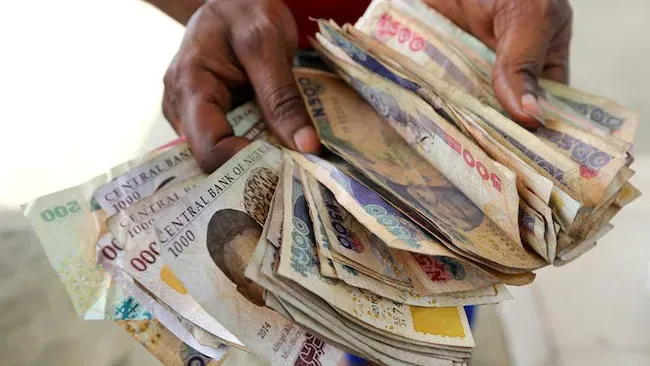
Naira Redenomination Is Speculators’ Antics

The issue of Naira redenomination started gaining traction on social media around September 2023. It was believed that the trending misinformation was the handiwork of some drunks in a Chinese bar”, idled, and needed to ruffle the economy’s feathers. The Central of Nigeria has denied the trending malicious story. Unperturbed though, the perpetrators retreated awhile, and recently, the malicious misinformation started gaining traction on social media. One may wonder what their motive is. No soothsayer is needed to know that economic saboteurs are at work again, but to gain what? The attack on the Naira is one of the many products of corruption bedeviling the nation. Others include untamed obnoxious taste for foreign items, and utter disdain for locally produced items (often of better quality than their foreign counterparts), mono-economy, – dependence on oil, forgetting that the foundation and strength of the economy was agriculture. Monumental legacies adorned the nooks and crannies of the country that are attestation to what agriculture did before the petrol-dollar craze. Agriculture was later neglected. The scramble for fast buck from oil till date incapacitated the economy. No effort was made to diversify the economy. At a time in the history of this economy, a regime once told the world that Nigeria’s problem was not money but how to spend it. Profligacy became the order of the day. Corruption crept in, and scrambles for power to get a bite of the oil ‘cake caused successive military coups. This was in connivance with corrupt civilians. Every successive administration embarked on primitive acquisition of wealth stolen from our commonwealth. Mediocrity reigned, leadership selection became “paddy-paddy, and merit took a flight. Some past leaders sought power for power’s sake, clueless of what to do with it. The economy was on autopilot, burdened, and still suffering from those uncoordinated and rudderless inactions. The economy has been in chains while the masses bear the brunt. The descent to this ignoble state started before1986 and became a reality with the introduction of Structural Adjustment Programme (SAP). It was the onset of gradual destruction of all economic fibers of Nigeria. A leader at the time frustratingly retorted that ‘the Nigerian economy defied all economic theories.’ Little did he know that vultures and vampires had taken over the economy, and ever since the economy has been under attack. Still the only legacy we hold onto, the Naira, is under serious threat now. They took over and destroyed all the refineries, made them non-functional despite trillions of Naira spent to fix them. They destroyed the Power Holding Company of Nigeria (PHCN),and bought them over under the disguise of privatization, leaving us with what we have today – darkness. The Nigerian Airways, and Nigeria National Shipping Line are all moribund, yet investors who professed competence and business acumen bought them. They hijacked the Nigeria National Petroleum Company (NNPC) making all refineries derelict. Fuel importation and subsidy was introduced through which the economy was sucked. No past regime had the political will to end the obnoxious regime. But since this regime took the bold decision to remove fuel subsidy and harmonize the exchange rate, the economic vampires and the vultures have swooped on the economy, baring their fangs ferociously on the Naira. While other oil producing nations are reaping bountifully from oil, building infrastructure, and bettering the welfare of their citizens, Nigeria, the 6th oil producing nation in the world is wallowing in poverty, corruption, darkness, yet its leaders are unperturbed. Those calling for the redenomination of the Naira are the faceless ‘owners’of Nigeria, attacking the economy with the main aim of wrecking it to enable them to take it over. They have gained, and still gaining bountifully from every crisis of the past.They are determined to destroy the Naira. Their grouse may have been the current administration’s gut to take away the fuel subsidy. They have the war chest – hoarded foreign and local currencies, through the BDCs they own. They are rich and entrenched individuals, using their ill-gotten wealth to attack the Naira. Their call for the redenomination is to cause disaffection between the government and Nigerians, thereby bending the hands of the government backward. When in 2006 the Republic of Zimbabwe redenominated its currency at the rate of 1,000 old Zimbabwean note to one Zimbabwean dollar, it was because of hyperinflation. The newly independent nation probably got carried away with the euphoria of independence and forgot to do the real business of governance. Things spiraled out of control, the currency began to lose value because of the taste for foreign goods, no effort to develop local capacity, and the currency suffered. The Republic of Ghana that plied same route thought it had no better option than to redenominate in 2007. If it must be recalled, Ghana’s hyperinflation between 1977-1983 hovered between 116% and 123%. The reason the government gave for taking the action was to reassert the monetary sovereignty of Cedi. The government was conscious of the fact that if Ghanaians should lose confidence in the currency and begin to embrace other foreign currencies as store of value, there will be problems. Another reason it gave was years of economic decline that took a toll on the Cedi. In fact, it was to arrest the spiraling hyperinflation that threatened the country, and to also make it easy for accounting and statistical purposes. According to the authorities, they believed it would be easier to maintain by setting 10,000 Cedis to be 1 Ghana Cedi. Has the Nigerian economic situation reached what can be compared to the Zimbabwe or Ghana situation? The answer is No. The problem with Nigeria is corruption and greed, self-centeredness, obnoxious foreign taste, and disdain for what she produces. Nigerians do not eat what they produce, nor produce what they eat. What the purveyors of this malicious misinformation set to achieve is to arm-twist the government and the CBN to do their bid and redenominate to suit their criminal desires.They are presently clueless about what the government is doing going forward
Naira Weakens Despite CBN’s Intervention

Since the unification of all the official foreign exchange (FX) windows, the Naira has continued to depreciate against the US dollar, down by 39.6 per cent to N765.83/$ as of 11 October 2023 from N462.88/$ at the I&E Window. Based on the half-year financial markets report of the Central Bank of Nigeria, it has maintained its intervention in the foreign exchange market in an attempt to alleviate demand pressures and ensure exchange rate stability. A total of $6,439.33 million was sold at the foreign exchange market made up of spot sales of $1,557.47 million and forward sales of $4,881.86 million. The spot sales comprised $612.41 million sold at the inter-bank Secondary Market Intervention Sales (SMIS) window, $455.31 million sold to Small and Medium Enterprises (SMEs), $441.75 million for Invisibles, and $48.00 million sold at the I&E window while the bank purchased a total of $655.53 million in the FX market. However, the shocks of the policy have been more pronounced at the parallel market leading to a steep depreciation of the Naira to N1020/US$ on 10 October 2023. With little control over the depreciation of the nation’s currency, the then acting governor of the Central Bank of Nigeria (CBN), Mr. Fola Shonubi, announced plans to put in place new policies that would guide the dealings of FX to boost supply in the market. Apparently, the measures put in place have not been effective as demand for FX continues to rise amidst an acute shortage of supply. “We have always argued that while we believe the unification of the various FX rates is a pro-market policy that will be positive for the economy in the long term, the short to medium-term impact will be hard too hard on the average consumer. “A focus on rate convergence without structural reforms to increase the supply of FX will be a case of treating the symptoms while ignoring the underlying cause of the problem which is an acute shortage of supply amidst a growing demand for FX. Meanwhile, while crude oil sales and Foreign Portfolio Investments (FPIs) are two major sources of FX that have declined significantly, Oil production remains depressed, reported at 1.57 mbpd in September (highest so far this year) and are yet to see any significant foreign capital inflows. According to the Nigerian National Petroleum Company Limited (NNPCL), between September 30 and October 6, 128 crude oil theft incidents were recorded across the oil-producing areas of the Niger Delta. In the specific timeframe mentioned, there were numerous illicit activities in the oil sector. These included 17 cases of unauthorized connections, 27 illegal refineries, 11 infractions related to vessel tracking systems (AIS), and 49 instances of wooden boat arrests.
Naira drops to new low of N923-950 per dollar

The naira extended its slump in black-market trading as the nation’s dollar shortage deepened two months after the central bank moved to a more flexible exchange rate to encourage inflows. The naira weakened to N923 per dollar, compared with N917 on Wednesday. Traders in Lagos said it worsened to an all-time low of N950 to one dollar at the parallel market on Thursday afternoon as against the N897 it traded at the previous day. At the official window, data showed that the naira closed at N782.38 per $1. The disparity is now N167.62/$1 one of the widest since the unification of the naira on June 14th, 2023. Banks have been unable to come up with the dollars to meet demand, and buyers are increasingly turning to the black market, widening the gap between the official exchange rate and the price on the street. On Tuesday, the naira plunged to a record low of N900/$1 on the parallel market on Tuesday, August 8, 2023, as demand for foreign currency outstripped supply with traders quoting the exchange rate as high as N900/$1 for “inflows” and N895/$1 for cash trades. The peer-to-peer market, where crypto-currency traders exchange forex, also saw the exchange rate soar above N900/$1. Meanwhile, in the official Investor and Exporter Window, the exchange rate closed at N774.78/$1 while the NAFEX rate was N776. The official market also faces supply constraints, with daily turnover averaging $80 million since July. Forex traders who attributed the depreciation of the naira to a scarcity of supply, said that there were more buyers than sellers in the market and that the situation was unlikely to improve anytime soon. When asked about the source of the increased demand, traders mentioned a diverse set of buyers, including importers, foreign travelers, and speculators. There are concerns among some traders that the state of depreciation is unlikely to improve as demand continues to rise unchecked. Forex analysts explained that there was a huge backlog of unmet forex demand in the official market, estimated at $8-10 billion. Some of this demand also spills over to the parallel market, as buyers struggle to find enough supply to meet their needs in the official market. The exchange rate between the naira and dollar has weakened by 16 per cent since the reunification of the exchange rate windows. This compares to a depreciation of 2.5 per cent between January 1 and June 14th. The exchange rate weakened by 22.9 per cent in the whole of 2022. The naira has been under pressure in the parallel market for several weeks, as the supply of forex from official sources remains inadequate. On July 1st, the beginning of the second half of the year, the exchange rate in the parallel market was around N772/$1. However, a surge in demand from various segments of the economy, such as importers, foreign travelers and speculators, has triggered exchange rate volatility.