Naira To Reach ‘Fair Value’ Of N750/$ By Year’s End – FG

Naira To Reach ‘Fair Value’ Of N750/$ By Year’s End – FG

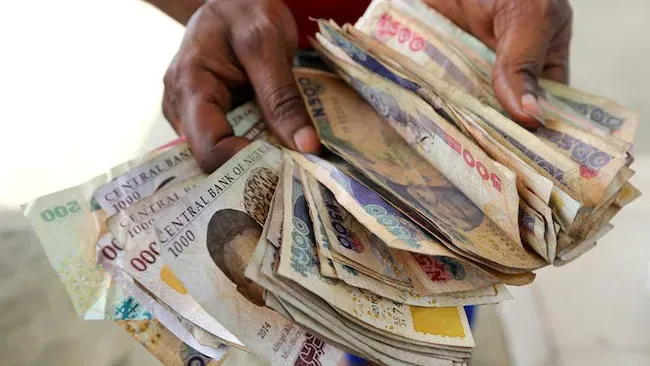
The Federal Government is planning to introduce new foreign exchange rules — including a crackdown on illegal currency trading — that it hopes will result in the naira closing its more-than-45 per cent gap with the unofficial rate and reaching a “fair price” by year-end, a top official has said. The government plans to clear a backlog of dollar demand estimated at about $6.7 billion, bolster the naira forward market, and set transparent rules for the operations of the official market, Taiwo Oyedele, chair of the presidential committee on fiscal policy and tax reforms, said in an interview with Bloomberg. The government sees a “fair price” for the dollar at N650 to N750, Oyedele said. In the parallel market, it traded at N1,165 per dollar yesterday, already beginning to recede from the former high of about N1,130 to the dollar. The government plans to clear a backlog of dollar demand estimated at about $6.7 billion, bolster the naira forward market, and set transparent rules for the operations of the official market, Oyedele said. It also aims to expand the official market to include all legitimate transactions, while snuffing out the illicit “black market” for foreign currency, he said. “We think all of that will happen before December, and maybe in a matter of a couple of weeks we will begin to see the results, such that before the end of the calendar year, naira should find its true value, not the one that is being done currently in the parallel market,” Oyedele said.

Analysts Forecast Increased Pressures On Economy As Naira Depreciates By 23%

Has Mission To Save The Naira Begun?

With the naira losing 23 per cent value in the third quarter of 2023, plummeting from N770/$1 at the end of the second quarter to over N1000/$1 by the end of the third quarter at the parallel market, analysts expect further pressure on the currency in the fourth quarter of 2023. Meanwhile, the official exchange rate at the end of the third quarter was N755.27/$1, a noticeable drop from N769.25/$1 at the end of the second quarter. The widening gap between the official and unofficial rates reflects the persistent scarcity of foreign exchange in the country, as well as the divergent policies of the CBN and the market forces. The Central Bank of Nigeria (CBN) has blamed the forex backlog estimated at between $6 billion to $10 billion as the major reason for the currency depreciation. At the recent Senate confirmation of the CBN governor, Yemi Cardoso stated that he intends to establish the exact unsettled obligations and find ways to “take care of it” confirming that progress will not be made without clearing the backlog. He said it would be naive to think that the CBN will be able to make progress if it don’t handle that side of the foreign exchange. “But definitely, the immediate priority will be to verify the authenticity and extent of the unsettled obligation and once we do that, we need to look for a way to take care of it. The naira’s weakness has had negative impacts on the Nigerian economy, as it has increased the cost of imports, fuelled inflation, eroding purchasing power, and discouraged investment. According to the Head of Macro Strategy at FIM Partners UK Ltd, Charlie Robertson, the CBN may have to devalue the official rate again to align it with the market reality and conserve its dwindling external reserves, which fell from $34.1 billion at the end of June to $33.2 billion at the end of September. He noted that further devaluation might be avoided if the apex bank is able to meet its obligations to clear forex backlogs, adding that achieving this might require the government tap new loans from friendly countries. Stears Africa FX Monitor, a data and intelligence company, also has predicted a continued naira volatility. The company highlighted fiscal policies, external trade, and global market trends, including inflation rates, interest rates, policy events, and geopolitical factors as key factors affecting the naira’s performance. Fadekemi Abiru, Head of Insights at Stears, expressed concerns about the naira volatility. “The continued unpredictability of the naira underscores the importance of timely and informed decision-making for businesses and investors in Nigeria,” she said. The CBN had removed trading restrictions on the official market in June which drove the naira to a record low of N750 to the Dollar on the official market, down from the previous N477 to the dollar it traded for. This was the first time since 2016 that the naira had recorded a big fall on the official market before the CBN introduced a managed exchange rate in 2017.

Liquidity, Supply Constraints Responsible For Naira’s Devaluation –Report

Liquidity, Supply Constraints Responsible For Naira's Devaluation –Report

A new report by Comercio Partners, has revealed that the depreciation of the naira is due to the complex interplay of various factors including liquidity and supply constraints. It said that within Nigeria’s financial system, liquidity constraints posed a formidable challenge as liquidity levels fluctuated, so did the naira stability add to the uncertainties in the forex markets. The August 2023 Nigeria Macroeconomic and Market an investment banking firm focused on trading global and local fixed income securities and equities, The report also noted that the dollar’s entrenched position in global transactions and foreign exchange reserves makes it challenging to replace with another currency, despite its flaws, as a result, the Naira and other frontier market currencies continue to face pressure amid the dollar’s dominance. According to the report, the depreciation of the Naira during the month of August was exacerbated by the incapacity of Nigerian banks to meet the surging demand for dollars, leading buyers to resort to the parallel market. The report noted that in the official market, August started with a bang as the Naira reached a high of N789.08/$1 on August 1st, and then later appreciated to N738.18/$1 by August 30th. “This marked a depreciation of roughly 0.76 per cent from the July closing rate of N756.94/$1, eventually settling at N762.71/$1 by month-end. The Naira’s erratic behaviour left both investors and market observers scratching their head They added that the naira faced a sharp decline, weakening to N930 to 1 dollar in the unofficial foreign exchange market, known as the parallel market, as the US dollar steadied near six-month highs. The report also noted the report from JP Morgan which revealed a startling revelation about Nigeria’s net foreign exchange (FX) reserves. “The report unveiled a complex web of financial instruments, including foreign exchange forwards, securities lending, currency swaps, and outstanding contracts, which had eroded Nigeria’s net external reserves to an alarming low of $3.7 billion by the end of 2022. “This revelation sent shockwaves through the market, resulting in a short-term repricing of Nigerian international bonds and exacerbating the Naira. They added with the revamped framework, BDC operators are now restricted to a permissible range of -2.5 per cent to +2.5 per cent of the Nigerian Foreign Exchange market window’s weighted average rate from the preceding day “This move aims to address the significant backlog of unmet foreign exchange demand, estimated at a staggering $10 billion. These FX backlogs have inflicted heavy losses on many firms and disrupted the economic ecosystem.” According to experts at Commercio Partners, CBN’s efforts to address liquidity challenges and enhance transparency via the revised BDC operational framework may bring stability, adding that vigilance and adaptable strategies are advised for navigating potential foreign exchange landscape shifts.

Naira drops to new low of N923-950 per dollar

Supreme Court Affirms Old, New Naira Notes As Legal Tender 

The naira extended its slump in black-market trading as the nation’s dollar shortage deepened two months after the central bank moved to a more flexible exchange rate to encourage inflows. The naira weakened to N923 per dollar, compared with N917 on Wednesday.   Traders in Lagos said it worsened to an all-time low of N950 to one dollar at the parallel market on Thursday afternoon as against the N897 it traded at the previous day. At the official window, data showed that the naira closed at N782.38 per $1. The disparity is now N167.62/$1 one of the widest since the unification of the naira on June 14th, 2023. Banks have been unable to come up with the dollars to meet demand, and buyers are increasingly turning to the black market, widening the gap between the official exchange rate and the price on the street. On Tuesday, the naira plunged to a record low of N900/$1 on the parallel market on Tuesday, August 8, 2023, as demand for foreign currency outstripped supply with traders quoting the exchange rate as high as N900/$1 for “inflows” and N895/$1 for cash trades. The peer-to-peer market, where crypto-currency traders exchange forex, also saw the exchange rate soar above N900/$1. Meanwhile, in the official Investor and Exporter Window, the exchange rate closed at N774.78/$1 while the NAFEX rate was N776. The official market also faces supply constraints, with daily turnover averaging $80 million since July. Forex traders who attributed the depreciation of the naira to a scarcity of supply, said that there were more buyers than sellers in the market and that the situation was unlikely to improve anytime soon. When asked about the source of the increased demand, traders mentioned a diverse set of buyers, including importers, foreign travelers, and speculators. There are concerns among some traders that the state of depreciation is unlikely to improve as demand continues to rise unchecked. Forex analysts explained that there was a huge backlog of unmet forex demand in the official market, estimated at $8-10 billion. Some of this demand also spills over to the parallel market, as buyers struggle to find enough supply to meet their needs in the official market. The exchange rate between the naira and dollar has weakened by 16 per cent since the reunification of the exchange rate windows. This compares to a depreciation of 2.5 per cent between January 1 and June 14th. The exchange rate weakened by 22.9 per cent in the whole of 2022. The naira has been under pressure in the parallel market for several weeks, as the supply of forex from official sources remains inadequate. On July 1st, the beginning of the second half of the year, the exchange rate in the parallel market was around N772/$1. However, a surge in demand from various segments of the economy, such as importers, foreign travelers and speculators, has triggered exchange rate volatility.