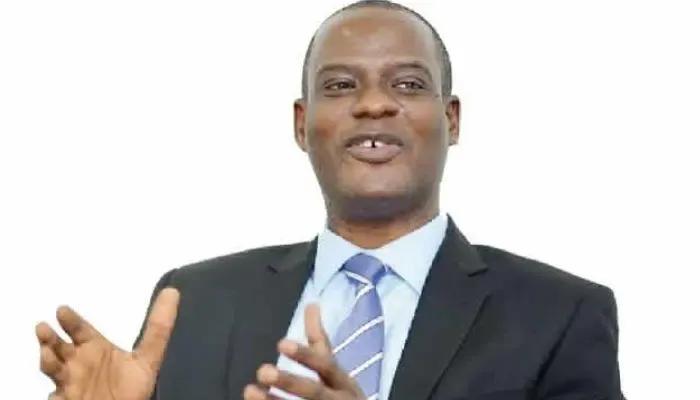
Suspicious Payments: Presidential Tax Committee Received N5bn From FIRS -Chairman

The Chairman, Presidential Fiscal Policy and Tax Reforms Committee, Taiwo Oyedele has confirmed that the committee got the sum of N5 billion from the Federal Inland Revenue Service (FIRS). In a statement on his official X handle, the Chairman, Presidential Fiscal Policy and Tax Reforms Committee, Taiwo Oyedele said the statement became necessary due to a report by the Cable Newspaper that the immediate past FIRS Chairman, Muhammad Nami, approved the sum of N11 billion after he left office. But in a statement Thursday, Nami explained that the Cable report was out to tarnish his hard-earned reputation. In the statement, Nami took time to explain the approvals he carried out before he left the revenue agency. “The N5 billion paid to the Joint Tax Board was paid to fund the activities of the Presidential Committee on Tax and Fiscal Policy Reforms two months before I left office. It was paid after we received a letter to that effect from the office of Mr. President signed by Zacch Adedeji himself. “The report maliciously attempts to portray a picture that I hurriedly left the country on September 16th after these so-called “suspicious approvals” were made. Again, nothing can be further from the truth. If I traveled out of the country on the 16th of September, how then did I attend the handover ceremony with Mr. Zacch on the afternoon of Monday 18th September 2023? That handover ceremony was covered by the media, and can be cross-checked. “It is disappointing to see the Cable, a revered online newspaper attempt to sensationalise events that took place in the ordinary course of work in office, making them seem as if they were done in bad faith,” Nami said. Oyedele said, “We are aware of a recent story regarding some funds transferred by the FIRS to the Joint Tax Board (JTB) for the Presidential Fiscal Policy and Tax Reforms Committee. “The Committee’s budget includes provisions for a national “Data for Tax” project which the JTB has been championing for over 2 years. The project was presented to the National Economic Council in 2022 and was meant to be funded by the federal government and the 36 states. However, it stalled due to lack of funds. Given the importance of the project to the effective reform of our tax system, it was included in the Committee’s budget. “Other expenses included in the Committee’s budget, which has the approval of the National Assembly, include setting up of offices for the Committee in Lagos and Abuja, payment of salaries for the full time staff engaged by the Committee, travels and other logistics for over 70 members representing more than 40 institutions and stakeholder groups mapped to 6 different Subcommittees, more than 30 Secretariat personnel and over 40 students across the country. In addition, the budget covers planned stakeholder engagements with various sectors and interest groups, as well as international engagements and understudy of some leading tax regimes around the world, and so on. The budget covers a period of one year being the lifespan of the Committee. “It should be noted that the Committee was not set up simply to produce reports and recommendations, we are also charged with the implementation of recommended and approved proposals which need to be funded. “The Committee’s mandate includes ensuring prudence and accountability in the management of our national resources. It will therefore be a contradiction for the same Committee to be wasteful or reckless in its own affairs. Members of the Committee work on a volunteering basis and are only paid reasonable allowances to cover their out-of-pocket expenses as we cannot afford to pay the commercial value for their time, skills and experience. As the Chairman of the Committee, despite working full time on the assignment, I do not receive a salary. “All the expenses of the Committee are properly documented and available for audit. We collect receipts for fuel, stationeries, and virtually every Naira that we spend to the extent possible. Over N4 billion of the said funds transferred by the FIRS to the JTB for the Committee’s work is yet to be spent and very much intact in the JTB account.” He assured that the Committee will be responsible, prudent and accountable with every Naira of public funds that it will be entrusted with.
Nigerian musicians rake in N11bn revenue from Spotify

Streaming giant Spotify has unveiled that Nigerian musicians enjoyed a substantial revenue of over N11 billion from the platform in the year 2022. In a statement released in Lagos on Thursday, Ms Jocelyne Muhutu-Remy, Spotify’s Managing Director for Sub-Saharan Africa, highlighted the transparency initiative by the company through its annual report named Loud & Clear, aimed at sharing insights into the music industry’s financial landscape and Spotify’s royalty disbursements. Muhutu-Remy emphasized the importance of providing artists with a comprehensive understanding of music streaming economics. She stated, “In the course of 2022, Nigerian artists collectively garnered an impressive sum of over N11 billion exclusively from Spotify. The overall revenue for the Nigerian music industry witnessed a remarkable growth of 63 percent between 2021 and 2022.” She further detailed, “The specific revenue generated by Nigerian artists solely from Spotify displayed a remarkable 74 percent growth during the same period. Notably, the count of Nigerian artists earning over N5 million and N10 million in Spotify royalties has risen by almost 25 percent in 2022.” Muhutu-Remy made clear that these figures exclusively represent Spotify earnings, excluding contributions from other platforms, live performances, merchandise, and concert tickets. Underscoring Spotify’s commitment to empowering African creators, Muhutu-Remy revealed the platform’s dedication to connecting these artists with its 550 million active users. Beyond revealing Nigerian artists’ revenue, the statement also featured fresh insights into the top-exported Afrobeats albums, artistes, tracks, and female Afrobeats tracks. Muhutu-Remy highlighted the global reach of Afrobeats, citing top streaming cities as London, Paris, Abuja, Nairobi, Amsterdam, and Accra. “Our unwavering pledge at Spotify is to ensure that professional musicians can sustain a livelihood through their craft. The disclosure of the 2022 earnings of Nigerian artists on our platform reflects our commitment to transparency and our mission to enable artists to thrive on their artistic pursuits,” Muhutu-Remy asserted. She elaborated on the factors behind Afrobeats’ remarkable surge, pointing to international collaborations, the amplifying effect of social media, the ascent of music streaming, and the influence of the African diaspora. Citing a survey commissioned by Spotify and conducted by Kuvora, Muhutu-Remy mentioned that 28 percent of fans identified international collaborations as a pivotal driver in Afrobeats’ expansion.