EFCC to Arraign Ex-AGF Malami on Money Laundering Charges

The EFCC will arraign former AGF Abubakar Malami, his son, and an associate on 16 counts of money laundering, involving billions of naira and multiple property acquisitions across Abuja, Kano, and Kebbi.
How Thousands Of Dollars Are Flown Out Of Nigeria Every Hour – INTERPOL

Vandalism of the Nigerian national treasury continues unabated as the International Police Organisation (INTERPOL) has revealed that “hundreds of thousands of dollars” are being laundered out of Nigeria every hour, reaching other African countries and locations worldwide.
Alleged N89.2b money laundering: Court to rule on service of charge on Yahaya Bello through lawyer

Justice Emeka Nwite will Tuesday, rule on the application whether the Economic and Financial Crimes Commission (EFCC) can serve court processes on former governor of Kogi state, Yahaya Bello, through his counsel. At the last adjourned date, EFCC’s counsel, Kemi Piniero SAN, urged the court to compel the ex-governor’s lawyer to accept service of the processes, explaining that it has been impossible to serve the charge sheet on him personally. Counsel to Yahaya, Abdul Wahab Mohammed, said he doesn’t have the authority of the defendant to accept service of the charges and proof of evidence. He insisted that the Abuja division of the court or the EFCC cannot arraign his client adding that his preliminary objection application has to be taken first, but the EFCC came behind him through a motion-exparte to obtain a warrant of arrest. Therefore, the court adjourned to reconvene Tuesday for ruling. The EFCC , Thursday, informed Justice Emeka Nwite about its intension to invite the Nigerian Army to effect the arrest of former governor of Kogi State, Yahaya Adoza Bello for arraignment before a Federal High Court sitting in Abuja. The anti-graft agency, through its legal team, issued the threat before the court after explaining how a person of immunity protected Bello from arrest following the court’s bench warrant. The court had fixed today(Thursday) for arraignment of Bello alongside the ex-governor’s nephew, Ali Bello, Dauda Suleiman and Abdulsalam Hudu on 19- count charges bordering on money laundering to the tune of N80, 246, 470, 088.88. When it was called up, Thursday, EFCC’s counsel, Kemi Piniero SAN, said in open court that the Commission was aware that Bello has been harboured in the home of a person that has immunity. He submitted that immunity is only attached to a person, not his house or car, adding that the law allows Nigerian security agencies to break into a house to arrest a defendant. He said, Some of the counts read: “That you, Yahaya Adoza Bello, Ali Bello, Dauda Suliman, and Abdulsalam Hudu( Still at large), sometime, in February, 2016, in Abuja within the jurisdiction of this Honourable Court, conspired amongst yourselves to convert the total sum of N80, 246,470, 088.88 (Eighty Billion, Two Hundred and Forty Six Million, Four Hundred and Seventy Thousand and Eight Nine Naira, Eighty Eight Kobo), which sum you reasonably ought to have known forms part of the proceeds of your unlawful activity to wit, criminal breach of trust and you thereby committed an offence contrary to Section 18(a) and punishable under Section 15(3) of the Money Laundering (Prohibition) Act, 2011 as amended”. “That you Yahaya Bello between 26th July 2021 to 6th April 2022 in Abuja within the jurisdiction of this Honourable Court aided E-Traders International Limited to conceal the aggregate sum of N3, 081, 804,654.00 (Three Billion, Eighty One Million Eight Hundred and Four Thousand Six Hundred and Fifty Four Naira) in account number 1451458080 domiciled in Access BankPlc, which sum you reasonably ought to have known forms part of proceeds of unlawful activity to wit, criminal breach of trust and you thereby committed an offence contrary to Section 18(a), 15(2) (d) of the Money Laundering (Prohibition) Act, 2011 as amended and punishable under Section 15 (3) of the same Act. “That you Yahaya Adoza Bello sometime in November 2021 in Abuja within the jurisdiction of this Honourable Court indirectly procured E-Traders international Limited to transfer the aggregate sum of $570,330.00 (Five Hundred and Seventy Thousand, Three Hundred and Thirty Dollars) to account number 4266644272 domiciled in TD Bank, United States of America which sum you reasonably ought to have known forms part of proceeds of unlawful activity to wit, criminal breach of trust and you thereby committed an offence contrary to Section 15(2) (d) of the Money Laundering (Prohibition) Act, 2011 as amended and punishable under Section 15( 3) of the same Act”. Bello’s arraignment followed a warrant of arrest and enrolment order granted the EFCC by Justice Emeka Nwite, Wednesday, in the motion ex-parte marked: FHC/ABJ/CR/98/2024 and filed by the EFCC lead counsel, Rotimi Oyedepo. The EFCC counsel argued that the ex-governor needs to be apprehended by security agencies so as to fast track his arraignment in court and immediate trial. The anti-graft agency maintained that the judge should either order Bello’s arrest or issue a public summons commanding the defendant to appear before the court.
Alleged N89.2b money laundering: EFCC threatens inviting army to arrest Yahaya Bello

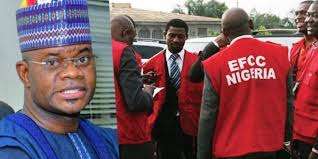
The Economic and Financial Crimes Commission(EFCC) Thursday, informed Justice Emeka Nwite its intension to invite the Nigerian Army to effect the arrest of former governor of Kogi State, Yahaya Adoza Bello for arraignment before a Federal High Court sitting in Abuja. The anti-graft agency, through its legal team issued the threat before the court after explaining how a person of immunity protected Bello from arrest following the court’s bench warrant. The court had fixed today(Thursday) for arraignment of Bello alongside the ex-governor’s nephew, Ali Bello, Dauda Suleiman and Abdulsalam Hudu on 19- count charges bordering on money laundering to the tune of N80, 246, 470, 088.88. When the called up, Thursday, EFCC’s counsel, Kemi Piniero SAN said in open court that the Commission was aware that Bello is been harboured in the home of a person that has immunity. He submitted that immunity is only attached to a person, not his house or car, adding that the law allows Nigerian security agencies to break into a house to arrest a defendant. He said, “If he is unwilling to produce his client in court, we will invite other security agencies including the Nigerian army to produce him. “We can come next week. We will produce him,” Piniero assured. Piniero also urged the court to compel the ex-governor’s lawyer to accept service of the processes, explaining that it has been impossible to serve the charge sheet on him personally. Counsel to Yahaya, Abdul Wahab Mohammed, said that the Abuja division of the court or the EFCC cannot arraign his client. He contended that his preliminary objection application has to be taken first, but the EFCC came behind him through a motion-exparte to obtain a warrant of arrest. He said, “The governor has a lawyer in court and if there is a justifiable issue for him to come to court, he would. “Our contention is that the defendant on record is not a fugitive. We are talking of rule of law, not rule of force. “We are contending that the warrant of arrest was given outside jurisdiction because there is a judgement. “I don’t have the authority of the defendant to accept service of the charges and proof of evidence.” What the judge said The judge said he was yet to read the Kogi state high court judgement of yesterday. But the judge held all parties including the ex-governor has to be formally before the court and the EFCC, without a warrant of arrest, can arrest a suspect or defendant. He adjourned to April 23 for ruling and arraignment. In the charge sheet, the anti-graft agency claims the defendants diverted public funds. Some of the counts reads: “That you, Yahaya Adoza Bello, Ali Bello, Dauda Suliman, and Abdulsalam Hudu( Still at large), sometime, in February, 2016, in Abuja within the jurisdiction of this Honourable Court, conspired amongst yourselves to convert the total sum of N80, 246,470, 088.88 (Eighty Billion, Two Hundred and Forty Six Million, Four Hundred and Seventy Thousand and Eight Nine Naira, Eighty Eight Kobo), which sum you reasonably ought to have known forms part of the proceeds of your unlawful activity to wit, criminal breach of trust and you thereby committed an offence contrary to Section 18(a) and punishable under Section 15(3) of the Money Laundering (Prohibition) Act, 2011 as amended”. “That you Yahaya Bello between 26th July 2021 to 6th April 2022 in Abuja within the jurisdiction of this Honourable Court aided E-Traders International Limited to conceal the aggregate sum of N3, 081, 804,654.00 (Three Billion, Eighty One Million Eight Hundred and Four Thousand Six Hundred and Fifty Four Naira) in account number 1451458080 domiciled in Access BankPlc, which sum you reasonably ought to have known forms part of proceeds of unlawful activity to wit, criminal breach of trust and you thereby committed an offence contrary to Section 18(a), 15(2) (d) of the Money Laundering (Prohibition) Act, 2011 as amended and punishable under Section 15 (3) of the same Act. “That you Yahaya Adoza Bello sometime in November 2021 in Abuja within the jurisdiction of this Honourable Court indirectly procured E-Traders international Limited to transfer the aggregate sum of $570,330.00 (Five Hundred and Seventy Thousand, Three Hundred and Thirty Dollars) to account number 4266644272 domiciled in TD Bank, United States of America which sum you reasonably ought to have known forms part of proceeds of unlawful activity to wit, criminal breach of trust and you thereby committed an offence contrary to Section 15(2) (d) of the Money Laundering (Prohibition) Act, 2011 as amended and punishable under Section 15( 3) of the same Act”. Bello’s arraignment followed an warrant of arrest and enrolment order granted the EFCC by Justice Emeka Nwite, Wednesday, in the motion ex-parte marked: FHC/ABJ/CR/98/2024 and filed by the EFCC lead counsel, Rotimi Oyedepo. The EFCC counsel argued that the ex-governor needs to be apprehended by security agencies so as to fast track his arraignment in court and immediate trial. The anti-graft agency maintained that the judge should either order Bello’s arrest or issue a public summons commanding the defendant to appear before the court.
EFCC uncovers religious sect laundering money for terrorists

The Chairman of the Economic and Financial Crimes Commission, Ola Olukoyede, has revealed that the anti-graft agency uncovered how a religious sect in Nigeria is laundering money for terrorists. He stated this during a public engagement on youth, religion, and the fight against corruption. This was as he also revealed that another religious body was found to be protecting a money launderer after some money suspected to have been laundered was traced to the organisation’s bank account. Speaking during a public engagement on youth, religion, and the fight against corruption, as well as the launch of the fraud risk assessment project for ministries, departments, and agencies, Olukoyede stated that the EFCC was investigating a N13bn fraud case when it discovered that N7bn of the N13bn was linked to a religious body’s bank account. He noted that religious organisations, institutions, sects, and bodies have been found culpable of money laundering. Olukoyede said, “A religious sect in this country had been found to be laundering money for terrorists.” He, however, noted that the religious organisation quickly obtained a restraining order to prevent the EFCC from probing its leaders. “We were able to trace some laundered money to a religious organisation, and when we approached the religious organisation about it and we were carrying out our investigation, we got a restraining order stopping us from carrying out our investigation,” he said. Olukoyede further said the commission will not give up on the investigation as it is appealing the restraining order to recover the stolen funds. The one-day event is aimed at addressing the challenges of youth involvement in cybercrimes and how religion could be used as a weapon for their reorientation. The event, themed “Youth, Religion and the Fight Against Corruption,” featured the launch of the Interfaith Preaching and Teaching Manual developed by the Interfaith Anti-Corruption Advisory Committee of the Commission as a resource to promote abhorrence for corruption among adherents of Islam and Christianity. The EFCC’s Fraud Risk Assessment Prevention and Control Project for Ministries, Departments and Agencies was also launched at the event.
Money Laundering: Gbajabiamila Seeks Creation Of Gaming Regulatory Associations To Tackle Menace

Mr Lanre Gbajabiamila, the Director-General of the National Lottery Regulatory Commission, has proposed the establishment of Africa Gaming Regulators Association to address money laundering and terrorism financing in Africa. Gbajabiamila made the proposal while presenting a paper at the ongoing 2023 International Gaming Regulators Association (IGRA) Conference in Botswana. He also called for the establishment of West Africa Gaming Regulators Association (WAGRA) to facilitate regional cooperation and collaboration. Gbajabiamila said money laundering, terrorism financing and syndicate gaming were serious threat to the gaming industry in Africa. He, however, called for an urgent need to address the issues. “These associations will play a crucial role in information sharing, developing standard guidelines, and advancing regulatory efforts to combat money laundering, gambling-related crimes, and other illicit activities within the African gaming industry. “The African gaming industry’s rapid expansion is marred with challenges that need urgent attention. Although it has great potential and has emerged as a crucial driver of economic growth and government revenue. “It possesses the capacity to generate employment opportunities, attract foreign investments, promote tourism, improve income, technological advancements, and an increasing interest in gaming activities. “In the same vein, terrorists can exploit this industry to finance their operations covertly. “However, the gaming industry comes with risks, such as, money laundering which allows criminals to hide their illegally obtained funds by disguising them as legitimate winnings from gambling activities,” Gbajabiamila said. He said the African gaming industry had demonstrated capacity to drive economic growth, generate employment, attract foreign investments, and promote tourism. Gbajabiamila said the industry had the risk of being exploited for money laundering and financing terrorist activities. This, he said, called for the implementation of stringent regulations to combat money laundering, while fostering innovation in the gaming sector. Gbajabiamila listed lack of synergy among African states and the absence of robust global standards to monitor money laundering as other challenges of the industry. He noted that regulatory disparities among African nations create vulnerabilities that can be exploited by criminals, noting that to address these challenges, there must be collaboration implementing “Know Your Customer” procedures. Gbajabiamila also called for the reporting of suspicious transactions, conducting regular audits, and promoting information sharing among regulatory bodies. “Syndicate gaming involving illegal gambling activities operated by organised criminal groups poses another threat. “I advocate for stronger regulations, information sharing, and regional cooperation to tackle this issue. “The proposed solutions should include the harmonisation of gaming regulations, enhanced financial intelligence units, public awareness campaigns, the utilisation of technology, strengthening legal frameworks, and the establishment of specialised units. “There should be international cooperation and capacity building as vital aspects of the strategy,” he added. “The fight against money laundering, terrorism financing, and syndicate gaming in the African gaming industry requires close coordination among African nations, strong legal framework and robust enforcement mechanisms.” “The establishment of AGRA and WAGRA is a significant step towards achieving these objectives,” he said.
EFCC Sensitises Gold Merchants In Zamfara Against Money Laundering

The Economic and Financial Crimes Commission (EFCC) has sensitised gold merchants in Zamfara on their obligations as provided under the Money Laundering (Prohibition and Prevention) Act, 2022. The sensitisation was conducted in Gusau for members of Zamfara Gold Buyers and Sellers Cooperative Union by the EFCC’s Special Control Unit Against Money Laundering (SCUML). According to EFCC Spokesperson, Wilson Uwujaren, in a statement on Thursday in Abuja, the sensitisation campaign is a routine industry assessment initiative meant to encourage the gold merchants to register, file report of their activities and shun money laundering. “It was undertaken to remind gold merchants in the state of their reporting obligations to SCUML. “Also, to remind them of the registration processes and punishment applicable for the flouting of rules and regulations as provided by the Money Laundering (Prohibition and Prevention) Act, 2022,” he said. He quoted the Head of SCUML in the Zone, Assistant Commander of the EFCC, Ahmadu Bello as stressing the importance of registration for the merchants. “Registration and compliance with requirements of SCUML as provided for in the Money Laundering (Prohibition and Prevention) Act, 2022 is non-negotiable amongst Designated Non-Financial Businesses and Professions. “SCUML will ensure that those that do not comply are presented before appropriate quarters for infringement,” Bello said. He further told the operators that SCUML was not out to punish them but to sanitise the sector and insulate it from money laundering. He therefore charged them to ensure that they register and obtain SCUML certificate, which is free, and render the required reports as at when due. The chairman of the cooperative, Mr Usman-Muazu Maishanu, assured that the members would comply with SCUML’s rules and regulations, including the registration and filing of reports electronically. He urged members that are yet to register, to do so in order to be on the wrong side of the law.