More Drama as Yahaya Bello’s Fraud Trial Resumes

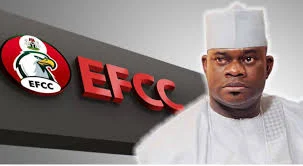
The trial of Yahaya Bello, the immediate past governor of Kogi State finally got off to a dramatic start today as the trial Justice Maryann Anenih bolted out of the courtroom at some point due to the surging crowd that accompanied the ex-governor. How it occurred that agents of the law could not maintain order in the Federal High Court remains inexplicable but it took the intervention of the Mr. Bello himself to bring calm to the courtroom as he prevailed on his crowd of supporters to vacate the courtroom. READ ALSO: Tinubu, Wife Depart for Three-Day France Visit Today At the resumption of proceedings, the former Kogi State Governor, denied the charges of financial fraud leveled against him by the Economic and Financial Crimes Commission (EFCC).  Appearing before Justice Maryann Anenih at the Federal High Court in Maitama, Abuja, Bello and his two co-defendants, Umar Oricha and Abdulsalami Hudu, were confronted with a series of serious allegations of embezzlement involving ₦110 billion. The court heard that Bello and his associates were accused of criminal conspiracy, breach of trust, and the possession of stolen property.  The charges are linked to accusations of embezzling state funds, which were allegedly used to acquire a series of high-value properties across Nigeria and beyond. PLEASE READ: CBN Rate Hike, Trump’s Tariffs Unchanged Naira’s Fortune in the Black Market Bello, who had been elusive in the weeks leading up to the trial, surrendered to the EFCC just a day before the court appearance, amid reports of his avoidance of authorities. Dressed in a traditional white caftan and blue cap, he entered the dock to formally respond to the charges in the case, which the EFCC has termed CR/7781. The list of properties tied to the accused includes real estate in Abuja, such as a building in Maitama valued at ₦950 million, a property in Gwarimpa worth ₦100 million, and another mansion in Asokoro priced at ₦920 million. Other properties are located in areas like Wuse Zone 4 and Dubai, including a hotel apartment valued at over 5 million dirhams. Additionally, the EFCC claims that Bello and his co-defendants were involved in transferring substantial amounts of money abroad, including $570,330 and $556,265 to a US-based bank. The investigation also uncovered that they were in possession of ₦677.8 million linked to an illicit business, Bespoque Business Solution Limited. Bello’s trial has sparked considerable attention, and the outcome of the proceedings could have serious ramifications for the former governor, who served as Kogi’s leader for two terms.  The case continues to unfold, with the EFCC determined to recover the allegedly misappropriated funds. READ ALSO: PH Refinery, Tinubu Celebrates Restart, Urges Action on Others

Appeal Court Postpones IPOB Hearing to October 31

The Court of Appeal in Abuja has moved the hearing for the Indigenous People of Biafra (IPOB) appeal to October 31. This appeal challenges the group’s proscription as a terrorist organization by the Federal Government. The three-judge panel postponed the session to allow both sides time to submit and exchange all necessary documents. IPOB’s leader, Nnamdi Kanu, who is currently detained, has applied to join the appeal as an interested party. The appeal targets the 2017 ruling by the late Justice Abdul Abdu-Kafarati of the Federal High Court, which banned IPOB’s activities across Nigeria. The proscription followed an ex-parte motion filed by the Attorney General of the Federation (AGF) and Minister of Justice, Abubakar Malami, on behalf of the Federal Government. In its appeal, IPOB argued that the court’s ruling was unjust and based on incorrect information. The group insisted that it operates within the law and that its actions are in line with its constitutional rights to self-determination. It claims that its protests have been peaceful, involving non-violent demonstrations such as marches with placards. IPOB also highlighted the lack of evidence showing it has engaged in any form of violence. The group further criticized the original ruling, alleging that the AGF failed to provide accurate information during the 2017 court session, which led to a biased judgment. IPOB’s appeal called for the appellate court to dismiss the proscription order, arguing that the high court misinterpreted its activities and failed to acknowledge its peaceful nature. The court instructed all parties involved to ensure that all legal processes are filed and exchanged before the scheduled hearing date.

LG Autonomy: Gov Soludo upsets the applecart

Governor Charles Soludo’s recent proposal for legislation may pose a threat to local government autonomy in Anambra State, raising concerns among representatives and citizens.  The proposed bill mandates that local government areas (LGAs) transfer a portion of their federal allocations into a unified account controlled by the state, sparking fears of reduced financial independence for local councils. Hon. Henry Mbachu, a member of the Labour Party representing Awka South I, has expressed strong objections to the bill, urging the governor to withdraw it from consideration by the Anambra State House of Assembly.  Mbachu argued that the legislation undermines the Supreme Court’s reaffirmation of local government autonomy, enabling the state government to access funds meant for LGAs. Despite these concerns, Governor Soludo maintained that the bill is consistent with the Supreme Court’s ruling, suggesting that any opposing parties should seek legal recourse if they disagree.  READ ALSO: GOVS IN FRESH MOVES TO DELAY LG AUTONOMY The Anambra State House of Assembly has already approved the bill, which establishes a “State Joint Local Government Account.” This requires all federal allocations for LGAs to be deposited into this account. Under the proposed law, local governments are compelled to remit a set percentage of their allocations to the consolidated account within two business days of receipt, even if the funds originate directly from the Federation Account.  Additionally, the state would withhold a percentage of these allocations before disbursing the remaining funds to the LGAs. Mbachu had raised alarms about the detrimental effects this legislation could have on local government operations, emphasizing that the mandated deductions might severely limit their ability to manage federally allocated resources effectively.  He had called on President Bola Ahmed Tinubu to monitor state governors to prevent interference in local government elections and ensure that elected officials can operate without undue pressure from the state.

Invincible Bello, his juju man and a pitiful EFCC

“Bello, a fugitive, according to the EFCC, visited the offices of the anti-graft agency in the company of Governor Ododo in broad daylight. They loitered around in the open. They exchanged pleasantries with the operatives and the staff of the EFCC. It was even alleged that they sent a message to the chairman of the EFCC announcing their presence and the desire of the former governor to be interrogated.”  LAST week was draining for many citizens. This opening statement sounds stupid. The question that should naturally strike anyone who has lived fairly consistently in this country for 25 years since the inception, or rather, return of rule by civilians in 1999, is how many weeks these past two decades and a half have we been spared the debilitating and wearisome drama of the absurd? How many times? And the absurdities are carefully crafted and orchestrated by a section of the ruling elite to keep Nigerians chewing their thumbnails in disgust and disbelief. But the joke has always been on us, though we do not get it. It would appear that our mumu (local lingo for collective foolishness) is factory made, or as we say in this clime follow come. If the truth be told, it has not always been like this. Citizens’ activisms against repressive governments from the colonial era to successive military dictatorships have been the fact of our national life. Protests by university students in the 1960s helped to abort an obnoxious Anglo – Nigerian Defence Pact early in the life of an independent Nigeria. There was also the bloody May riots of 1989 or so that moderated the Ibrahim Babangida plot for a wholesale adoption of the International Monetary Fund (IMF’s) Structural Adjustment Programme (SAP) prescriptions for economic recovery. We have lost the verve as a people and the younger elements whose futures are more in jeopardy do not seem interested in looking for where the ball was dropped. Many decades ago, flamboyant journalist the now late Dele Giwa wrote two articles which were published about the same period. In one, he titled it: ‘Adewusi’s men can’t shoot straight’. Sunday Adewusi, also late, was the inspector – general of the Nigerian Police Force. Almost 40 years after the provocative headline, police operatives under Adewusi’s successors still can not shoot straight unless they are targeting innocent and unarmed protesters. Two recent examples will illustrate the state of the police – the murderous put down of the August 1-10 #EndBadGovernance nationwide protests, and the show that was put up at the Kogi state government lodge in Abuja last week. In the August protests police killed scores of Nigerians in cold blood while those who survived are currently in captivity facing charges ranging on terrorism, treason, treasonable felony, subversion and attempt to overthrow the federal government. The charges may sound phony, and they certainly do, but they are in sync with the ways of repressive regimes worldwide. However, last week the police/security details of Kogi state governor Musa Ododo and his predecessor Yahaya Adoza Bello, the White Lion, and the police of the Economic and Financial Crimes Commission (EFCC), both federal police, shot at themselves in a firefight, shattering the peace of the Asokoro-Abuja night for a considerable length of time. When the dust settled in the morning of the day after, a Thursday, there were no deaths; no reports of injuries; and, there were no arrests. It would not matter that there could have been some residents of that neighborhood with heart and/or other pre-existing health conditions whose situations could have been exacerbated by that night of madness by government security agents. In a sane place, the expectation is that there may at times be collateral damage in the course of an official task by security agencies. But that was not the case in this Abuja ‘shootout’. The EFCC police and those of Ododo/Bello were merely entertaining themselves at the expense of Nigeria. READ ALSO: http://Ganduje Celebrates, Opens Up: How We’ll Use Edo Template To Win Polls in Anambra, Ondo, Others The sorom chia (Igbo for comic display) by the EFCC and their ‘prey’ Bello, will be a box office hit any day, and a classic in later years. Creative Nollywood must have taken note. What’s the genesis? Bello was governor of Kogi state for eight years until last January. Corruption allegations swirled around him even as a governor. He had absolute immunity, so nothing could be done to him. We have conveniently forgotten that there’s an existing court decision that a sitting governor can be investigated but not prosecuted while in office, thanks to the efforts and doggedness of the late Gain Fawehinmi, a renowned and unblemished anti-corruption crusader. Well, Bello installed his relative Ododo as governor. Then the EFCC slapped a charge of N80blllion misappropriation/money laundering on Bello. The former melted away but tied up the case in court through proxies. He did not for once appear in court. At one point he even insisted that only the courts in his Kogi state and the judges he appointed while he was governor had jurisdiction over his matter. He fought his cases up to the Supreme Court. And he lost all of them. Yet he would not answer to the summons of the EFCC for interview nor present himself in court for arraignment and to prove his innocence. In what has now been exposed as a contrived frustration, the anti-graft agency declared Bello wanted and caused his name to be published in the Red List of the International Police Organisation (Interpol) as a global fugitive. Interpol may have taken the notice seriously. But not Nigerians. And now with the events of last week not even the EFCC took their wanted notice on Bello seriously. Nigerians and the EFCC knew that Bello was in this country and enjoying immunity by other means. In April, the EFCC had besieged the Abuja residence of Bello but failed to apprehend him, just as it failed again last week. But this time

AGF Explains Why Nnamdi Kanu’s Case Still In Court – AGF …says FG convicted 250 terrorism, criminal cases

FG Expresses Readiness To Increase Supreme Court Justices

Attorney General of the Federation(AGF) and Minister of Justice, Prince Lateef Fagbemi SAN, Friday, maintained the leader of the Indigenous People of Biafra (IPOB) Mazi Nnamdi Kanu’s case is very difficult, requested it is left to court. Also, the Federal Government, revealed that it prosecuted and convicted 250 terrorism and criminal offenses in various courts across the country. The AGF made this revelation, Friday, at the Sectoral Ministerial briefing to mark President Bola Tinubu’s one year in office. Fielding questions from the press, the minister explained that there is a remarkable difference between Kanu’s case and that of the convener of #RevolutionNow protest, Omoyele Sowore. He said, “Sowore and Kanu are not the same. When it comes to the first one, I didn’t have difficulty to say go, but I have difficulty with the second one. “The matter is still in court, let’s wait for the court”. Sowore was arrested in 2019 and prosecuted for allegedly calling for the forceful take over of the administration of former President Muhammadu Buhari. However, the federal government through the office of the AGF in February this year filed a notice of discontinuation of the case. Breaking down the achievements of justice ministry in the year under review, Fagbemi said the FG has secured 160 convictions for criminal offences, 87 convictions for terrorism cases, 3 novel convictions in the last one year for extremist terrorism actors involved in the radicalization of children and violence against women. He hinted on enhanced interagency synergy for prosecution of Maritime Cases, Electricity offences, collaboration with public and private sector stakeholders on cybersecurity protection and cybercrime prosecution. Following the Ministry’s intervention for the upgrade of facilities designated for trial of terrorism cases, Fagbemi said the Ministry has resumed trials of terrorism cases in conjunction with the Legal Aid Council, National Human Rights Commission and other stakeholders. “The percentages of terrorism cases initiated and corruption cases concluded within the reporting period has been significant,” the Justice Minister said. Speaking on the development of the proceeds of Crime Recovery and Management Regulation, 2024, by the Ministry, the AGF said the objective of the regulation which is being developed with relevant agencies is to ensure transparency, accountability and standardization in the management of recovered assets, in line with global best practices. “This document is being finalized for validation, the AGF said. On terrorism financing and other transnational crimes, the AGF stated that the Tinubu administration has facilitated international cooperation and secured conviction of 13 terrorism financing cases, and have also concluded 150 mutual legal assistance requests and 12 extradition requests from law enforcement agencies and foreign countries. “The Ministry places priority on enhancing the prosecutorial and litigation capacity of its staff, to this end it organized capacity building programmes to improve knowledge on various aspects of the law including Darknet and Cryptocurrencies applied to terrorism financing, investigation and prosecution of financial and wildlife crimes in Nigeria. “The coordination of the effective implementation of the National Anti-Money Laundering/Combating Proliferation Financing (AML/CPF) Strategy 2023 – 2027 is also a top priority for the Ministry, the AGF said. On the fight against corruption, the Minister submitted that the present administration has achieved successes under its international asset recovery and management efforts. The asset sharing agreement between the Federal Republic of Nigeria and the Bailiwick of Jersey was signed in February 2024, for the return of £2,125,944 (Two Million, One Hundred and Twenty-Five Thousand, Nine Hundred and Forty-Four GBP) proceeds of corruption, the AGF revealed. “This has been approved by the President to be utilized, for continuation of works on the Abuja-Kano Road project” Fagbemi said. On the Glencore settlement, the Justice Minister said the Ministry on behalf of Nigeria on April 25, 2024, concluded negotiation of a settlement agreement with Glencore International A.G. wherein the firm is expected to pay the sum of $50 million USD as penalty and compensation for certain activities in Nigeria.

Health, welfare of judges topmost priority, FG assures …Justice Orji-Abadua, jurist of unimpeachable character – Justice Dongban-Mensem

FG Expresses Readiness To Increase Supreme Court Justices

The Attorney General of the Federation (AGF) and Minister of Justice, Lateef Fagbemi (SAN), has assured of the federal government’s commitment to improving the justice system and enhancing the capacity of the judges. The AGF spoke at a valedictory court session held by the Court of Appeal for the late Justice Theresa Orji-Abadua, who died on March 8 as the presiding justice of the Benin division of the court. Fagbemi said: “The federal government will continue to support to support the judiciary and ensure that the health and welfare of the judges remain the priority of this administration.” Fagbemi, who, like every speaker at the event, eulogised the deceased, said her keen and brilliant insight into legal matters, earned her the respect and admiration of her peers and colleagues. He added: “It is indeed, safe to say that throughout her professional journey, Honourable Justice Orji-Abadua not only achieved brilliant success, but also served as a beacon of inspiration for aspiring legal professionals in her exceptional demonstration of the importance of integrity, diligence, and unwavering dedication to the pursuit of justice. “Her contributions to the Judiciary, at the different levels of the Nigeria Judicature, indeed stands as a testament to her exceptional legal prowess and unwavering commitment to upholding the Rule of Law.” The President of the Court of Appeal, Justice Monica Dongban-Mensem, said Justice Orji-Abadua was a jurist of unimpeachable character who had a very simple and humble nature. Justice Dongban-Mensem, who was represented by the Presiding Justice of the Abuja division of the Court of Appeal, noted that the deceased was in the service of the Judiciary for 27 years, 16 of which were spent at the Court of Appeal. She added that although Justice Orji-Abadua was no longer around, her “contributions to the development of the law will remain and continue to help our jurisprudence to grow.” The chairman of the Body of Benchers (BOB), Adegboyega Awomolo (SAN), and former President of the Nigerian Bar Association (NBA), who spoke for the Body of Senior Advocates, Paul Usoro (SAN) equally spoke glowingly about the deceased. Awomolo described the late Justice Orji-Abadua as a fair and thorough jurist who served without blemish. The deceased’s widower, Dr. Benjamin Abadua expressed delight about the beautiful things he said about his late wife. Abadua said his late wife was a forthright personality who was always conscious of the truth and justice.