Nigeria records 1,580 human rights violations in March alone – NHRC

The National Human Rights Commission (NHRC) Friday revealed that the country recorded 1,580 human rights violations in the six geopolitical zones in the March alone. The rights violations included killings , kidnapping, domestic violence , abductions, and children’s rights, among others. According to the Commission, North Central topped the list of the complaints of human rights violations recorded with 468 cases. The senior human rights advicer, Mr Hilary Ogbona, made this known at the National Human Rights Commission headquarters in Abuja. At the presentation of the findings attended by the Executive Secretary of the Human Rights Commission and Senior Advocate of Nigeria SAN, Dr. Tony Ojukwu, Ogbona explained that the police, military, and Department of State Service DSS grouped as state actors recorded 94 rights violations cases. The human rights adviser who explained that the killings of the military and police personnel in Delta State formed part of the report revealed that 542 cases of violation of children’s rights were also recorded during the period. Besides, Ogbona explained that domestic violence, which he said was becoming too rampant in some parts of the country, had 471 cases recorded. He said that the non state actors and private actors have 32 and 36 respectively while 3 cases of violation of rights were recorded against disabled people. According to him, other sectors, including social economic and cultural rights, accounted for 157, while referred cases were put at 24. He said that killings and kidnapping accounted for 499, while another 71 violations of rights to life were also recorded by the commission during the period. Ogbonna said that the 1,580 human rights violations were the entire figures recorded in the 36 states offices of the commission and Abuja. Expressing worry over the increasing cases of human rights violation, Ogbonna said that about 301 school children were abducted in kaduna state alone while 40 people were killed in Benue state. He expressed dismay that rights to life were being violated in various ways and manner because four deaths were recorded in Nassarawa State during the sharing of palliative. He then called for restraint on both State and Private Actors, adding that reprisal attacks contributed to the recorded rights violations. Ogbona also appealed to police and military to always conduct their investigations in compliance with the rules of engagement and rule of laws as provided for in the national and international laws. Earlier in his welcome address, the Executive Secretary of the Commission Ojukwu reaffirmed the commitment of the commission to the promotion and protection of human rights in the country. He promised to partner with other stakeholders, including the government, in the bid to step up efforts to protect lives and properties and in ensuring downward size in the violations of human rights. The NHRC monthly dashboard aimed at making the human rights situation public is supported by the United Nations Development Program, the Office of the United Nations High Commission for human rights, and others.

Many ENDSARS Protesters Still Languishing In Lagos Prisons –Amnesty Int’l

Many ENDSARS Protesters Still Languishing In Lagos Prisons –Amnesty Int’l

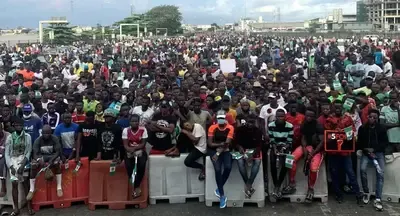
Amnesty International has reported that a total of fifteen protesters, arrested in 2020 during the #EndSARS protests, are still being arbitrarily detained three years after the movement that shook Nigeria. The majority of these detainees are held in Kirikiri Medium Correctional Centre and Ikoyi Medium Security Correctional Centre in Lagos, without trial. According to human rights group, charges filed against the protesters include theft, arson, possession of unlawful firearms, and murder, some of whom have alleged torture. Isa Sanusi, Director of Amnesty International Nigeria, expressed concern, stating, “Our investigation shows the Nigerian authorities’ utter disdain for human rights. Three years in detention without trial is a travesty of justice. The protesters must be immediately and unconditionally released.” The report also highlighted the ongoing issue of police brutality in Nigeria despite claims of comprehensive police reforms following the #EndSARS protests. “The police continue to commit violations of human rights, including extrajudicial killings, harassment, arbitrary detention, and extortion with almost absolute impunity,” he said, adding that Amnesty International documented the unlawful killing of at least six people by law enforcement officers in the past year. Amnesty International further called on Nigerian authorities to take concrete and effective measures to end police impunity, including giving clear directives to the police not to violate human rights. It also urged genuine reforms to address widespread human rights violations by the police. The #EndSARS protests in Nigeria began on October 8, 2020, in response to the notorious Special Anti-Robbery Squad (SARS) and police brutality. The protests led to casualties, including peaceful protesters and individuals hired to confront the protesters. Despite claims, police reforms, and ongoing investigations, concerns about human rights abuses and justice persist.