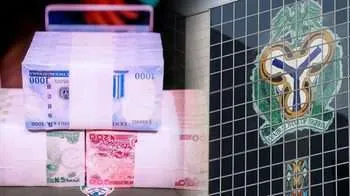
FX Policy: LCCI Tasks CBN On Creative Financing Options

The Lagos Chamber of Commerce and Industry (LCCI) have urged the CBN to adopt creative financing options for clearing the short to medium-term backlog of foreign exchange. LCCI noted that the new FX policy of the CBN unbanning the 43 items that were excluded from accessing FX at the official market is a market-friendly step towards unifying the exchange rates and is expected to curtail inflationary pressures in the short term. The body also said the policy change was expected to reduce the demand pressure on the parallel market and ensure there is a gradual convergence in FX market rates. The President/Chairman of Council, LCCI, Asiwaju Michael Olawale-Cole, said this in a statement at the weekend, adding that the policy would promote orderliness and professional conduct by all market participants to ensure market forces determine exchange rates on a willing buyer- willing seller principle. “The Chamber recommends that the CBN adopt creative financing options for clearing the short to medium-term backlog and establish a mechanism to address forex unification under the current system. “The Chamber believes the authorities must pursue the right monetary policy reforms to improve the investment climate and boost investor confidence. We call on the CBN to ensure transparency and accountability in banks’ foreign exchange dealings at the Investors & Exporters window”. Recall that the CBN recently lifted the forex ban on 43 items and also promised to intervene in the FX market from “time to time”. The apex bank had in 2015 restricted the items from accessing FX from the I&E window, saying they were “not valid for foreign exchange and could be produced in the country. Items affected include rice, cement, palm kernel, meat and processed meat products, poultry, soap, and cosmetics among others. But in a statement, the bank’s Director of Corporate Communications Isa AbdulMumin said the ban has been lifted. “As part of its responsibility to ensure price stability, the CBN will boost liquidity in the Nigerian Foreign Exchange Market by interventions from time to time. As market liquidity improves, these CBN interventions will gradually decrease,” the Thursday statement read. “As part of its responsibility to ensure price stability, the CBN will boost liquidity in the Nigerian Foreign Exchange Market by interventions from time to time. As market liquidity improves, these CBN interventions will gradually decrease.” “The CBN has set as one of its goals the attainment of a single FX market. Consultation is ongoing with market participants to achieve this goal,” CBN added.
Unity Bank Suffers N35bn Loss On FG’s FX Policy

Unity Bank Plc’s profit in the first half of 2023 was impacted by foreign exchange revaluation on the back of Nigeria’s recent FX liberalization policy, resulting in the lender suffering a revaluation loss of N35 billion within the period. In the retail lender’s financials for the period, notwithstanding the FX liberalization policy and its impact on the bottom-line, the bank grew its FX trading income significantly by 17 per cent to N239.8 million from N204.4 million in the corresponding period of 2022, underscoring the Bank’s strategic focus on diversifying and growing its earnings portfolio. According to the bank, deposits grew to N333.38 billion, representing a marginal increase of 2 per cent compared to N327.42 billion recorded in the first half of 2022 in its Half-Year unaudited financial statement submitted to the Nigeria Exchange Group Limited. The net loans portfolio reduced significantly by 31 percent to N198.6 Billion as at 30 June 2023 from N289.4 Billion as at 31st December 2022. The Bank’s NPL Ratio remained moderate at below 3 per cent while liquidity ratio stood strong at over 45 per cent. The Managing Director/CEO of Unity Bank Plc, Mrs. Tomi Somefun noted that the significant disruptions which characterized the operating environment has impacted the positions of the Bank to the extent that we have constraints in income generation on the back of revaluation of the bank’s net foreign liabilities occasioned by the Naira devaluation during the period. Mrs. Tomi stated: “In the light of the prevailing FX revaluation in the financial system, what we have is a market-driven impact which is adjustable envisaged from the positive economic outcomes of the government policies in the near term. “Be that as it may, the negative shareholders’ fund has improved considerably through the injection of N135 billion which moderated the negative shareholders’ fund from (-ve) N275 Billion in December 2022 financial year-end to (-ve) N178 Billion as at the end of June 2023, after absorbing the FX revaluation loss suffered in the second quarter of 2023. “We are however, focused with clear-cut plans to close out on our recapitalization programme very soon to enable us do business as expected in the fast-growing markets in Nigeria” She further stated that while we remain optimistic that the government’s policy initiatives will lead to cause correction in the market, the Bank has accelerated measures to ramp up asset creation and liability generation in the short and medium term. “The Bank is aggressively driving its retail growth in every segment of the market, expanding strategic partnerships; and growing commercial banking business to develop new and sustainable income lines for the Bank as well as pay sufficient attention to fast-paced process automation, cost and resource efficiency, targeted value chain relationships, and product marketing to enhance value creation in the market.