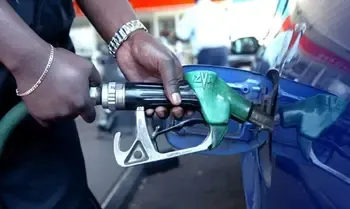
Petrol Price Increased To N630.63 In October -NBS

The National Bureau of Statistics (NBS), has said that the average retail price of a litre of petrol increased from N195.29 in October 2022 to N630.63 in October 2023. It made the declaration in its Petrol Price Watch for October 2023 released in Abuja on Wednesday. It stated that the October 2023 price of N630.63 represented a 222.92 per cent increase over the price of N195.29 recorded in October 2022. “Comparing the average price value with the previous month of September 2023, the average retail price increased by 0.71 per cent from N626.21. “On state profiles analysis, Zamfara paid the highest average retail price of N659.38 per litre, followed by Gombe and Borno at N658.33 and N657.27, respectively. “Conversely, Lagos, Oyo, and Delta paid the lowest average retail price at N590.95, N592.19 and N599.38 respectively,’’ it stated. Analysis by zones showed that the North-East Zone recorded the highest average retail price in October 2023 at N644.16, while the South-West recorded the lowest price at N616.81 per litre. The NBS also stated in its Diesel Price Watch Report for October 2023 that the average retail price was N1004.98 per litre. It said that the October 2023 price of N801.09 per litre amounted to a 25.45 per cent increase over the N801.09 per litre paid in October 2022. “On a month-on-month basis, the price increased by 12.82 per cent from the N890.80 per litre recorded in September 2023,’’ it added. On state profile analysis, the report said the highest average price of diesel in October 2023 was recorded in Plateau at N1150.00 per litre, followed by Nasarawa at N1138.00 and Benue at N1091.67. On the other hand, the lowest price was recorded in Rivers State at N824.44 per litre followed by Borno at N827.27 and Kebbi State at N845.00 per litre. In addition, the analysis by zones showed that the North-Central had the highest price of N1090.69 per litre, while North- East recorded the lowest price at N947.32 per litre.
Petrol Increased To N626.21 In September- NBS

The National Bureau of Statistics (NBS), says the average retail price of a litre of petrol increased from N191.65 in September 2022 to N626.21 in September 2023. It made the declaration in its Petrol Price Watch for September 2023 released in Abuja on Saturday. It stated that the September 2023 price of N626.21 represented a 226.75 per cent increase over the price of N191.65 recorded in September 2022. “Comparing the average price value with the previous month of August 2023, the average retail price increased by 0.08 per cent from N626.70. “On state profiles analysis, Taraba paid the highest average retail price of N665.56 per litre, followed by Borno and Benue at N657.37 and N641.29, respectively. “Conversely, Rivers, Delta and Jigawa paid the lowest average retail prices at N602.55, N605.88 and N617.42, respectively,’’ it stated. Analysis by zones showed that the North-East recorded the highest average retail price in September 2023 at N638.33, while the South-South recorded the lowest at N618.47 per litre. The NBS also stated in its Diesel Price Watch Report for September 2023 that the average retail price was N890.80 per litre. It explained further that the September 2023 price of N890.80 per litre amounted to a 12.77 per cent increase over the N789.90 per litre paid in September 2022. “On a month-on-month basis, the price increased by 4.27 per cent from the N854.32 per litre recorded in August 2023,’’ it added. On state profile analysis, the report said the highest average price of diesel in September 2023 was recorded in Kano at N967.78 per litre, followed by Anambra at N950.95 per litre and Niger at N950.55 per litre. On the other hand, the lowest price was recorded in Bayelsa at N840.16 per litre followed by Katsina at N840.55 per litre and Rivers at N840.82 per litre. In addition, the analysis by zones showed that the South-East has the highest price at N918.06 per litre, while the South-South recorded the lowest price at N863.97 per litre.
No Plan To Increase Petrol Pump Price –NNPCL

The Nigeria National Petroleum Company Limited (NNPCL) has said it has no plans of increasing the pump price of petrol. In a statement posted on its verified X handle, and signed by the company’s Retail Management, it urged Nigerians to ignore speculations about a possible increase. NNPC Limited GCEO, Mele Kyari, had repeatedly stressed that the company would not increase the price of petrol from its present N617 per litre. “Dear esteemed customers, we at NNPC Retail value your patronage, and we do not have the intention to increase our PMS pump prices as widely speculated. “Please buy the best-quality products at the most affordable prices at our NNPC Retail Stations nationwide,” the statement read.
Petrol Price Increased To N626.70 In August -NBS

The National Bureau of Statistics (NBS) has said the average retail price of a litre of Petrol increased from N189.46 in August 2022 to N626.70 in August 2023. It made the declaration in its Petrol Price Watch for August 2023 released in Abuja on Friday. It stated that the Aug. 2023 price of N626.70 represented a 230.78 per cent increase over the price of N189.46 recorded in Aug. 2022. “Comparing the average price value with the previous month of July 2023, the average retail price increased by 4.39 per cent from N600.35. “On state profiles analysis, Taraba paid the highest average retail price of N680 per litre, followed by Borno and Benue at N657.27 and N649, respectively. “Conversely, Adamawa paid the lowest average retail prices of N594.81 per litre, followed by Rivers at N596.80 and Delta at N604.63,’’ it stated. Analysis by zone showed that the North-East recorded the highest average retail price in Aug.2023 at N636.93 per litre, while the South-South recorded the lowest at N616.95 per litre. The NBS also stated in its Diesel Price Watch Report for August 2023 that the average retail price was N854.32 per litre. It explained further that the Aug. 2023 price of N854.32 per litre amounted to a 8.57 per cent increase over the N786.88 per litre paid in August 2022. “On a month-on-month basis, the price increased by 7.53 per cent from the N794.48 per litre recorded in July 2023,’’ it added. On state profiles analysis, the report said the highest average price of diesel in Aug. 2023 was recorded in Abia at N970 per litre, followed by Niger at N960.14 per litre and Abuja at N950.22 per litre. On the other hand, the lowest price was recorded in Bayelsa at N700 per litre, followed by Katsina State at N771.43 per litre and Kaduna State at N775.42 per litre. In addition, the analysis by zone showed that the North-Central had the highest price at N907.86 per litre, while the South-South recorded the lowest price at N820.02 per litre.
Oil marketers mull N750/litre fuel price amid forex crisis

*Stop importation of products In the wake of a deepening forex crisis, oil marketers have signaled a potential surge in the cost of Premium Motor Spirit (PMS), commonly known as petrol, projecting prices between N680/litre and N720/litre in the near future. The escalation hinges on the prevailing exchange rate, which oscillates between N910 and N950 for a US dollar in the parallel market. Market insiders have also disclosed that the scarcity of foreign exchange has prompted prospective PMS importers to shelve their plans temporarily. This revelation emerges shortly after the local currency surpassed the N900/dollar benchmark, with the naira trading at over 945/dollar in the parallel market on Friday. The forex dilemma has significantly impacted the availability of foreign exchange through the Central Bank of Nigeria’s (CBN) Importers and Exporters official window, which offers a more favorable exchange rate of approximately $740/litre. However, the window remains insufficiently liquid to accommodate the $25 million to $30 million required for PMS imports by dealers. As a result, the shortage has forced dealers who were initially eager to import petrol to suspend their plans. Leaders of notable organizations such as the Major Oil Marketers Association of Nigeria, Independent Petroleum Marketers Association of Nigeria, and Petroleum Products Retail Outlets Owners Association of Nigeria have underscored the need for Federal Government intervention to address the mounting crisis. Chief Chinedu Ukadike, the National Public Relations Officer of the Independent Petroleum Marketers Association of Nigeria, highlighted that petrol prices now closely follow forex fluctuations, thus foreshadowing an impending price hike. Ukadike pointed out that the demand and supply of forex significantly impact petrol costs, and this situation extends beyond petroleum products, affecting other import-dependent industries as well. He indicated that with the dollar’s upward trajectory to N910 to N940, and potentially nearing N1,000, consumers should anticipate a PMS prices of about N750/litre. Ukadike emphasized that since many importers, including oil marketers, rely on the parallel market for dollar sourcing, the price increase is a direct result of dollar strength. While the Nigerian National Petroleum Company Limited remains the primary petrol importer in the country, independent importer Emadeb recently entered the market. However, Ukadike noted that the depreciation of the naira creates challenges for importers when trying to recover funds from sales conducted in the local currency. He projected that once NNPC adjusts its petrol prices, other marketers are likely to follow suit. The nation’s growing forex predicament continues to cast uncertainty on fuel prices and availability.
Dangote, BUA Cements spend whopping N204.925bn on power

Nigeria’s two biggest cement factories, Dangote Cement and BUA Cement spent a whopping sum of N204.925 billion on fuel and power during the half year ended June 30, 2023. A look at the financials showed that Dangote Cement spent the sum of N157.020 billion during the half year 2023 as against N129.957 billion in 2022 representing a growth of 20.82 per cent. Following the high cost of sales, profit after tax grew marginally by 3.77 per cent to N178.603 billion for the half year 2023 as against N172.104 billion in 2022. The cost of sales grew by 18.80 per cent to N383.088 billion from N322.461 billion. Similarly, BUA Cement spent N47.905 billion on energy in the first half of 023, representing an increase of 9.92 per cent over N43.580 billion reported in 2023. Profit after tax was N63.616 billion in 2023 as against N61.363 billion in 2022, accounting for an increase of 3.67 per cent while the cost of sales stood at N114.943 billion in the half-year of 2023 from N97.503 billion in 2022, representing a growth of 17.88 per cent. Dangote Cement on the other hand complained that it recorded lower volumes due to surging inflation. According to the company’s six months of unaudited results, sales volume for pan-African operations was up 11.6 per cent compared to 4.9Mt in the first half of 2022. The total pan-African volume accounts for 40.4 per cent of Group volumes in the half year. Chief Executive Officer of Dangote Cement, Arvind Pathak said: “Dangote Cement delivered positive results in the first half of the year. Our Nigeria operations achieved a 22.6 per cent recovery in sales over the first quarter, which was impacted by the general elections and the cash crunch. However, the steep currency devaluation in mid-June slowed this volume recovery and increased the already inflated operating cost.” According to data, the profit after tax of these companies stood at N242.219 billion from N233.467 billion in 2022 representing a 3.75 per cent increase. The profits were impacted by the rise in production cost of sales which was driven mainly by an uptick in raw materials cost and cost of energy. The rising cost of sales swallowed much of the earnings following rising inflation and high exchange rate. The cost of sales for the firms stood at N498.031 trillion for the half year 2023 as against N419.964 billion in 2021, accounting for a growth of 41.15 per cent.
Nigerian Breweries hints of ‘moderate’ hike in beer price

The Nigerian Breweries (NB) has said that it is set to carry out a moderate adjustment to its current price regime. According to the company, the proposed exercise is due to the continued rise in the cost of production. NB has 19 high-quality brands (Heineken, Desperados, Maltina, Life, Amstel Malta, Gulder, Fayrouz, and Legend) produced by nine breweries and distributed nationwide. The removal of fuel subsidy by President Bola Ahmed Tinubu has led to an increase in transportation costs. A statement by the management of the company read in part: “We are aware of the memo in circulation issued by our Sales Director, Ayo Lawal on Tuesday, August 1, 2023, to all our direct customers notifying them of the upcoming review of prices of some of our SKUs, effective Thursday, August 10, 2023. “This notification to our esteemed trade partners is in keeping with our standard business practices, and commitment to business continuity for our customers. “We would like to use this opportunity, to clarify, that this is a moderate price adjustment planned on some of the SKUs of our brands, due to the continued rise in input cost.” The company assured all stakeholders of its unwavering commitment to excellent customer service delivery and consumer satisfaction.
Market realities forcing price of fuel up, explains NNPC

The Nigerian National Petroleum Company Limited (NNPCL) has attributed the recent increase in the price of Premium Motor Spirit (PMS) also known as petrol to the current market realities. The company’s Group Chief Executive Officer, Malam Mele Kyari, stated this in an interview with newsmen shortly after a private meeting with the Vice President, Kashim Shettima, at the Presidential Villa, on Tuesday in Abuja. Kyari explained that the increase in the price of PMS has nothing to do with supply issue, adding that there are robust supply of the product in the country. ”I don’t have the details this moment. You know we have the Marketing Wing of the company and they adjust prices depending on the market realities. ”And this is the meaning of making sure that the market regulates itself so that prices will go up and sometimes they will come down also and this is really what we are seeing in reality; this is how the market works. ”There is no supply issue completely when you go to the market you buy the product you come to the market and sell it at prevailing market price; there is nothing to do with supply we don’t have supply issues.” ”There are robust supply, we have over 32 days’ supply in the country, that’s not a problem. What I know is that the market forces will regulate the market as prices will go down sometimes and sometimes it will go up but there will be stability of supply. He assured Nigerians that the policy was the best way for the country going forward. ”And I am also assuring Nigerians that this is the best way to go forward so that we can adjust prices when market comes. ”I know that a number of companies have imported petroleum PMS so many of them are online. Market forces have started to play, people have confidence in the market and the private sector people are now importing products. ”And there is no way they can recover their cost if they cannot take market reflective costs,” Kyari explained. On his part, Alhaji, Farouk Ahmed, Chief Executive Officer, Nigerian Midstream and Downstream Petroleum Regulatory Authority (NMDPRA), said the authority doesn’t set the price of the product but it was market determined. ”As a regulator you know I told you back in May we are not going to be setting the price as the market will determine itself and as you saw back in early June, when prices came out it was based on the cost of importation plus other logistics of distribution and of course, the profit margin by the importer. ”This market is deregulated and is open to all participants. As I mentioned also yesterday (Monday) when I was in Lagos, we have about 56 marketing companies that have applied for and obtained licenses to import. ”Out of those, 10 of them have indicated interest to supply within the third quarter which is July, August and September. And out of those already, we received some cargoes from some of these Marketers. Prudent Energy, AYM Shafa and Emadeb Cargo is arriving tomorrow (Wednesday), So, this is like just an encouragement to see that the market is liberated and everyone is free to import, so long as you are working within the framework, especially in terms of quality.” He insisted that the authority as a regulator would not put cap on the price because it was not part of those importing the product. ”But the pricing as a regulator we are not going to put the cap on the price because we are not part of those importing, we are not a marketing company, we are just a regulator. ”So when you say market forces are working basically what it means is that you can see the price of the Crude Oil going up, couple of week ago recovering around 70 dollars per barrel now is around 80 dollars per barrel ”So of course, the crude price also drives the product price; you know because the imposters are importing they are basing it on the course of importation plus other cost element in terms of local distribution,” he said.