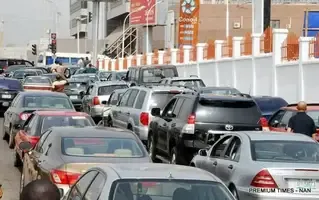
Fuel Scarcity Returns To Lagos Amid Increased Pump Price

Fuel Scarcity Returns To Lagos Amid Increased Pump Price

Fuel scarcity has made a troubling return to Lagos and its surroundings, as numerous oil marketers have closed their outlets, leaving motorists and consumers in a lurch. Last week, a similar issue was reported in Abuja, attributed by oil marketers to poor road conditions and the soaring cost of diesel for distribution. However, recent observations over the weekend have revealed that both independent and major oil marketers have halted operations, leaving the responsibility of serving customers in most parts of Lagos to NNPC Limited, the only remaining importer of the product. This scarcity has persisted despite fuel deregulation, as other operators have struggled to import petrol due to market instability and a lack of foreign exchange.  The informal exchange rate has reached over N1,000 per dollar, compounding the challenges faced by these operators. Chinedu Okoronkwo, the President of the Independent Petroleum Marketers Association of Nigeria (IPMAN), has indicated that measures are being taken to address this crisis.  He stated, “Stakeholders have been meeting, and measures have been taken to enable oil marketers to access foreign exchange at a rate that will not disrupt the current price of the product.” Meanwhile, in Abuja, most major marketers that are still operational have raised their pump prices from N615 per liter to N625 per litre, adding to the woes of already burdened consumers.

Independence Day: Benue Govt Purchases 100 Buses to Mitigate Subsidy Removal Effects

Independence Day: Benue Govt Purchases 100 Buses to Mitigate Subsidy Removal Effects

The Benue Government says it has procured 100 buses to be handed over to the Benue Links, the state-owned transport company to cushion the effects of the subsidy removal on petrol. Governor Hyacinth Alia stated this in a radio and television broadcast as part of activities to mark Nigeria’s 63rd Independence Anniversary in Makurdi. Alia said he was aware of the sufferings of the people following the removal of fuel subsidy and other harsh economic realities in the country. “Our good people of Benue, I share the pains most of you are going through; and I assure you that your resilience and patience would not be in vain as this administration continues to reposition, as well as strengthen our institutions for good governance. I want to assure you that succour is on the way. “In the meantime, we have purchased 100 buses to be handed over soon to Benue Links, the state-owned transport company, to provide affordable transportation to the public. “In addition, plans are underway to distribute N50,000 each, to market women across the state, to enhance their petty trade businesses. “Our lofty visions, policies and strategies for good governance cannot be achieved in a society bereft of security of lives and property,” he said.Alia added: “No society thrives in the face of wanton killings, kidnapping, banditry, communal conflicts, and so forth.“The independent anniversary is a moment for us to salute our heroes past. It took valour, sacrifice and cohesive nationalistic onslaught for them to actualise our country’s political freedom. “It is important to thank the Almighty God for preserving us amidst several storms, some of which at some point within the last 63 years, threatened our very own existence as a country.“While we reflect in retrospect, it is equally pertinent for us to examine where we are, and look to the brighter future that lies ahead of us, especially in a State like ours that possesses allthe potentials of peaking us in the comity of states.”

Fuel Subsidy: Senate urges NLC to shelve planned strike

Akpabio Appoints New Senate Deputy Leaders

The Nigerian Senate has appealed to the Nigeria Labour Congress (NLC) to shelve its impending strike on fuel subsidy removal and continue negotiation with the Federal Government. Senate resolution followed the consideration and adoption of a motion at plenary on Monday. The motion titled: ”Urgent Need to Avert the Intending Strike of the Nigeria Labour Congress”, was sponsored by Sen. Kawu Suleiman (NNPP-Kano). Suleiman in his lead debate said the NLC has given the Federal Government a seven-day ultimatum to reverse what the union termed as “anti-poor policies” or face an indefinite nationwide strike from August 2nd. He said the NLC had directed all its affiliates and state councils to immediately begin mobilisation of workers and other Nigerians, including civil society allies for a long-lasting strike and mass protests. Suleiman said the labour, in a statement signed by its National President, Joe Ajaero, alleged that the Federal Government had failed to meet up with the demands it presented to it following subsidy removal on petrol. Not meeting the demand as stated in the statement could cause an astronomical rise in price of the commodity. He expressed worry that the strike would cripple the country as commercial transport operators would withdraw their services, while markets, schools and healthcare facilities would be forced to shut down. According to him, the action could heat up the polity when it occurred, saying that gains from the strike were far below the costs to either of the parties in conflict. The senator said the strike threat by the NLC, if not averted, could plunge Nigeria into deeper economic woes, dislocate businesses, hunger, and frustration. Suleiman said more hardship would lead to unquantifiable financial losses and reduce Nigeria’s Gross Domestic Product (GDP). He said the NLC proposed strike was a bad reputation for Nigerian economy and the educational system, saying that it portrayed the country in a bad light to the external world  According to him, it discourages foreigners from coming to do business or study in Nigeria. The senator said that the society always bears the brunt of strikes, adding that an idle mind was the devil’s workshop. He said there was a tendency for an increase in crime rate, social vices like armed robbery, oil bunkering, prostitution, cyber scams, among others, if the strike was allowed to hold. Following support of senators on the motion, Senate accordingly resolved to mandate its leadership to interface between the NLC and the Federal Government to avert the intending strike.

‘Tinubunomics’, fuel price hike and market forces

Nigeria's H1 2023 foreign trade data raises questions about economic balance

President Tinubu’s government appears to have committed the citizenry to biting the bullet, with the removal of fuel subsidy, all in its bid to rescue the nation from using its revenue to service a fraudulent subsidy regime. However, it is an encouragement for the operationalization of the Petroleum Industry Act 2022, to stimulate investment growth and transparent pricing model in the oil and gas sector. Though a painful choice considering the ripples on the economy, many analysts applaud the government, describing it as a modest approach by Tinubu and his economy team, with the resumption of fuel imports by newly licensed 56 oil marketing companies.  This, in our view, is another fraudulent and cosmetic quick fix, that successive governments’ feeble character established the monsters behind the fuel subsidy regime. Sadly, it was Nigerian masses that suffered, just as they are doing now under Tinubunomics opium that has put every citizen in a sidon look mode.  It was all the Nigeria National Petroleum Company Limited (NNPCL) needed to, tactically hike the pump price of fuel citing ‘market forces’ or what economists regard as ‘market fundamentals’ to justify, free entry and exit in an economy based on the theory of supply and demand, alongside other vague eternal technicality that includes, price elasticity, marginal profit, marginal cost as well as equilibrium principles.  Hence, the NNPCL made mention of market forces behind Petroleum Motor Spirit (PMS) price hike of N617 as against N537. Here, we want to be critical and avoid classroom theoretics, because clarification is necessary. Instructively, with recent development in global crude oil price hitting $80 per barrel and a move from previous shock and pandemonium of the Russia – Ukraine war outbreak which disrupted free flow of energy sources, as well as drastic reduction in imports of wheat and grain, iron and steel across the globe, has led to induced economic downturn, creating headline and core inflation. Those factors made several central bankers the world over to result in hiking interest rates and other tightening monetary measures.  The Nigerian economy was not spared from this global phenomenon with food inflation hovering over us as a nation. Again, the news of the NNPCL hiking fuel price didn’t come as a surprise, going by the prevailing circumstances around activities in Nigeria’s oil and gas sector, that is opaque in operation and a cesspool of corruption. If Nigerians could recall, this same market forces played out under the Buhari administration. For instance, the defunct Petroleum Products Pricing Regulatory Agency (PPPRA) now Nigeria Midstream and Downstream Petroleum Regulatory Authority (NMDPRA), was fixing PMS Price on a monthly basis on one hand, claiming it was doing price reduction. Suddenly, it said the price would reflect market fundamentals. And this happened in 2020. The Federal Government, through the PPPRA, announced a new fuel price regime. First, it was the reduced price regime from N145 to N125/litre that came into effect on March 19, 2020, followed by the government’s approval of price adjustment from N121.50 to N123.50 per litre of PMS. Then, again, there was the N141.80 to N143.80 per litre of petrol adjustment in June, 2020. Secondly, the  Petroleum Products Pricing Regulatory Agency (PPPRA), said, “Going forward, pricing of the PMS will reflect market fundamentals,” in a circular dated Wednesday, July 1, 2020, to oil marketers, with PMS pump price being increased from N143.80 to N145 /litre.  It noted that the essence of “the price band was to ensure price efficiency that would be beneficial to both consumers and oil marketers, PPPRA will continue to monitor price trends and advise monthly guiding price for all petroleum products, based on prevailing market realities and other pricing fundamentals.” The excuse of then PPPRA now NMDPRA was the plunge in oil price occasioned by the outbreak of COVID-19 which slowed down global oil demand, with direct bearing on petrol, thereby pushing it to a level below the pump price cap of N145/litre.  With the caution that Nigerians should be ready to pay high or low prices for petrol following the price liberalisation scheme currently in place and that what we have in place is a market reflective pricing system,  the fact of the so called market forces increase in PMS (Petrol Motor Spirit) price from N145 to N151.56/litre; was that in reality,  fuel was being sold majorly between N161 to N170/ litre in filling stations across the country then. The import of the foregoing is to draw our attention simply to the action of the past, that same market forces, few years back, were used to exploit Nigerians. Presently, the landing cost of PMS is N565, and various prices across the country posit N588 in Lagos, N617 in Abuja, Port Harcourt N625, Kano N630. More so, from the aforementioned, it stands to reason that there is a glaring contradiction that would be creating controversy and confusion soon especially with the term, “market forces.” The crux of this piece is to deconstruct the ingenuity of market forces that the Tinubu government and NNPCL have so much put their hopes on to drive the pump price of PMS in Nigeria. Accordingly, price will naturally be adjusted to reflect a true picture of market force at any particular period, high or low. The question is how true the above statement is knowing full well that the so called market forces are hinged on supply and demand, anchored on the invisible hand of market forces, embellished in the profit maximization drive of global capitalism.  Regrettably, with the shambles and rot in the midstream and downstream sector of Nigeria’s oil and gas industry, the government throwing the sector up into the risky and uncertain space and manipulative tendency of market forces leaves us with great concern. One great pitfall of market forces is its poor scientific outlook and dangers it will pose to our economy. The petroleum products marketers in this realm would be market forces. To this end, we are confronted with the following questions: Will the market forces not exploit consumers with arbitrary pricing and round-tripping of PMS? Would the market forces not create artificial scarcity