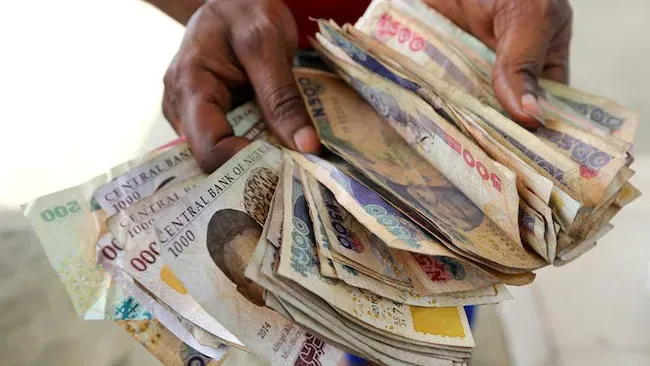
Naira Weakens Despite CBN’s Intervention

Since the unification of all the official foreign exchange (FX) windows, the Naira has continued to depreciate against the US dollar, down by 39.6 per cent to N765.83/$ as of 11 October 2023 from N462.88/$ at the I&E Window. Based on the half-year financial markets report of the Central Bank of Nigeria, it has maintained its intervention in the foreign exchange market in an attempt to alleviate demand pressures and ensure exchange rate stability. A total of $6,439.33 million was sold at the foreign exchange market made up of spot sales of $1,557.47 million and forward sales of $4,881.86 million. The spot sales comprised $612.41 million sold at the inter-bank Secondary Market Intervention Sales (SMIS) window, $455.31 million sold to Small and Medium Enterprises (SMEs), $441.75 million for Invisibles, and $48.00 million sold at the I&E window while the bank purchased a total of $655.53 million in the FX market. However, the shocks of the policy have been more pronounced at the parallel market leading to a steep depreciation of the Naira to N1020/US$ on 10 October 2023. With little control over the depreciation of the nation’s currency, the then acting governor of the Central Bank of Nigeria (CBN), Mr. Fola Shonubi, announced plans to put in place new policies that would guide the dealings of FX to boost supply in the market. Apparently, the measures put in place have not been effective as demand for FX continues to rise amidst an acute shortage of supply. “We have always argued that while we believe the unification of the various FX rates is a pro-market policy that will be positive for the economy in the long term, the short to medium-term impact will be hard too hard on the average consumer. “A focus on rate convergence without structural reforms to increase the supply of FX will be a case of treating the symptoms while ignoring the underlying cause of the problem which is an acute shortage of supply amidst a growing demand for FX. Meanwhile, while crude oil sales and Foreign Portfolio Investments (FPIs) are two major sources of FX that have declined significantly, Oil production remains depressed, reported at 1.57 mbpd in September (highest so far this year) and are yet to see any significant foreign capital inflows. According to the Nigerian National Petroleum Company Limited (NNPCL), between September 30 and October 6, 128 crude oil theft incidents were recorded across the oil-producing areas of the Niger Delta. In the specific timeframe mentioned, there were numerous illicit activities in the oil sector. These included 17 cases of unauthorized connections, 27 illegal refineries, 11 infractions related to vessel tracking systems (AIS), and 49 instances of wooden boat arrests.
CBN opens FX price verification system portal

*Vows to sanction infractors In a bid to address the constraints that has bedeviled the foreign exchange market, the Central Bank of Nigeria has introduced a foreign exchange price verification system, specifically for importers to access forex. The portal is scheduled to begin on August 31, 2023. The CBN’s Trade and Exchange Department said in statement that the price verification report from the portal is now mandatory for all ‘Form M’ requests. “Following the successful conduct of the pilot run and various trainings held with all the banks, the Central Bank of Nigeria hereby announces the Go- Live of the Price Verification System (PVS),” the statement reads. “All applications for Forms M shall be accompanied by a valid price verification report generated from the price verification portal. “For the avoidance of doubt, by this circular, the price verification report has become a mandatory trade document precedent to the completion of a Form M,” the statement said. The Apex Bank insisted that it would not fail to sanction any case of infraction. “Please, ensure compliance,” the Bank said.
Allow us access banks’ autonomous window, BDCs appeal to CBN

President of the Association of Bureau De Change Operators of Nigeria (ABCON), Aminu Gwadebe has urged the Central Bank of Nigeria (CBN) to immediately leverage the BDCs by allowing them access banks’ autonomous window and agency of international money transfer operators. This, he said, will allow them to provide liquidity in the retail end of the foreign exchange market and help stop the free fall of the Naira occasioned by forex scarcity in the country. Gwadebe also urged the CBN to reinstate its 2015 policy guidelines which allow the BDCs to effectively provide liquidity in the retail end of the market through the forex windows. The 2015 policy guidelines allow the BDC operators to access foreign exchange from the autonomous window of the commercial banks as well as act as agents for diaspora remittances. Gwadebe in his statement said BDCs are effective tools of the transmission mechanism of the CBN. “I quickly want to advise the apex bank to leverage on the BDCs and allow them access banks’ autonomous window and agency of international money transfer operators. Gwadebe, who accused some of the International Money Transfer Organizations (IMTOs) of diverting diaspora remittances, said the commercial banks revealed that they don’t even see most of these remittances. “Imagine you are the IMTO and then you are the one that will pay the beneficiary the naira, invariably, then I as well just give you the naira without paying you the dollar.’’ “Even the banks have been saying that they are not seeing the diaspora remittances that the fintechs have taken over. We had a meeting with the banks where we even tried to bring up the issue of diaspora remittances so that we can harness it and bring liquidity, but they said they don’t see it. That’s the truth of the matter, a lot of unlicensed online firms are in the process.’’ The black market rate fell to as low as N950/$1 last week, opening up about N200 disparity with the I&E window as demand continued to outstrip supply. Meanwhile, the official rate averaged N765/$1.
Naira drops to new low of N923-950 per dollar

The naira extended its slump in black-market trading as the nation’s dollar shortage deepened two months after the central bank moved to a more flexible exchange rate to encourage inflows. The naira weakened to N923 per dollar, compared with N917 on Wednesday. Traders in Lagos said it worsened to an all-time low of N950 to one dollar at the parallel market on Thursday afternoon as against the N897 it traded at the previous day. At the official window, data showed that the naira closed at N782.38 per $1. The disparity is now N167.62/$1 one of the widest since the unification of the naira on June 14th, 2023. Banks have been unable to come up with the dollars to meet demand, and buyers are increasingly turning to the black market, widening the gap between the official exchange rate and the price on the street. On Tuesday, the naira plunged to a record low of N900/$1 on the parallel market on Tuesday, August 8, 2023, as demand for foreign currency outstripped supply with traders quoting the exchange rate as high as N900/$1 for “inflows” and N895/$1 for cash trades. The peer-to-peer market, where crypto-currency traders exchange forex, also saw the exchange rate soar above N900/$1. Meanwhile, in the official Investor and Exporter Window, the exchange rate closed at N774.78/$1 while the NAFEX rate was N776. The official market also faces supply constraints, with daily turnover averaging $80 million since July. Forex traders who attributed the depreciation of the naira to a scarcity of supply, said that there were more buyers than sellers in the market and that the situation was unlikely to improve anytime soon. When asked about the source of the increased demand, traders mentioned a diverse set of buyers, including importers, foreign travelers, and speculators. There are concerns among some traders that the state of depreciation is unlikely to improve as demand continues to rise unchecked. Forex analysts explained that there was a huge backlog of unmet forex demand in the official market, estimated at $8-10 billion. Some of this demand also spills over to the parallel market, as buyers struggle to find enough supply to meet their needs in the official market. The exchange rate between the naira and dollar has weakened by 16 per cent since the reunification of the exchange rate windows. This compares to a depreciation of 2.5 per cent between January 1 and June 14th. The exchange rate weakened by 22.9 per cent in the whole of 2022. The naira has been under pressure in the parallel market for several weeks, as the supply of forex from official sources remains inadequate. On July 1st, the beginning of the second half of the year, the exchange rate in the parallel market was around N772/$1. However, a surge in demand from various segments of the economy, such as importers, foreign travelers and speculators, has triggered exchange rate volatility.