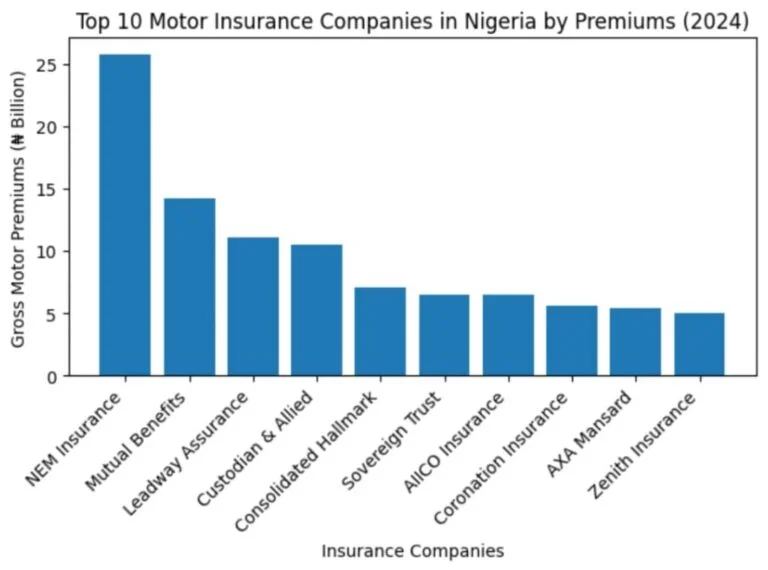
NIA 2024 Digest: NEM Insurance Tops Motor Insurance Market as Competition Intensifies

Lagos — The Nigerian Insurers Association (NIA) has released its 2024 Digest, ranking the top 10 insurance companies by motor insurance underwriting and revealing sustained growth and heightened competition in the segment over the past five years. According to the report, which was made available to journalists on Thursday in Lagos, NEM Insurance Plc retained its position as Nigeria’s leading motor insurance underwriter in 2024, recording the highest premium income in the category. NEM Insurance posted ₦23.483 billion in comprehensive motor premiums, ₦2.148 billion in third-party premiums and ₦156.8 million from third-party fire and theft policies, bringing its total motor insurance premium to ₦25.8 billion for the year. This represents a significant increase from ₦20.1 billion recorded in 2023 and ₦10 billion in 2020. The insurer first emerged as the market leader in motor insurance underwriting in 2015 and has maintained the top position for more than a decade, steadily widening its lead over competitors. Mutual Benefits Insurance Plc and Leadway Assurance Ltd. followed with strong performances. Mutual Benefits generated ₦14.05 billion in comprehensive premiums and ₦157.08 million in third-party premiums, bringing its total motor premium to ₦14.21 billion, while Leadway recorded ₦11.05 billion. Custodian and Allied Assurance Ltd. ranked fourth with ₦10.48 billion, closely followed by Consolidated Hallmark Insurance Ltd., which posted ₦7.02 billion, placing both companies among the top five motor insurance underwriters in 2024. Other insurers that featured prominently in the ranking included Sovereign Trust Insurance Plc, AIICO Insurance Plc, Coronation Insurance Plc, AXA Mansard Insurance Plc and Zenith Insurance Ltd., all of which recorded varying levels of growth during the review period. The NIA data showed that comprehensive motor insurance premiums among leading insurers more than tripled between 2020 and 2024, with NEM Insurance accounting for a substantial share of the expansion. Industry analysts attributed the growth in the motor insurance segment to stronger regulatory enforcement, rising vehicle ownership and increasing awareness of the importance of motor insurance among Nigerians. They noted that the segment remains one of the most competitive in the industry and is expected to continue expanding in the coming years, supported by consistent year-on-year growth among major players.
Majority Rural Women Can’t Access Financial Services – Centre

The Executive Director of the Policy Innovation Centre, Dr Osasuyi Dirisu has said that 80 per cent of poor rural women have difficulty accessing financial services. In a pre-conference press briefing, Monday in Abuja, Dr. Osasuyi also said the situation has further made it difficult for them to drive trade and inclusiveness. The Gender and Inclusion Summit, with the theme “Building Bridges: Advancing Gender and Inclusion through the Intersection of Trade and Health”, will hold on November 28 and 29, in Abuja, Nigeria. Analysts say the event would be a catalyst for positive change, uniting voices, inspiring commitments, and mobilizing stakeholders to advance gender equality. She said, “About 80 per cent of the 133 million people who are multi-dimensionally poor live in rural settings, who are talking about access to financial services to drive trade and inclusion. Who is talking about the gaps in infrastructure to drive productivity? The PIC Executive Director noted that it is becoming increasingly difficult for women and vulnerable groups to access healthcare making Nigeria one of the countries with the worst indices for maternal mortality, new-born to child birth. “There needs to be real conversation around gender inclusion centred around trade for that is the powerhouse that drives productivity and drives conversation around GDP that we are able to address issues around inflationary pressures and ensure that we have a productive society. “The summit is special because we are not just talking about health, we are talking about trade. We are talking about an intersection where vulnerability is likely to occur,” Dr. Osasuyi said. Speaking about the upcoming event, the Chief Executive Officer Designate of the Nigerian Economic Summit Group, Dr Tayo Aduloju stated that ‘’To facilitate the advancement of a gender-inclusive society, it is necessary to consider how trade, investment, and health policies/interventions affect women, men, and vulnerable populations differently. Despite their significant contributions to informal trade, women continue to have limited access to resources and markets. There are also significant gaps in access to health services and Nigeria’s maternal mortality remains among the highest in the world.” He further stated that “Considering these realities, the high-level forum on the SDGs has partnered with the Policy Innovation Centre (PIC) to ensure seamless delivery of the Gender and Inclusion Summit 2023”. PIC, an initiative of the Nigeria Economic Summit Group (NESG), is the first national institutionalized behavioural initiative in Africa supporting governments and stakeholders to make behaviourally informed decisions and generate contextually relevant evidence for high-impact interventions in critical thematic areas.
Debt Rising Cost May Increase Cost Of Borrowing – PwC

Cost of funding increase in debt concerns which has led to lowering of credit ratings may lead to increase in the cost of international funds, PricewaterhouseCooper (PwC) has said. In its Nigeria bi-monthly Economic Outlook released on its website titled “Impact of global economic trends on Nigeria’s foreign exchange and the way forward”, the professional services firm said it may increase the demand pressure on forex to meet future FX debt service obligations. According to the firm, it is evident in the decline in capital importation from $24 billion in 2018 to $5.3 billion in 2022. “The increase in the global Central Bank’s policy rate may lead to capital reallocation away from Nigeria’s financial market to other markets with more attractive yields on investment. This may reduce FX flows to the economy “The Nigeria MSCI index recorded a significant decline of 113%, from 23.5% in 2020 to -3.02% in 2022, reflecting capital reallocation to other economies A marginal trade surplus may lead to an increased pressure on FX threatening liquidity in the forex market. In Q2 2023, Nigeria recorded a positive balance of trade of $2.3 billion. The positive trade balance could be attributed to the growth of total export by 9% (y/y) to $12.5 billion “The decline in remittance flows may reduce FX flows to the economy. Though remittances to Nigeria accounted for 38% of the total flows to the region, it increased by only 3.3% to $20.1 billion “Lower credit ratings due to Nigeria’s widening fiscal deficit, debt service to revenue ratio may reduce confidence in the Nigeria economy. This may lead to reallocation of funds from the Nigerian economy and reduction in FX flows,” it said. Over time, the company observed that there has been a rise in the inflows of FX from autonomous or non-CBN sources, which has led to the widening divergence between the official and parallel market rates. “Since 2007, the FX inflows from autonomous sources exceeded inflows from the CBN “The implication of official interventions may not accurately reflect the market demand and supply dynamics as annual inflows are skewed towards unofficial sources,” it said. To address this imbalance, there is a need for authorities to boost investors’ confidence by deepening the financial markets, ensure longer term sectorial policy to maximise exports or deepen domestic consumption, and roll out short-term fixes to enhance foreign exchange liquidity.
Digital Payments, Key To Microfinance Banking Growth, Innovation, Experts Say

Leaders and experts in the financial technology sub-sector have said digital payments hold the key to the success and stay of Nigeria microfinance banking sector of the country’s economy. The experts spoke at Africa’s leading integrated payments and digital commerce company, Interswitch TechConnect event held in Port-Harcourt where they explored the transformative impact of digital payments in the microfinance sector. Keynote speaker and Group Head, Financial Services Business, Digital Infrastructure & Managed Services (Interswitch Systegra) Tyoyila Aga emphasized the pivotal roles latest trends in digital payment solutions, such as mobile wallets, QR codes, and contactless payments play in shaping the future landscape of microfinance banking. Aga noted that digital payments innovation is big for the microfinance sector as it comes with opportunities for growth, and ultimately, financial inclusion, hence the reason Interswitch is at the forefront of driving the growth of digital payments across the country and beyond. He said, “We are excited to have come this far in propagating the good news around what digital payment innovation holds for our microfinance sector. At Interswitch, we are all about innovation and as a company committed to driving the digital transformation of Nigeria’s financial services, we are proud to play a leading role in shaping the future of microfinance banking.” Attendees who spoke to our correspondent said they gained valuable insights into the technological advancements that are revolutionizing financial services and the potential these innovations hold for financial inclusion and economic empowerment. The event also featured panel discussions, where industry leaders engaged in conversations on different strategies for growth in the microfinance sector, sharing their perspectives on leveraging digital technologies to drive growth in the financial sector. The discussion covered topics ranging from cybersecurity and regulatory compliance to the integration of emerging technologies, providing attendees with a comprehensive understanding of the multifaceted aspects of digital transformation.
The Fintech Revolution: Transforming MSMEs and Financial Inclusion in Nigeria

Fintech has emerged as a transformative force in Nigeria, reshaping the financial landscape and ushering in an era of unprecedented financial inclusion. Among its many impacts, perhaps the most noteworthy is its role in fostering the growth of Micro, Small, and Medium-sized Enterprises (MSMEs), which are the backbone of the Nigerian economy. Fintech has undeniably improved financial access and penetration across Nigeria. By introducing innovative solutions like mobile banking, digital wallets, and agent banking, it has reached underserved populations that traditional banking services could not. Not only has this expanded access, but it has also brought down transaction costs, making financial services more affordable for all. One of the remarkable achievements of fintech in Nigeria is the transformation of payment systems. The proliferation of mobile money platforms and digital payment solutions has revolutionized the way transactions are conducted. Nigerians can now seamlessly make payments, transfer funds, and settle bills through their mobile devices. This has significantly contributed to the adoption of cashless transactions, reducing the risks associated with physical cash. However, the real success story of fintech in Nigeria lies in its impact on MSMEs. These enterprises, often struggling to access traditional financial services, have reaped unparalleled benefits from the fintech revolution. Fintech platforms have bridged the financing gap that has historically plagued MSMEs. Through peer-to-peer lending and crowdfunding, they can secure much-needed capital for their businesses. This has not only injected much-needed funds into these enterprises but has also fueled entrepreneurship and innovation. Beyond financing, fintech has streamlined MSME operations. Tools such as accounting software, digital marketing platforms, and supply chain management systems empower these enterprises to operate more efficiently and compete effectively with larger players. Moreover, e-commerce platforms, enabled by fintech, have expanded their reach, allowing MSMEs to tap into a broader customer base. Risk management is another critical aspect where fintech has made substantial contributions. Fintech solutions offer valuable risk assessment tools, enabling MSMEs to make informed credit decisions. This is essential for ensuring the long-term sustainability of these enterprises. However, while the impact of fintech in Nigeria is undeniable, it is essential to address the challenges that come with this rapid transformation. Fintech regulation in Nigeria is still evolving, requiring a delicate balance between promoting innovation and providing effective oversight. The rapid growth of fintech adoption has also given rise to escalating concerns about cybersecurity. Robust measures are required to protect financial data and services from cyber threats. Furthermore, addressing financial literacy gaps remains a critical challenge. Not all segments of the population possess the necessary skills to fully utilize fintech services, emphasizing the need for comprehensive educational initiatives. Overall, the impact of fintech in Nigeria extends beyond improved financial penetration; it is reshaping the fortunes of MSMEs, introducing a new era of financial accessibility, efficiency, and innovation. As the fintech ecosystem in Nigeria continues to mature, its contribution to economic growth and development is poised to become even more profound. Nevertheless, addressing regulatory, cybersecurity, and educational challenges will be instrumental in sustaining and maximizing these benefits. The revolution has the potential to propel Nigeria into a new era of economic prosperity, and it’s imperative that stakeholders work together to overcome the associated challenges and ensure the continued success of this dynamic industry.
Inadequate Infrastructure, Bane Of e-Payments in Nigeria -Fintech Experts

Experts in Nigeria’s Fintech industry have said that the major challenges facing electronic payments in Nigeria is the inadequacy of infrastructure, including operational and telecommunications facilities, as well as reliable electricity supply. They opined the need for stakeholders in the financial industry to work together and extend e-payments channels across the country as well as finding solutions to the growth of fraudulent activities in the system. Chief Finance Officer Parthian Partners, Yinka Arewa while making presentation on the “Collaboration, Key to tackling challenges facing E-PAYMENT System in Nigeria, said many e-payment systems depend on stable power sources and robust IT infrastructure, such as laptops, mobile phones, POS terminals, and dependable internet connectivity. He said during the period of cash scarcity earlier this year, banks faced unprecedented e-payment failures, prompting the urgent need for technological infrastructure upgrades. He said the failure of e-payment channels on such a scale compelled customers to wait for banks’ networks to stabilize before completing their transactions while the FinTech companies, initially considered a lifeline, also encountered challenges due to increased pressure. He pointed out that the recent events, such as the implementation of the cashless policy following the Naira redesign late last year/early this year, highlighted the challenges associated with the country’s transition to a cashless economy He said the issue of failed transactions has persistently affected numerous businesses reliant on electronic payment systems. He stated that the rapid growth in financial technology has broken down geographical barriers, introduced innovative approaches, and ushered in numerous advancements, but at the same time has exposed us to unprecedented risks, including cybercrime. He pointed out that cybercrime poses severe societal and economic consequences, ranging from facilitating corruption, money laundering, and military espionage to terrorism, all of which undermine technological and socio-economic development. Speaking further, he said Cybercrime’s impact on customers is substantial, as everyone desires the safety and security of their hard-earned money. Trust is the linchpin of finance, and no one wishes to witness their funds vanish. Security concerns stemming from electronic fraud and cyberattacks are real. The automated nature of payments without direct interaction between the payer and payee renders e-payments vulnerable and with the proliferation of digital financial activities, cyber threats are expected to rise” But despite all these challenges, he said In 2022, Nigeria unlocked $3.2 billion in additional economic output through the development and utilization of electronic payments, particularly real-time payment services. “Electronic payments continue to attract substantial global investments and have exhibited the highest returns and growth within the sector over the past decade. Indeed, Nigeria has witnessed a remarkable digital transformation, with over 100 million active mobile phone users as of 2023. “This statistic signals the advent of a fully digitized financial services sector. However, despite these advancements, Nigeria’s payment system predominantly relies on cash.” Managing Director, Nigerian Inter Bank Settlement Systems (NIBSS), Premier Oiwoh, called for stakeholders’ partnership to extend e-payment channels across the country. He said that such partnership will, in addition to wider coverage, help to checkmate abuses, dispense errors, instant resolution of errors as well as update technological resources in delivering first-class e- payment across the country. Oiwoh who was represented by the Divisional Head, Enterprise Support NIBSS Bola Onigbokan, said: “Collaboration is mandatory; it is not a choice, adding that as we have gathered here doing our workshop planning how to move forward, the fraudsters are also brainstorming and strategizing on how to operate and often times, they are even ahead of us. I think that is even why we are even having this discussion today.” He assured Nigerians that the national payment infrastructure of NIBSS, owned by banks, were committed to ensuring seamless transactions, customer protection, and the improvement in technologies driving e-payment systems.