Ororo Burning Well Harming Marine System, Disrupting Fishing – HOMEF

Ororo Burning Well Harming Marine System, Disrupting Fishing – HOMEF

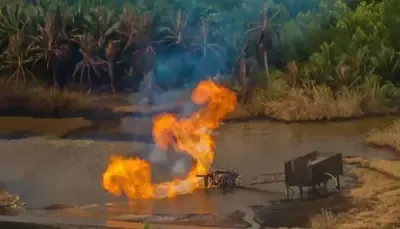
As the Ororo -1 Well at OML95 fire continues to rage for the past three years without attention, the Health of Mother Earth Foundation (HOMEF) has said the inferno is harming marine ecosystems and disrupting fishing and other economic activities of the nearby communities. The Foundation in a statement titled, “Ororo-1 Inferno- A Tragic Case of Injustice and Environmental Destruction,” made available to journalists on Saturday by its Communication lead, Kome Odhomor, said the burning well has now become a symbol of ecocide and outright neglect by the Nigerian government. According to the statement, several environmentalists have expressed their concerns over decades of destructive extraction of petroleum resources that disrupt ecosystems with decades of exploration and have turned a once-thriving region into one of the most deadly and polluted places on earth. “Awoye’s tale is a sad example of a healthy region turned into a sacrifice zone by the pursuit of fossil fuels. “A 2021 report by African Oil and Gas Report, stated that “Although the company that engaged the services of the owners of Grace-1 HWU was Guarantee Petroleum, a Nigerian E&P independent, the Nigerian government, having revoked the rights of the company to the field, took ownership of controlling the Well fire. “The Department of Petroleum Resources (DPR), in May 2022, told Africa Oil+ Gas it would do all it could to extinguish the fire, including possibly drilling a relief well and engaging Boots & Coots Services, a Halliburton-owned firm of well control specialists, to put out the fire,” the statement reads. The Foundation therefore called for quenching of the raging fire at Awoye, saying this tragic incident compounds the climate crisis and harms the communities and ecosystems in multiple ways. According to it, “Field data reports show that the reservoir pressure was 8,000 pounds per square inch (psi) and above, and surface pressure was about 4,600 psi as of the incident.  It’s a widely held view by a range of technical specialists in the industry that such a highly pressured well should not have been re-entered with a workover rig with less than adequate blowout preventer (BOP). “Stopping the flaming well isn’t rocket science. What is needed is an understanding that the cost of this unattended disaster is far higher than the cost of drilling relief wells and other actions to quench the flames and save the communities,” the Foundation said. It also called for the ending of dependence on fossil fuels and leaving the oil on the ground while ramping up investment in renewables.

Reducing Supply Will Not Solve Climate Change – ExxonMobil  

Reducing Supply Will Not Solve Climate Change – ExxonMobil  

Oil major ExxonMobil Corp has warned that attempting to limit the supply of fossil fuels will impede progress toward achieving net zero emissions as well as potentially perpetuating poverty for millions in the developing world. Speaking at the Asia Pacific Economic Cooperation CEO Summit in San Francisco, ExxonMobil CEO Darren Woods, insisted that the solution to climate change has been too focused on reducing supply, noting that it’s “a recipe for human hardship and a poorer world.” Woods said that attacking oil and gas companies for their role in climate change will only serve to keep net zero as an “aspiration” rather than a reality Woods called for governments to “harness the industry’s capabilities for change” by providing taxpayer support for emissions-reducing technologies like carbon capture before market forces can take over. Exxon has ramped up its energy transition efforts over the past two years after losing a bruising proxy battle with activist investor Engine No. 1 at the height of the ESG movement. It plans to spend $17 billion over six years on low-carbon initiatives, and it recently acquired Denbury Inc., the largest carbon dioxide pipeline operator in the US, for about $5 billion.  But Exxon is also spending big on oil and gas. It agreed to buy US shale driller Pioneer Natural Resources Co. last month in a deal valued at about $62 billion. Woods is adamant that Exxon won’t reduce oil and gas production or invest heavily in renewable energy as his European peers have done. Instead, the Texas oil giant will invest in low-carbon technologies that complement fossil fuels such as carbon capture and hydrogen.  “Oil and gas companies reliably provide affordable products essential to modern life,” he said. “Making them into villains is easy. But it does nothing – absolutely nothing – to accomplish the goal of reducing emissions.” In unusually personal remarks, Woods talked about his commitment to the environment.  “I’m a father and grandfather – who cares about his family, their quality of life, and their futures. Which means I care very much about our environment and the health of our planet,” he said. He also attempted to draw a line under the multiple climate lawsuits that have dogged Exxon for much of the last decade.  “I’m fully aware that there are many who question ExxonMobil’s commitment because of what was said over 30 years ago – or what they think Exxon knew back then,” he said.  “Frankly, I’m more interested in what ExxonMobil knows today. Climate change is real. Human activity plays a major role,” he added.

Expert Decry 3.5% Annual Deforestation In Nigeria

Expert Decry 3.5% Annual Deforestation In Nigeria

As climate change wreaks havoc across the 36 States and FCT, an expert has raised the alarm over continued depletion of forests through illegal tree logging. The Publisher and Editor-in-chief of Development Agenda Magazine, Mr Paddy Ezeala, said this at a one-day seminar organised by Development Agenda in collaboration with Environmental Media Correspondents Association of Nigeria recently in Abuja. The seminar had as its theme: “Climate Change and COP28: The Way Forward For Nigeria.” He estimated that 1.5 million trees are felled daily through illegal logging, thereby leading to 3.5 percent deforestation annually. Ezeala stated that the establishment of a foreign privately-owned charcoal producing factory in Nsukka, Enugu state worsened the destruction caused by the foreigners, adding that the adjoining states were affected by the massive logging.  The publisher lamented that Nigeria is experiencing four percent forest loss annually, which is about the highest globally, as people continue to cut down trees in Cross Rivers, Ondo, Ogun, as well as in some North Central States. Ezeala hinted that between 1981 and 2000, Nigeria lost 3.7 million hectares of forests which implied colossal loss of biodiversity.  The forest cover had depleted to less than 10 percent as against the mandate of the Food and Agricultural Organizations’ (FAO) that each state is expected to keep its forest cover to a minimum of 25 percent of its land area. While about 484 plant species are threatened with extinction, the publisher lamented the absence of measures aimed at encouraging forest regeneration “Related to this is the absence of a valuation system to place a value on forest resources so that when forests are destroyed through individual or corporate negligence, adequate compensation will be paid,” he said.  He stated that there is a need to develop more environmentally and socially equitable approaches to forest management in Nigeria, noting that the wanton destruction of forests across the country must be checked. Ezeala added: “Forests perform a broad range of critical environmental and climatic functions, including the maintenance of constant supply of water. Forests harbour species and at the same time have very deep economic, aesthetic, industrial and religious significance for humans.  “However, economic development pressures often lead to the conversion of forest ecosystems without consideration for both the long-term economic costs and the implications of the immediate loss of biodiversity, ecosystem structure and function.”  The publisher maintained that Nigeria’s remaining rainforests harbour about 4000 different species of plants, including those effective in the development of alternative medicine.  Ezela harped on the need to priortise tree planting and secure protected areas, noting that the National Park Service and others managing the protected areas should be supported.  The Emir of Nasarawa, Alhaji Ibrahim Usman Jibril hinted that the rising sea level at the coastal areas, climate change, deforestation, drought and desertification are some of the environmental challenges affecting Nigeria.  He said though charcoal has been banned that the government cannot stop households from cooking with charcoal without providing alternative means of fuel.  The Chairman of EMCAN, Mr Chuks Oyema said that the essence of the seminar was to showcase how Nigeria is tackling climate change and how the government is prepared for COP28.  He urged the media to publish more stories on climate change and embark on collective actions toward mitigating the impact of climate change on the environment.

Plastic Wastes In Drainages, Waterways Cause Of Flooding In Benin –ERA/FoEN

Plastic Wastes In Drainages, Waterways Cause Of Flooding In Benin –ERA/FoEN

The Environmental Rights Action/Friends of the Earth Nigeria (ERA/FoEN) has urged the Edo State government to compel Coca Cola Company, Seven Up Bottling Company and other producers of plastics to engage in Extended Producer Responsibility (EPR) by taking responsibility for the plastic waste they produce. According to ERA/FoEN, the flooding experienced in Benin City and its environs is fueled by plastic waste materials that have found their way into the drainage systems and waterways. A statement by ERA/FoEN’s Communications Officer, Elvira Jordan, at the weekend, noted that the statement was the highpoint of a Return-To-Sender Action protests by ERA/FoEN and other groups in Benin City. The exercise was in collaboration with Zero Waste Ambassadors (ZEWA), Edo Civil Society Organization (EdoCSO) and Students Environmental Assembly of Nigeria (SEAN), University of Benin Chapter. The statement states that the exercise was targeted at determining the highest polluting brands. Coca Cola and Seven Up came up as the highest polluters, with a frequency rate of 33% and 23% respectively. Speaking during the action, the Executive Director of ERA/FoEN, Chima Williams, represented by Babawale Obayanju said the flooding in Benin City and its environs is aggravated by the plastic waste materials that have found their way to drainage systems and waterways. He added that statistics clearly show that the identified companies are making lots of money and are equally contributing heavily to the plastic waste menace in Benin, without any waste management systems in place.  “We brought their plastic waste back to them as it is polluting our environment and based on our findings during the brand audit, The Coca-Cola Company, Seven Up Bottling Company and others primarily use plastics for their packaging, including PET bottles with plastic caps. “It is very crucial for these companies to design and develop a take-back or withdrawal scheme for their products as there are no active withdrawal schemes currently in place. Implementing the take-back/withdrawal schemes and exploring circular economy models can enhance recycling rates and reduce plastic pollution.” “We also request that The Coca-Cola Company and the other brands should have a squint at further research and development into eco-friendly packaging materials, collaborate with recycling partners, and engage with consumers to achieve its plastic reduction targets and contribute to a cleaner environment”, he stated. He called on Coca-Cola Company, Seven Up, CWAY Group and others to transition to sustainable packaging alternatives such as biodegradable materials, reusable containers, or reduced plastic packaging Also speaking, Project Officer, Waste Management of ERA/FoEN Melody Enyinnaya said the plastic pollution experienced in Benin City was appalling as manufacturers continue to produce without retrieving their waste. “This situation has thrown our environment into a dumping ground for plastics, especially our drainage systems and our rivers,” she said. Eyinnaya demanded that coca cola, seven up and all other manufacturers withdraw their plastics waste from the environment “as we need fishes in our rivers not their plastics.”

Nigeria Lost $22.9bn To Gas Flares In 10 Years -NOSDRA

Nigeria Lost $22.9bn To Gas Flares In 10 Years -NOSDRA

The Revenue Mobilisation Allocation and Fiscal Commission (RMAFC) is to part the Nigeria Upstream Regulatory Commission ( NUPRC) and Nigerian Oil Spill Detection and Response Agency (NOSDRA) to boost revenue generation through proper management of gas flares in line with global best practice. This is in a bid to arrest huge revenue losses recorded and enhance revenue generation into government coffers.    According to RMAFC Public Relations Officer, Christian Nwachukwu, RMAFC   Chairman Mohammed Bello Shehu disclosed this during an interactive forum with delegations from NUPRC and NOSDRA recently in Abuja.    Bello noted that in view of the current government’s efforts to shore up the Nation’s revenue generation, the gas sector of the economy must be given adequate attention with NUPRC and NOSDRA as regulatory bodies in determining quality and quantities of gas production alongside adherence to environmental standards for host Communities.             Responding, the Director of Economic Regulation and Strategic planning of NUPRC, Mr. Babajide Fashino noted that Nigeria is at the fore front of managing gas flares in line with global best practices for economic growth and sustainability. This is done with the introduction of a metering system and calibration of the meters for accurate records of gas management.  According to Babajide, the introduction of such technologies has gone a long way in reducing gas flares gas flaring in Nigeria from 40 per cent to a mere 7 per cent. Earlier, the Director of ICT in NOSDRA, Mrs. Margaret Adeshida underscored the need for proper monetisation of gas flares in Nigeria, noting that Nigeria flared more than 4.2 billion standard cubic feet of gas leading to the country’s loss of more than $14.6 billion revenue between 2012 and 2021.  This is in addition to $8.3 billion loss in penalty for the wastages. Mohammed Shehu therefore called on all the relevant stakeholders in the management of the gas economy including the revenue monitoring Committee of the present administration to salvage the Country by coming together to work out proper strategies to convert the gas flare to economic use for enhancing revenue generation into the Federation Account.

Oil spill has destroyed Aleto, Eteo communities’ source of water -Group

Oil spill has destroyed Aleto, Eteo communities’ source of water -Group

Health of Mother Health Foundation (HOMEF), has again decried the recent oil spills that ravaged Aleto and Eteo communities in Eleme Local Government of Rivers State, saying it has crippled farming and fishing activities in the area. HOMEF said the spills also destroyed the communities’ only source of potable water. HOMEF and members of Oilwatch Nigeria that paid visits to the two scenes recently for an on-the-spot assessment to ascertain the level of response and possiblecleanup of the affected environment, said it met the environment still in asorry situation as nothing is being done to salvage or clean the pollutions caused by the spills. A statement by HOMEF on Saturday signed by the Media and Communication Lead, Kome Odhomor, Executive Director, Nnimmo Bassey, expressed displeasure that the oil companies are neither decommissioning their aged infrastructure nor ensuring that their facilities are in good working condition. He regretted that rather than remediating the harm caused by their activities, more investments are being made by the oil companies to expand the areas of threat. Bassey further lamented that two months after the spill occurred, the companies have yet to respond and interface with the communities in any meaningful way. “It was heartbreaking to listen to the lamentation of the community women who now have no source of potable water and cannot process their cassava, a major staple due to the pollution of their stream. The insensitivity of the polluters andregulatory agencies is appalling. These atrocious incidents are also compounding the work of HYPREP. While the agency is working to cleansome areas, these polluting incidents are threatening to erase their efforts.” During the site visits, coordinator, Peoples Advancement Centre (PAC), and member Oilwatch Nigeria Celestine Akpobari, called on NOSDRA andother relevant agencies of government to do the needful and send reliefmaterials to the starving people immediately. “It is sad and very embarrassing that a spill of this magnitude at Eteo would happen in very close proximity to human habitation and the NPDC and the government ofNigeria carries on as if nothing has happened to the people. It is worse that the spill has affected the community’s only source of drinkingwater.  It is not enough to just sneak in at night to clamp the pipe, the right thing must be done.” While receiving the team of CSOs who visited his palace, His Royal Highness Emere Emmanuel T. Akobe the Paramount ruler of Eteo communityexpressed shock over the attitude of the NPDC saying, “Our beautiful stream is dead, my people don’t deserve this type of treatment and afterwe have brought the notice of the National Assembly, there is still noresponse from them, and my people continue to suffer the impact of thespill.” HOMEF reiterates that Aleto and Eteo communities and the entire Niger Delta must not be treated like disposable or sacrifice zones forprofit-seeking endeavours. NOSDRA should be more proactive in meeting thechallenging situations of oil spills in the region, while the polluting companies should urgently halt their polluting activities, clean uptheir spills, and pay compensation to affected individuals andcommunities. The CSOs also demanded that oil companies decommission all aged pipelines and facilities in the region in line with UNEPrecommendations in the assessment of the Ogoni environment.

Heavy flooding looms as Cameroon prepares to open Lagdo Dam

NIHSA confirms closure of Lagdo Dam, cautions on possible floods

*NEMA put on high alert The National Emergency Management Agency (NEMA) has been put on high alert due to the impending threat of flooding along the banks of the River Benue. This warning comes following a communication from the Ministry of Foreign Affairs, as revealed in a document obtained by NIGERIAN ANCHOR and dated August 21. Recall that the Minister of Water Resources and Sanitation, Prof. Joseph Utsev, had recently said there is no immediate threat of flooding, whilst calling on the government at all levels to put measures in place to prevent flood emergencies. Utsev told newsmen in Abuja that the Nigeria Hydrological Services Agency (NIHSA) had observed an increase in the volume of flow along the River Benue system, registering a flow level of 8.97 meters today. This, he said, was insignificant, as compared to a flow level of 8.80 meters on the same date in 2022. According to him, reports from inland dams including Kainji, Jebba, and Shiroro also showed a consistent flow regime. “In Lokoja, the heightened flow volume along the River Benue system, the flow situation at the confluence of the Niger and Benue rivers in Lokoja, Kogi State, remains within normal parameters. “The flow level at the monitoring station downstream of the confluence records 7.80 meters today, compared to 8.24 meters on the same date in 2022. “As at today, there is no threat to lives and properties, especially those states that are contiguous to Rivers Niger and Benue.” The minister called on all tiers of government to ensure preparedness and deploy appropriate measures to minimise the potential impact of flooding during the peak of the rainy season. Read more on this story: But the official letter gotten by NIGERIAN ANCHOR, which is bearing the signature of Umar Salisu, Director of African Affairs at the ministry, divulges the concerning news that the Cameroonian government intends to initiate the opening of the floodgates at the Lagdo Dam on the Benue River in the near future. This course of action is being taken in response to heavy rainfall that has been experienced within the dam’s catchment area in Northern Cameroon. Salisu clarified that the Cameroonian authorities have designed a controlled approach, planning to release water in measured, manageable quantities. This strategy is aimed at minimizing and averting potential damages that could arise both along the River Benue basin in Cameroon and Nigeria. According to Salisu, the Cameroonian authorities will be releasing “only modulated variable small amount of water at a time”. “This is in order to mitigate and avoid damages that the released water may cause along the River Benue basin in both Cameroon and in Nigeria.” The ministry, therefore, urged NEMA to take precautionary measures in order to reduce damages. “In view of the above, it would be appreciated if the esteemed agency takes all the necessary proactive steps and actions that will mitigate the damage as well as sensitise the populace living in such areas for vigilance and all necessary precautions,” the letter added.  Understanding the gravity of the situation, the ministry has called upon NEMA to undertake precautionary measures that will contribute to damage reduction. The ministry’s letter underscores the urgency of NEMA’s proactive steps and actions, not only to mitigate harm but also to educate and sensitize the residents of the affected areas. This preparedness includes encouraging vigilance and adherence to necessary precautions. In response to these developments, the Ministry of Foreign Affairs also extends its advice to the inhabitants of the at-risk regions, urging them to remain composed and to diligently follow the guidance provided by the authorities. The ministry also urged residents of the affected areas to remain calm and to follow the instructions of the authorities.

Ban single-use plastics, experts urge FG  

Ban single-use plastics, experts urge FG  

Environment stakeholders have called on the Federal Government to ban the production of single-use plastics in the country. According to them, a total ban on the production will help mitigate the effect of climate change. Single-use Plastic Products (SUPs) are used once, or for a short period of time, before being thrown away. Analysts have said that they are more likely to end up in the ocean than reusable options. In a webinar organized by Environmental Rights Action/Friends of the Earth Nigeria (ERA/FoEN) on Wednesday in Abuja, the Director, Global Climate Programme Global Alliance for Incinerator Alternatives (GAIA), Ms Mariel Vilella, said plastic production and pollution resulted in greenhouse gas emissions at each stage of its lifecycle. Vilella said there is a need for effective waste management policies in Africa, which would promote zero and reduced plastic waste, saying that it contributed 20 per cent of anthropogenic methane. This, she said, made it an extremely dangerous greenhouse gas and a super pollutant. “Seventy per cent of global greenhouse gas emissions come from product life cycles – the stuff we extract, transport, and use and how we waste it,” she said. In his opening remark, Dr Chima Williams, Director of the ERA/FoEN said a lot of policies that would outlaw single use plastics were needed in the global south. The call for ban, he said, was necessary due to the problems associated with the use of the product such as flooding that always lead to perennial loss of lives and properties in the developing countries. Also speaking, the Executive Director, Sustainable Research and Action for Environmental Development (SRADev) Nigeria, Mr Leslie Adogame advocated policies that would fill the gap between waste management vis-a-vis plastic waste management in the country. He suggested cross-fertilisation of ideas across Africa on how to leverage on zero waste to address the climate crisis.

Global Warming: July 2023 is hottest month since 1880 -NASA

Global Warming: July 2023 is hottest month since 1880 -NASA

July was hotter than any other month in the global temperature record, which dated back to 1880, NASA has said. Overall, July was 0.24 degrees Celsius warmer than any other July in NASA’s records, according to scientists at NASA’s Goddard Institute for Space Studies (GISS). July 2023 was 1.18 degrees Celsius warmer than the average July between 1951 and 1980, NASA said. “NASA data confirms what billions around the world literally felt: temperatures in July 2023 made it the hottest month on record,’’ NASA administrator Bill Nelson said. “The science is clear. We must act now to protect our communities and planet; it’s the only one we have.’’ Parts of South America, North Africa, North America, and the Antarctic Peninsula were especially hot, experiencing temperatures increased around 4 degrees Celsius above average, NASA said. According to NASA data, the five hottest Julys since 1880 had all happened in the past five years. GISS Director, Gavin Schmidt said warming around earth was primarily driven by human-caused greenhouse gas emissions. He said: “And that rise in average temperatures is fueling dangerous extreme heat that people are experiencing here at home and worldwide.’’ High sea surface temperatures contributed to July’s record warmth with NASA’s analysis showing especially warm ocean temperatures in the eastern tropical Pacific. It said evidence of the weather phenomenon known as El Niño that began developing in May. Phenomena such as El Niño or La Niña, which warm or cool the tropical Pacific Ocean, can contribute a small amount of year-to-year variability in global temperatures. NASA expects to see the biggest impacts of El Niño in February, March and April 2024.

Global gas flaring detrimental to health, environment, IEA warns

Global gas flaring detrimental to health, environment, IEA warns

The International Energy Agency (IEA) has issued a stark warning about the harmful effects of worldwide gas flaring, which releases approximately 140 billion cubic meters (bcm) of natural gas annually. This process contributes significantly to CO2 emissions, methane, and black soot, posing severe health and environmental risks. In its report titled ‘Tracking Flaring Emissions,’ the IEA highlighted a slight reduction in global gas flaring volume for 2022, down by about 5 billion cubic meters (bcm) to 139 bcm, marking a roughly 3% decrease. Surprisingly, the volumes of natural gas flared in 2022 were comparable to levels observed in 2010. The report underscored that gas flaring led to the emission of approximately 500 million tonnes of CO2 equivalent in greenhouse gases during 2022. Moreover, nearly 70% of flared gas is directed to flares that operate almost continuously. In the context of the Net Zero Emissions by 2050 (NZE) Scenario, the IEA projected that all non-emergency flaring would be eradicated globally by 2030. This ambitious target would result in a remarkable 95% reduction in flared volumes, thereby preventing the release of 365 million tonnes of CO2-equivalent emissions. The IEA emphasized the dire consequences of non-emergency flaring and venting, processes that are even more environmentally damaging than flaring. These practices occur when operators opt to burn associated gas continually or semi-permanently during production or release it into the atmosphere. The IEA estimated that the average global combustion efficiency, considering both active and extinguished flares, is roughly 92%, leading to the substantial release of potent greenhouse gases like methane, black soot, and nitrous oxide into the atmosphere. Highlighting potential solutions, the report indicated that oil producers possess a range of readily available options to reduce and eliminate flaring. Additionally, various new technologies are under development to address this pressing concern.