Electoral Bill Passes Second Reading, Paving Way for Electronic Transmission of Election Results

The Nigerian House of Representatives achieved a significant milestone on Wednesday as it passed the Electoral Act 2022 Amendment Bill for Second Reading, brightening the prospect for electronic transmission of election results to minimise fraud in the nation’s electoral process. The Bill sponsored by Hon. Francis Waive, representing the Ughelli North/Ughelli South/Udu federal constituency of Delta State, aims to amend the existing Electoral Act to facilitate the electronic transmission of election results. During the debate on the general principles of the bill, Hon. Waive underscored the inadequacies of the current Electoral Act 2022 and emphasized the importance of modernizing it to accommodate electronic transmission of election results. He argued that such an amendment is essential for strengthening Nigeria’s democracy and combating electoral fraud. In addition to advocating for electronic transmission, Hon. Waive proposed a regular review of the voter register every ten years. This measure, he argued, would contribute to the overall transparency and fairness of the electoral system by ensuring accuracy and integrity in voter data. The advancement of the Electoral Act 2022 Amendment Bill to its Second Reading marks a significant step forward in Nigeria’s electoral reform efforts. If passed into law, it has the potential to usher in a new era of transparency and accountability in the country’s electoral processes.
Tribunal: No mandatory provision for electronic result transmission in Electoral Act

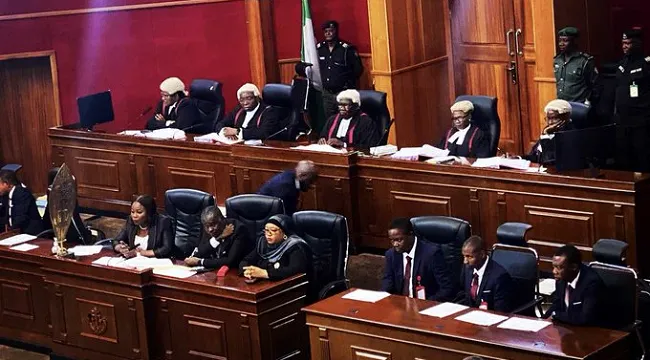
The Presidential Election Petitions Court has provided clarity on the use of electronic transmission of election results, asserting that the Electoral Act 2022 does not mandate it. In a ruling led by Justice Haruna Tsammani on Wednesday, the five-man panel emphasized that the only technological device required for Independent National Electoral Commission (INEC) use is the Bimodal Voter Accreditation System (BVAS). Regarding compliance with the Electoral Act and INEC Regulations and Guidelines, Justice Tsammani stated that there is no indication in the regulations that BVAS must electronically transmit polling unit results. Furthermore, the Tribunal clarified that the commission’s Results Viewing Portal (IReV) is not a collation system. This interpretation aligns with the judgment in the case of Oyetola vs INEC. Justice Tsammani highlighted, “There is no provision for the electronic transmission of election results in the Electoral Act 2022.” He underscored that any such transmission is, at best, optional.
INEC has freedom to determine election results transmission method, Tribunal rules

The Presidential Election Petitions Court issued a significant ruling on Wednesday, affirming the Independent National Electoral Commission’s (INEC) authority to determine the mode of transmitting election results for the presidential election held on February 25, 2023. Led by Justice Haruna Tsammani, the five-member panel referenced Sections 52 and 65 of the Electoral Act 2022 to emphasize INEC’s discretion in prescribing the method of result transmission during the electoral process. In response to a petition filed by the Labour Party (LP) and its presidential candidate, Peter Obi, challenging the victory of President Bola Tinubu from the All Progressives Congress (APC), the Tribunal made several key determinations. The LP and Obi argued for the annulment of President Tinubu’s victory, primarily citing the alleged “failure” of INEC’s Results Viewing Portal (IReV) to electronically upload election results in real-time. Furthermore, the Tribunal addressed the LP and Obi’s objections regarding the allocation of 25 per cent of the votes to Tinubu in the Federal Capital Territory (FCT), asserting that Abuja should be treated no differently than other states. Additionally, the court delved into the matter of Tinubu’s alleged money laundering conviction in the United States, a claim raised by the petitioners. However, the Justice Tsammani panel concluded that the petitioners, Obi and the LP, failed to substantiate their assertions, as no concrete evidence of Tinubu’s criminal arrest or conviction was presented. In essence, this ruling highlights INEC’s authority in determining result transmission methods while addressing and dismissing various allegations and challenges raised by the LP and its presidential candidate in relation to the presidential election of 2023.