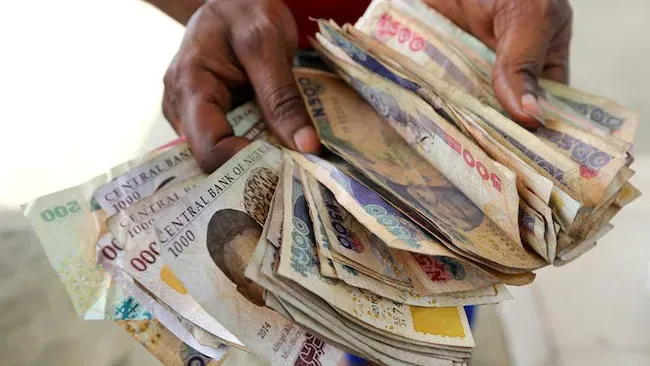
Petrol Price Increased To N630.63 In October -NBS

Petrol Price Increased To N630.63 In October -NBS

The National Bureau of Statistics (NBS), has said that the average retail price of a litre of petrol increased from N195.29 in October 2022 to N630.63 in October 2023. It made the declaration in its Petrol Price Watch for October 2023 released in Abuja on Wednesday. It stated that the October 2023 price of N630.63 represented a 222.92 per cent increase over the price of N195.29 recorded in October 2022. “Comparing the average price value with the previous month of September 2023, the average retail price increased by 0.71 per cent from N626.21. “On state profiles analysis, Zamfara paid the highest average retail price of N659.38 per litre, followed by Gombe and Borno at N658.33 and N657.27, respectively. “Conversely, Lagos, Oyo, and Delta paid the lowest average retail price at N590.95, N592.19 and N599.38 respectively,’’ it stated. Analysis by zones showed that the North-East Zone recorded the highest average retail price in October 2023 at N644.16, while the South-West recorded the lowest price at N616.81 per litre. The NBS also stated in its Diesel Price Watch Report for October 2023 that the average retail price was N1004.98 per litre. It said that the October 2023 price of N801.09 per litre amounted to a 25.45 per cent increase over the N801.09 per litre paid in October 2022. “On a month-on-month basis, the price increased by 12.82 per cent from the N890.80 per litre recorded in September 2023,’’ it added. On state profile analysis, the report said the highest average price of diesel in October 2023 was recorded in Plateau at N1150.00 per litre, followed by Nasarawa at N1138.00 and Benue at N1091.67. On the other hand, the lowest price was recorded in Rivers State at N824.44 per litre followed by Borno at N827.27 and Kebbi State at N845.00 per litre. In addition, the analysis by zones showed that the North-Central had the highest price of N1090.69 per litre, while North- East recorded the lowest price at N947.32 per litre. 

Average Price Of 5kg Cooking Gas Hits 8.89% -NBS

Average Price Of 5kg Cooking Gas Hits 8.89% -NBS

The average retail price for refilling a 5kg Cylinder of Liquefied Petroleum Gas (Cooking Gas) increased by 8.89% on a month-on-month basis from N4,189.96 recorded in September 2023 to N4,562.51 in October 2023. In its Liquefied Petroleum Gas (Cooking Gas) Price Watch (October 2023), the bureau noted that on a year-on-year basis, it increased by 1.76% from N4,483.75 in October 2022. On state profile analysis, Kano recorded the highest average price for refilling a 5kg cylinder cooking gas with N5,181.43, followed by Adamawa with N5,142.86, and Ogun with N5,093.75. On the other hand, Ebonyi recorded the lowest price with N3,971.43, followed by Osun and Edo with N4,000.00 and N4,025.00 respectively. “In addition, analysis by zone showed that the North-West recorded the highest average retail price for refilling a 5kg cylinder cooking gas with N4,738.20, followed by the North-Central with N4,662.62, while the South-East recorded the lowest with N4,088.65. “Also, the average retail price for refilling a 12.5kg cylinder of cooking gas increased by 14.04% on a month-on-month basis from N9,247.40 in September 2023 to N10,545.87 in October 2023. “On a year-on-year basis, this rose by 4.93% from N10,050.53 in October 2022. On state profile analysis, Edo recorded the highest average retail price for the refilling of a 12.5kg cylinder of cooking gas with N12,536.88, followed by Jigawa with N12,050.00 and Delta with N11,987.50. Conversely, the lowest average price was recorded in Zamfara with N9,050.00, followed by Lagos and Oyo with N9,071.05 and N9,407.14 respectively,” the statistics bureau stated. Analysis by zone showed that the South-South recorded the highest average retail price for refilling a 12.5kg cylinder cooking gas with N11,480.60, followed by the North-Central with N10,683.97, while the South-East recorded the lowest price with N9,847.42.

More Proactive Push Needed For Central Bank Digital Currencies – IMF   

More Proactive Push Needed For Central Bank Digital Currencies – IMF   

The head of the International Monetary Fund (IMF) has urged countries to make a more proactive push to develop Central Bank Digital Currencies (CBDCs). Eleven countries, including a number in the Caribbean, and Nigeria, have already launched CBDCs. Around 120 others are exploring them, although progress and approaches differ widely and a few have even abandoned the idea altogether. “We may be at a point where the public sector needs to offer a little more guidance,” IMF Managing Director Kristalina Georgieva said in a speech in Singapore. “Not to crowd out, not to disrupt,” she added. “But to act as a catalyst, to ensure safety and efficiency – and to counter fragmentation.” She made her remarks as the IMF published the first instalment of a “virtual handbook” on CBDCs, designed to help countries with the design and set-up process and ensure that the new technologies are globally interoperable. Supporters say CBDCs will modernise payments with new functionality and provide an alternative to physical cash, which seems in terminal decline. But questions remain as to why they represent an advance when current systems are already capable of many of the proposed benefits, and countries such as Nigeria that have already launched CBDCs are seeing very low uptake among the public. Georgieva said that with technology advancing so rapidly, countries needed to push ahead with development now to avoid getting caught out in future. “If anything, we need to raise another sail to pick up speed,” she said, likening the efforts to a nautical journey. “The world is changing faster than most imagined”.

Nigeria’s Currency Circulation Jumps To N66.4trn -CBN

FAAC: FG, States, LGs Share N906.955bn October Revenue

The Central Bank of Nigeria CBN) has reported that Nigeria’s total money supply (M2) increased to N66.4 trillion in September 2023. The data from the apex bank on money supply in the economy in the month other review comprising demand deposits, quasi-money, and currency outside banks, reflected increases in the components. Specifically, quasi-money, which pertains to financial tools that can be easily converted to cash, rose from N40.8 trillion in the preceding month to N41 trillion; demand deposits, primarily made up of funds in banks accessible without prior notice, moved from N21.7 trillion to N23 trillion while currency outside banks’ vaults marginally increased from N2.29 trillion to N2.3 trillion. Over the past few years, Nigeria’s money supply has been increasing based on the micro and macroeconomic whirlwinds of the economy, particularly the surging inflation rate, FX pressure on the Naira, and declining interest rates. The money supply, also known as M2, represents the total amount of money available in the economy at a particular moment, including physical currency such as coins and banknotes as well as deposits maintained by individuals, enterprises, and institutions in banks and other financial entities. However, the nation’s Net Foreign Assets dipped in September from N7.1 trillion to just N591 billion while Net Domestic Assets rose to N66.5 trillion from N58.3 trillion. A further analysis of the M2 trend during the month under review showed that the net domestic credit rose from N87.2 trillion to N92.7 trillion, thereby raising the net domestic credit to GDP by around 42.7 per cent. The breakdown of the net domestic credit indicated that credit to the government marginally increased to N34.1 trillion from N32.5 trillion while credit to the organized private sector surged from N54.7 trillion in the preceding month to N58.6 trillion, representing 63% of net domestic credit.

Average Price Of 5kg Cooking Gas Stood At N4,189.96 In September – NBS

Average Price Of 5kg Cooking Gas Hits 8.89% -NBS

The National Bureau of Statistics (NBS) has said the average price of 5kg of cooking gas increased from N4,115.32 recorded in August 2023 to N4,189.96 in September 2023. This is contained in the Bureau’s “Cooking Gas Price Watch’’ for September 2023 released on Thursday in Abuja. The report said the September 2023 price represented a 1.81 per cent increase, compared to what was obtained in August 2023. However, the average price of 5kg of cooking gas decreased on a year-on-year basis by 6.36 per cent from N4,474.48 recorded in September 2022 to N4,189.96 in September 2023. On state profile analysis, the report showed that Kwara recorded the highest average price at N4,866.60 for 5kg cooking gas, followed by Benue at N4,789.26, and Adamawa at N4,785.71. It said on the other hand, Ondo State  recorded the lowest price at N3,364.62, followed by Ekiti and Edo at N3,450.06 and N3,626.17, respectively. Analysis by zone showed that the North-Central recorded the highest average retail price at N4,555.95, followed by the North-West at N4,394.40. “The South-East recorded the lowest average retail price at N3,809.22,” the NBS said. Also, the NBS said the average retail price for refilling a 12.5kg cooking gas increased by 0.58 per cent on a month-on-month basis from N9,194.41 in August 2023 to N9,247.40 in September 2023. However, the report said average retail price for 12.5kg cooking gas fell by 6.65 per cent on a month-on-month basis, from N9,906.44 recorded in September 2022 to N9,247.40 in September 2023. State profile analysis showed that Cross River recorded the highest average retail price of N10,203.13 for 12.5kg cooking gas, followed by Ogun at N9,967.11 and Nasarawa State at N9,950.15 On the other hand, the report showed that the lowest average price for 12.5kg of cooking gas was recorded in Adamawa at N7,604.29, followed by Borno and Gombe State N8,113.69 and N8,188.75, respectively. Analysis by zone showed that the South-South recorded the highest average retail price for refilling a 12.5kg cooking gas at N9,613.55, followed by the South-East at N9,393.69. The report said the North-East recorded the lowest price at N8,683.62. Similarly, the average retail price per litre of kerosene rose to NN1,299.03 in September 2023 on a month-on-month basis, showing an increase of 2.09 per cent, compared to N1,272.40 recorded in August 2023. According to its National Kerosene Price Watch for September 2023, on a year-on-year basis, the average retail price per litre of kerosene rose by 37.13 per cent from N947.30 in September 2022. On state profile analysis, the report showed that Adamawa recorded the highest average price at N1,746.05 per litre of kerosene in September 2023, followed by Cross-River at N1,541.67 and FCT-Abuja at N1,492.50. “On the other hand, the lowest price was recorded in Jigawa at N1,104.78, followed by Enugu State at N1,134.52 and Kano State at N1,142.27.” The NBS said the analysis further showed that the North-East recorded the highest average retail price per litre of Kerosene at N1,390.67, followed by the South-East at N1,368.49. It said the North-West recorded the lowest average retail price per litre of kerosene at N1,190.81. The report said the average retail price per gallon of Kerosene paid by consumers in September 2023 was N4,379.31, indicating a 0.64 per cent increase from N4,351.53 recorded in August 2023. “On a year-on-year basis, the average price per gallon of kerosene increased by 35.32 per cent from N3,236.27 recorded in September 2022. On state profile analysis, it showed that Lagos State recorded the highest average retail price at N5,350.00 per gallon of kerosene, followed by Katsina State at N5,000.00 and Borno at N4,997.47. On the other hand, the report said Delta recorded the lowest price at N2,956.18, followed by Rivers and Oyo at N3,296.02 and N3,712.50, respectively. Analysis by zone showed that the North-East recorded the highest average price per gallon of Kerosene at N4,712.01, followed by the South-East at N4,646.63. The report said the South-South recorded the lowest average price per gallon of Kerosene at N3,769.59. 

Inflation Rate Climbs To 26.72% In September -NBS

Inflation Rate Climbs To 26.72% In September -NBS

In September 2023, the headline inflation rate increased to 26.72% relative to the August 2023 headline inflation rate which was 25.80%, the National Bureau of Statistics has said.  In it’s CPI and Inflation Report for September, released Monday in Abuja, the bureau said the rates showed a showed an increase of 0.92% points when compared to the August 2023 headline inflation rate.  On a year-on-year basis, the headline inflation rate was 5.94% points higher compared to the rate recorded in September 2022, which was 20.77%. This shows that the headline inflation rate (year-on-year basis) increased in September 2023 when compared to the same month in the preceding year (i.e., September 2022). Furthermore, on a month-on-month basis, the headline inflation rate in September 2023 was 2.10%, which was 1.08% lower than the rate recorded in August 2023 (3.18%).  This means that in September 2023, the rate of increase in the average price level was less than the rate of increase in the average price level in August 2023. 

Nigeria’s Q2 Capital Importation Decreases By 32.9% – NBS

Nigeria’s Q2 Capital Importation Decreases By 32.9% - NBS

In the second quarter of 2023, total capital importation into Nigeria stood at $1,030.21 billion, lower than $1,535.35 billion recorded in the second quarter, indicating a decrease of 32.90 per cent, the National Bureau of Statistics (NBS), has said. The bureau noted in its Nigeria Capital Importation Q2 2023, when compared to the preceding quarter, capital importation fell by 9.04 per cent from $1,132.65 billion in Q1 2023. The statistics agency stated that Other Investment ranked top accounting for 81.28 per cent ($837.34 million) of total capital importation in Q2 2023, followed by Portfolio Investment with 10.37 per cent ($106.85 million) and Foreign Direct Investment (FDI) with 8.35 per cent ($86.03 million). “The production sector recorded the highest inflow with $605.04 million, representing 58.73 per cent of total capital imported in Q2 2023, followed by the banking sector, valued at $194.58 million (18.89%), and Shares with $68.63 million (6.66%). “Capital importation during the reference period originated largely from the United States with $271.92 million, accounting for 26.39 per cent, followed by Singapore and the Republic of South Africa with $177.44 million (17.22%) and $136.95 million (13.29%) respectively. “Lagos state remained the top destination in Q2 2023 with $778.06 million, accounting for 75.52 per cent of total capital, followed by Abuja (FCT), with $194.28 million (18.86%). “First Bank of Nigeria Limited received the highest capital into Nigeria in Q2 2023 with $323.13 million (18.23%), followed by Citibank Nigeria Limited with $187.77 million (12.23%) and Rand Merchant Bank with $126.03 (6.47%), the bureau said.  

FG’s Fiscal Deficit To Further Decline In Q3, Q4 -MPC

CBN Shifts Monetary Policy Committee Meeting

Some members of the Monetary Policy Committee (MPC) of the Central Bank of Nigeria (CBN) have projected that the federal government’s fiscal deficit will continue to decline in the third and fourth quarters of 2023. Their projections are predicated on the recent efforts by the government to manage expenditures better and also improve oil and non-oil revenues.  Their prediction contained in their various personal statements during the last MPC meeting, as posted on the CBN website.                In his personal statement, the Permanent Secretary, the Federal Ministry of Finance, Budget, and National Planning, Aliyu Ahmed, said: “The fiscal deficit is expected to decline in the third and fourth quarters of 2023 on the back of recent efforts by the new government to manage expenditures better and also improve oil and non-oil revenues. “With expenditure reprioritization and fiscal wisdom at both the federal and state levels, there is an expectation that the government debt ratio may fall at least marginally by the end of 2023.  “Speaking on the fiscal sector, Adenikinju Adeola, a member, explained that both government revenue and expenditure underperformed between January and May 2023. He explained that the Federal Government’s retained revenue stood at N1.67 trillion, lower than the pro-rata target of N1.96 trillion due to the underperformance of Federation Account Allocation Committee (FAAC) receipts and gross independent revenue.       However, on the positive side, he stated: “Total FGN expenditure as of May 2023 was N4.76 trillion, 27.8 percent lower than the budget estimate of N6.606 trillion. The shortfall came mainly from allocations for debt service, interest on Ways and Means, and capital expenditure. “Overall budget deficit reduced by -18.15 percent in the first five months of 2023.   “The underperformance of the budget is especially felt in the capital expenditures, thus impacting negatively on economic development”, he added.  On his part, another member, Obadan Mike, noted that although the new government is making serious efforts to boost revenue generation, fiscal deficits and associated public debt accumulation will continue to elicit deep concerns.      Meanwhile, the MPC members also called for a review of border closures to increase food supply in the country while expressing concern about the decline in growth of the agricultural sector in the first quarter of 2023.                                                            Adenikinju said, “The continuous closure of the borders should also be reviewed. This is to expand food and non-food supply to the economy and force down domestic prices, especially food.  Also expressing concern about the declining growth in the agricultural sector, Ahmed said: “The decline in growth in the agriculture sector is particularly worrisome, given its role in food production and employment generation.    “Targeted intervention by the fiscal and monetary authorities in the agriculture sector is crucial to ensuring medium- to long-term food security and price moderation. The recent initiative by the CBN to offload grains from the national strategic grain reserves to lower food prices could not have come at a more auspicious time. “There is also a need to leverage the African Development Bank (AfDB) Agro Pocket Wallet to support farmers in the production of grains and fertilizers.”

Dollar index decreases by 1.6% in July – OPEC

LCs’ Rejection Pushes Nigerian Businesses To Black Market

The Organisation of the Petroleum Exporting Countries (OPEC) has said the U.S. dollar index decreased by 1.6 per cent month-on-month (m-o-m) in July, erasing gains from the previous period. The dollar index rose for the second consecutive month in June, increasing marginally by 0.3 per cent m-o-m. OPEC said this in its Monthly Oil Market Report at the weekend. The report, while stating the impact of the dollar and inflation on oil prices, said the dollar receded, although the Federal Reserve hiked interest rates by 25 basis points (bp) in July. This, it said, underscored a shift in risk sentiment as investors’ global macroeconomic outlook improved, and financial markets wagered that the U.S. economy would avoid recession. According to the OPEC report, Year-on-Year (Y-o-Y), the index was down by 5.2 per cent. The OPEC report said the dollar experienced mixed movement against major developed market currencies for a second consecutive month in July. It said it recovered against the euro by 2.2 per cent m-o-m, but receded against the yen and the pound by 0.2 per cent and 2.2 per cent, respectively, over the same period. It said Y-o-Y, the dollar was up by 8.9 per cent and 3.0 per cent against the euro and yen, respectively; however, it was down by 7.1 per cent against the pound over the same period. “In terms of emerging market currencies, the dollar declined for a second consecutive month in July against the rupee and the Brazilian real by 0.1 per cent and 1.1 per cent respectively, m-o-m. “Meanwhile, it advanced against the yuan for a second consecutive month by 0.3 per cent m-o-m,” the oil market report said. It said Y-o-Y, the dollar was up by 3.2 per cent and 6.7 per cent against the rupee and yuan, respectively; however, it was down by 10.6 per cent against the real over the same period. It said the differential between nominal and real OPEC Reference Basket (ORB) prices widened m-o-m. It said inflation (nominal price minus real price) went from negative 1.78 dollars per barrel in June to negative 3.11 dollars per barrel in July, a 76.7 per cent increase m-o-m. It further stated that in nominal terms, accounting for inflation, the ORB price went from 75.19 per cent per barrel in June to 81.06 per barrel in July, a 7.8 per cent increase m-o-m. It added that Y-o-Y, the ORB was down by 25.3 per cent in nominal terms. In real terms (excluding inflation), it said the ORB went from 76.95 dollars per barrel  in June to 84.17 dollars per barrel in July, a 9.4 per cent increase m-o-m. “Y-o-y, the ORB was down by 24.4 per cent in real terms,” it said. 

Naira drops to new low of N923-950 per dollar

Supreme Court Affirms Old, New Naira Notes As Legal Tender 

The naira extended its slump in black-market trading as the nation’s dollar shortage deepened two months after the central bank moved to a more flexible exchange rate to encourage inflows. The naira weakened to N923 per dollar, compared with N917 on Wednesday.   Traders in Lagos said it worsened to an all-time low of N950 to one dollar at the parallel market on Thursday afternoon as against the N897 it traded at the previous day. At the official window, data showed that the naira closed at N782.38 per $1. The disparity is now N167.62/$1 one of the widest since the unification of the naira on June 14th, 2023. Banks have been unable to come up with the dollars to meet demand, and buyers are increasingly turning to the black market, widening the gap between the official exchange rate and the price on the street. On Tuesday, the naira plunged to a record low of N900/$1 on the parallel market on Tuesday, August 8, 2023, as demand for foreign currency outstripped supply with traders quoting the exchange rate as high as N900/$1 for “inflows” and N895/$1 for cash trades. The peer-to-peer market, where crypto-currency traders exchange forex, also saw the exchange rate soar above N900/$1. Meanwhile, in the official Investor and Exporter Window, the exchange rate closed at N774.78/$1 while the NAFEX rate was N776. The official market also faces supply constraints, with daily turnover averaging $80 million since July. Forex traders who attributed the depreciation of the naira to a scarcity of supply, said that there were more buyers than sellers in the market and that the situation was unlikely to improve anytime soon. When asked about the source of the increased demand, traders mentioned a diverse set of buyers, including importers, foreign travelers, and speculators. There are concerns among some traders that the state of depreciation is unlikely to improve as demand continues to rise unchecked. Forex analysts explained that there was a huge backlog of unmet forex demand in the official market, estimated at $8-10 billion. Some of this demand also spills over to the parallel market, as buyers struggle to find enough supply to meet their needs in the official market. The exchange rate between the naira and dollar has weakened by 16 per cent since the reunification of the exchange rate windows. This compares to a depreciation of 2.5 per cent between January 1 and June 14th. The exchange rate weakened by 22.9 per cent in the whole of 2022. The naira has been under pressure in the parallel market for several weeks, as the supply of forex from official sources remains inadequate. On July 1st, the beginning of the second half of the year, the exchange rate in the parallel market was around N772/$1. However, a surge in demand from various segments of the economy, such as importers, foreign travelers and speculators, has triggered exchange rate volatility.