Umahi stops payments to South East road contractors

The Minister of Works, Dave Umahi has stopped some road construction in the South East pending the review of the existing and additional contracts. Umahi gave the directive on Thursday in Enugu during the inspection of some ongoing construction/rehabilitation of federal roads across states in the South-East. The minister expressed dismay that four bridges and three kilometres of additional work were costing N15 billion. “I have directed directors in the ministry to sit with the contractors and review it. “I strongly believe that there is no way that the project will cost us more than three to four billion naira, and when a project is too expensive, and the budgeting process is very low, then contractors will remain on site for 10 to 15 years,” he said. Some of the roads inspected included the Ozalla- Akpugo-Amangunze-Isu Onicha (Enugu-Onitsha) with a spur to Onunwere in Enugu State done by Arab Contractors and rehabilitation of Old Enugu- Onitsha Road also done by Arab Contractors. Others were the construction of the Nenwe-Nomeh-Mburubu -Nara Road with a spur from Obeagu-Oduma road, Enugu State, Rehabilitation of Nsukka -Ikem, Eha Amufu – Nkalagu in Ebonyi State among others. Umahi commended the quality of work done on some of the roads in Enugu, adding that he stopped certain payments until contractors, and the ministry reviewed the existing contracts and additional works. The former Ebonyi governor said he stopped payment of RCC and Arab Contractors until they all sit down to review the cost of the projects and methods of construction. He also said because of funding he had directed works on spots should come in the second phase to enable contractors to complete carriage ways first. He equally directed the contractor handling the Mmaku road seven days to return to the site to cover the binder course. He also directed that the right-hand side of the Enugu-Onitsha expressway be done with concrete to save costs. “I discovered something unprofessional where contractors put a binder course and leave it up to five to eight years, and within that period, the binder course fails. “Henceforth, no contractor will leave the binder course for more than one month without covering it because the binder course admits water which affects subgrade. “It is not healthy for contractors as they lose money for the equipment they are using to maintain the work,” he said. The binder course is an intermediate, bitumen-bound aggregate layer placed between the base layer and the surface of an asphalt pavement. The minister explained that Nigerian roads failed because of the bad asphalt placed on them as a result of adulterated bitumen imported into the country. According to him, most of our roads are not failing because of sub-base or subgrade but fail because of bad asphalt placed on them. “So the fight of turning to concrete is a continuous one, and we will not give up until our roads are able to last up to 30 years to 40 years without maintenance when built. “At Enugu section three to Port Harcourt section 3, I have also directed that the second carriage be totally done on concrete as we are safer with concrete in southeast roads,” he said. To buttress his point on the concrete road, Umahi, who took newsmen to Nigercem – the first cement factory in Nigeria, said the factory road built in 1950 with concrete was still stable as well as other roads in Nkalagu built with concrete seven years ago. “This is what we are advocating and basically, South East, South-South, and South-West roads shall be on concrete because of their terrain,” he said.
Crude production plunges to 1.22mbpd in Q2 2023 -Report

Hope for increased crude oil production deemed with second quarter figures plunging to 1.22 million barrel per day (mbpd), Nigeria’s statistics bureau, has said. The decrease is coming in spite of the restoration of fragile peace in the Nigeria Delta region; the second quarter of 2023 recorded an average daily oil production of 1.22 million barrels per day (mbpd). This according to the Nigerian Bureau of Statistics (NBS) was much lower than the daily average production of 1.43mbpd recorded in the same quarter of 2022 by 0.22mbpd and lower than the first quarter of 2023 production volume of 1.51 mbpd by 0.29mbpd. The real growth of the oil sector was 13.43 per cent (year-on-year) in the second quarter of 2023, indicating a decrease of 1.66 per cent points relative to the rate recorded in the corresponding quarter of 2022 (-11.77 per cent). Growth also decreased by 9.22 per cent points when compared to the first quarter of 2023 which was –4.21 per cent. On a quarter-on-quarter basis, the oil sector recorded a growth rate of -14.12 per cent in the second quarter of 2023 and contributed 5.34 per cent to the total real Gross Domestic Product (GDP) in the second quarter of 2023, down from the figure recorded in the corresponding period of 2022 and down from the preceding quarter, where it contributed 6.33 per cent and 6.21 per cent respectively. The statistics bureau further said the non-oil sector grew by 3.58 per cent in real terms during the reference quarter (Q2 2023). This rate was lower by 1.19 per cent points compared to the rate recorded in the same quarter of 2022 and 0.81 per cent.
Much ado about BRIC as threat to America’s global economic dominance

No question, powers rise and fall. It is the immutable law of nature and of geopolitics. The US has dominated the globe both in the economic, military and geopolitical spheres for over half a century and beyond, frankly since the end of the Second World War. Hence, this is often described as the US century. So, it is natural for any nation that has been on top for such a long time to expect emerging powers to challenge it. So, the ongoing realignment of the globe’s economic and geopolitical power structure is to be expected. However, any boxer who has faced a dominant, undefeated super heavyweight champion of the world knows it is much easier to talk about dethroning him than actually doing it. So, when you see and hear all the hyperventilation about the decline of the US and how its dethronement is imminent, take it with more than a pinch of salt. The US is not sitting on its rear end waiting for someone to walk up and take the championship belt from it. Whoever wants the crown would have to do better that the iconic Zaire Kinshasa rumble in the jungle bout to get it. So, when you see a half-baked, amateurish, voice-over, outlandish, really hogwash of a video reporting China suspending all trade with the U.S., you need to put your thinking cap on. It is so outlandish and an obvious no-brainer hogwash, that it is so shocking that anyone will share that video. Anyway, no surprises here. Almost anything, including the master of all absurdities, gets shared on Nigerian social media, including a platform like the “Great Minds” populated by the cream de la cream of Nigerian intellectuals and movers and shakers of society. We have already entered the phase of the diminution and override of the human neural cells by AI. We are so bombarded with information overkill to the point that we are slowly losing our ability to conduct nuance and critical analysis of information. Otherwise, why would anyone share a video that announced with fanfare and so authoritatively that China has officially cut off all trade with the US!!!? For China to do that will be akin to a man cutting off his trachea to stop the passage of inspired and expired air into and out his lungs. Does that even pass the laugh test? Yet people are mindlessly sharing that video on Nigeria social media predicting a global economic earthquake. China is an export dependent economy while the U.S. is a consumption-based economy (the consumer confidence index is a great indicator of US’s economic health). China economy will crumble like a house of cards without demand from the West, especially the U.S. for its manufactured goods. Yes, the exploding Chinese middle class and super rich is changing its economy to a more mature consumption and service driven economy, but it still depends on exports for its sustenance. So, this ridiculous post about China suspending trade with US and how BRIC is a threat to a dollarized global economy in the near term, reveals an abject misreading and lack of knowledge of how the global economy operates. While China and Russia might want to use BRIC as a counterbalance and in fact, anti-U.S. body in their geopolitical struggle with the U.S., India and Brazil have a different objective. Brazil is in the orbit of the North and South America economic zone. India is trying to decouple its military from its reliance on Russia for her military equipment. Who would blame them after what the world has now seen about the incompetence weakness of Russia’s military industrial capacity and its military? Russia’s overblown and oversold military is depending on Iran made drones and missile from North Korea in its disastrous war against Ukraine. India is a rising global power. It just landed its spacecraft on the moon, the first country to do so on the more challenging moon’s southern hemisphere. Juxtapose that against Russia’s space mission to the moon which just failed spectacularly. Global policy analysis requires nuanced and critical analysis than simply sharing alarmist, half baked propaganda of an economic earthquake. The US, because of the dynamism of its economy, and its leadership as the innovation heartbeats of the globe’s economy, will continue to remain a major, albeit diminished force in the globe economy as new power centres emerge. India is the country to watch. It also has territorial dispute with China. The Indian diaspora is also deeply entrenched and connected to the U.S. with high profile Indians in both the political and more so in the economic domain. Anyone who is hoping India will align with China or Russia in opposition to the West should look at who is the current occupant of No 10 Downing Street, the residence of the UK Prime Minister. In case we have forgotten, Rishi Sunak is a full-blooded British-Indian. About the Author: A current affairs analyst, Prof. Wale Alonge is a university Don and Head, Africa-Diaspora Partnership for Empowerment and Development (ADPED) based in Miami, Florida.
Subsidy Removal: Extend palliatives to all industries, NACCIMA appeals to FG

The Nigerian Association of Chambers of Commerce Industry, Mines and Agriculture (NACCIMA) has appealed to the Federal Government to extend palliatives to all productive industries to cushion the effects of the removal of fuel subsidy. Its National President, Otunba Dele Oye, made the appeal at the 3rd Quarterly Council meeting of the association in Abuja. The Federal Government had announced N5 billion palliative for each state of the federation, including the Federal Capital Territory to ameliorate the rise cost of living arising from the removal of the petrol subsidy. Oye said that the removal of petrol subsidy was not only affecting consumers but also the productive industries. According to him, the removal of the petrol subsidy and the floating of the Naira currency have in one way or the other affected industries. “These affected both consumers and industries because every new policy has its own casualties. “So, in the long term, it is good for the country, but in the short term, you have to consider people who are wrongly affected so that the prices do not cause unusual inflation. “It is important that the government ensures that the palliatives also go to the industries,’’ Oye said. He added that it would take time for businesses to adjust to the new policy of Naira floating. “The short term is always a bit difficult for a lot of people, because it takes time to adjust for businesses to get to know the new policy and also to work with it.” NACCIMA boss said that providing loans at a single digit rate could provide certain cushioning effects to industries affected in the short term. “This is because it is from us we generate the money from the tax to sustain the economy. “So, government must focus and find a way to make sure that the palliative goes to every sector,’’ he said. In his remarks, Dr Al-Mujtaba Abubakar, President, Abuja Chamber of Commerce and Industry (ACCI) said that the business community also needed incentives to cushion the effects of the fuel subsidy removal and the depreciation of the Naira. Abubakar, who was represented by the Director-General of ACCI, Victoria Akai, also emphasised the need for stable power supply and harmonisation of tax to enable businesses thrive. According to him, the business community is in dire need of incentives that will cushion the effect of the fuel subsidy removal and the depreciation of the Naira. He urged NACCIMA president to liaise with relevant government agencies to press home the association’s demands such as stable power supply and harmonisation of tax among others. “I will like to commend the determination of the NACCIMA President to further deepen the relationship of NACCIMA and policymakers which I believe will go a long way to bring the much-needed relief to the business community,’’ Abubakar said.
World Bank puts Nigeria’s GDP at $477.4bn in 2022

A new report by the World Bank Group showed that Nigeria’s recorded an estimated Gross Domestic Product of $477.4 billion in 2022. The report showed that the country ranks 18th position on the continental ranking of countries by GDP per capita for 2022. The 2022 ranking showed that Nigeria notched one point up from the 19th position it ranked in the previous year when the GDP stood at $440.8 billion. According to the World Bank’s latest data, Nigeria recorded a 5.7 per cent increase in its GDP per capita, which rose to $2,184 in 2022, from the $2,066 reported in the preceding year. In terms of nominal GDP, the country’s economic performance demonstrated remarkable resilience, registering an 8.3% nominal year-over-year expansion in 2022, in spite of the whirlwinds across the global and regional economy. Broadly analyzed, the World Bank’s report showed that the African economy slowed to 3.8% in 2022, dipping the continent’s nominal GDP to an estimated $2.75 trillion. In addition, the report Indicated that the Sub-Saharan region recorded a slow growth rate of 3.6%, in contrast to 4.1% recorded in 2021, with a projected growth rate of 3.1% in 2023, due to what the bank attributed to sluggish global economic growth, high inflationary pressure, and tough financial conditions exacerbated by the high debt profiles of the countries in the continent. A further analysis of the report in terms of GDP per capita, which is a more accurate measure of productivity in an economy, the continent’s economy recorded an average of $2,705 in 2022, indicating a 6.6% increase compared to $2,538 recorded in the previous year. The report further covered the top 10 countries in Africa based on GDP per capita in 2022 with Seychelles topping the ranking table with an impressive GDP per capita standing at $15,875, followed by Mauritius, which recorded a 12.7% upswing in its GDP per capita, which climbed to $10,216; and Gabon which came third with 2.1% increase in its GDP per capita to $8,820 in 2022. Others are in order of ranking, Botswana which came fourth, boasting an average GDP per capita of $7,738; Equatorial Guinea with a GDP per capita of $7,053 in 2022, representing a 6% decline compared to $7,507 in 2021; the 6th position in ranking was South Africa at $6,776 GDP per capita; Libya at number 7th with $6,716 GDP per capita; Namibia ranked 8th with $4,911 GDP per capita; Egypt followed with $4,295; and Algeria came 10th with $4,274 GDP per capita in 2022.
FG raises N4.46trn bonds in 8 months

The Federal Government raised the sum of N4.46 trillion from the bond market in the last eight months. The result is that the interest rate on 30-year FGN bonds increased to 15.85 per cent in August 2023 from 14.3 percent in July 2023. The Debt Management Office (DMO) received N5.42 trillion total subscriptions as against N2.88 trillion offered during the period amid monetary policy tightening by the Central Bank of Nigeria (CBN) and global uncertainties. An analysis of the bond market activity during the period revealed that FGN bonds recorded 53 percent oversubscription as interest rates continued on a steady trajectory. The DMO has conducted four auctions in 2023, which were oversubscribed despite a hike in inflation rate and investors’ diversification into the stock market. While the information on the buyers of corporate bonds are publicly disclosed, other publicly available reports indicate Pension Fund Administrators (PFA), asset managers, banks, and institutional/foreign investors are among the largest buyers of FGN Bonds. The auction results released by DMO indicate strong investors’ demand for FGN bonds, as the total amount allotted exceeded the total amount offered. It also suggests investor confidence in the Nigerian economy and the ability of the government to meet its debt obligations. A breakdown showed that in the first quarter (of 2023, total subscription to FGN bonds stood at N2.61trillion while the DMO allotted N1.996 trillion out of the N1.080 trillion offered to the investing public. In the second quarter of 2023, investors were also offered N1.080 trillion FGN bonds; it witnessed N2.503 trillion subscriptions. The DMO eventually allotted N2.23trillion. However, a July 2023 auction revealed that subscriptions stood at N945.14billion as against the N360 billion offered. The DMO allotted N657.84 billion. At the just concluded FGN bond auction in August, the four instruments were 14.55 per cent April 2029 FGN bond; 14.70 per cent June 2033 FGN bond; 15.45 per cent June 2038 FGN bond; and 15.70 per cent June 2053 FGN bond. They were valued at N90 billion each, making a total offer of N360 billion. In spite of current market conditions, the auction received a total subscription of N312.56 billion and amount allotted to successful bidders for the four instruments was N230.26 billion. Investors’ appetite for the 15.70 June 2053 (30-year bond) remained strong, with a bid-to-cover ratio of 2.71 times. Allotments were made at 13.85 per cent for the 14.55 per cent April 2029 instrument and 15.00 per cent for the 14.70 per cent June 2033 instrument. Also, “15.20 per cent was for the 15.45 per cent June 2038 instrument and 15.85 per cent for the 15.70 per cent June 2053 instrument,” the DMO said. The federal government had proposed to borrow over N11 trillion to finance the proposed 2023 budget deficit. Findings by Economic Confidential revealed that FGN Bonds auctioned were re-openings with rates below the inflation rate. The debt office in 2023 maintained four tenor bond auctions between January and June and each FGN bond offer was oversubscribed. Meanwhile, finance experts have attributed the strong demand for FGN bonds to attractive yields, which offer investors high returns on their investments. They added that the oversubscription also revealed that investors have confidence in the government’s ability to meet its debt obligations. The appetite for FGN bonds indicates that PFAs, and Nigerian investors prefer investment instruments with less volatility that assures them of their capital returns albeit with low yield on investment. But, in recent years, Nigeria’s rising debt profile has been a topic of concern, as Vice President, Highcap Securities Limited, Mr. David Adnori warned that the country’s debt levels are unsustainable. DMO stated in January that Nigeria’s public debt could rise to N77 trillion if the country’s “ways and means” are securitized. “Ways and means” refer to the CBN’s lending to the federal government. The DMO said that the securitization of ways and means” is not unusual and is a common practice in many countries, but it is not a decision that can be made by the DMO alone. Adnori expressed concerns that Nigeria’s rising debt levels could become unsustainable if not managed properly. The government has argued that borrowing is necessary to finance critical infrastructure projects and stimulate economic growth. The Chief Executive Officer of the Centre for the Promotion of Private Enterprise, Dr Muda Yusuf, said the FG had notified the general public of borrowing more in 2023. According to him, “With all the volatility and foreign exchange issues, it makes sense to borrow at the domestic market rather than borrowing from the international market. It is all a reflection of our macro economy environment challenges and weak fiscal policy of the government. All this borrowing also is a reflection of the weak financial position of the government and it will continue like that.” He noted that the oversubscription to FGN bond is a lucrative investment, stressing that the low risk involved attracted investors. He added, “Anything sovereign has the lowest risk and nothing will go wrong with it except the country is collapsing completely. All over the world, sovereign bonds have the lowest risk and secondly it is an investment outlet for investors to invest their money.” On his part, the Chief operating officer of InvestData Consulting Limited, Mr. Ambrose Omordion, said, “We know that previous government borrowing was high. Excessive borrowing by the previous government at the expense of the private sector, which is the engine room of the economy, brings to question the soundness of their economic strategy. “The careless use of debt as a financing tool is fraught with calamitous dangers. Even more disheartening is when the debts are principally used to finance consumption or to unwisely finance a few secondary infrastructures (Roads and Rail). “These will neither enhance the productive momentum of Nigeria’s light industries nor make the economy self-reliant. The disorderly growth of the economy the last administration pursued can only mislead the country into an abyss if public borrowing is not curtailed to lower cost of funds so that production will be competitive.”
Tinubu, CBN, and Nigeria’s economy

The resurgence of the Gestapo era last witnessed during General Sani Abacha’s jackboot regime is gradually staging a comeback in our democratic dispensation. Nigeria witnessed the abrasive invasion of the National Assembly by the Nigerian secret police, the Department of State Security Service (DSS), under former President Muhammadu Buhari. The President though was not in the saddle at the time, was away on medical treatment abroad. His Vice President, who acted as the President, Professor Yemi Osinbajo held sway. The Vice President didn’t blink an eyelid sacking the Director General of the agency, Lawal Daura, for the assault, and desecration of the symbol of democracy. The vice president considered the incident a misnomer that should not be allowed to fester. The northern political elite never forgave Osinbajo for that singular action. Their oligarchical chauvinism made sure Osinbajo never acted in presidential capacity till the regime timed out. Power was no longer transmitted to him even when the president was on official or medical trips. July 25, 2023, reenacted the ugly DNA of the DSS. The agency had arraigned Godwin Emefiele, the suspended governor of the Central Bank of Nigeria, in a high court in Lagos, accused of illegal possession of firearms and ammunition by the Federal Government. Recall that the DSS in November/December 2022 had declared Godwin Emefiele wanted for terrorism sponsorship. The hide and seek game came to a temporary halt after the DSS withdrew their operatives from the security details of the governor, making him vulnerable, but the former Chief of Defence Staff, General Lucky Irabor, provided him a succour, replacing his security details with military personnel. We all know it was just a temporary reprieve as those who wanted their pound of flesh of Emefiele were waiting. About a week ago, a court of competent jurisdiction ruled and ordered the DSS to either arraign Emefiele or release him from their detention. Emefiele until his arraignment has been incarcerated for 36 days. The agency, a few hours after the court order, announced that Godwin Emefiele has been charged to court. However, on the day of arraignment, the DSS threw decency to the winds, engaging a sister agency in supremacy. It was not only deplorable, but condemnable. The judge had ruled and committed Godwin Emefiele to bail of N20m and one surety with landed property within the jurisdiction of the court. The judge also ordered that Emefiele be kept in the custody of the Correctional Service pending when the accused will perfect his bail. The DSS opposed that, claiming to have been directed by ‘orders from the above’ to take Emefiele back into custody. Correctional Service personnel were disallowed from carrying out the court order, as the squadron leader of the Correctional operatives was forcefully rough-handled. It took the directive of the Comptroller General of the Service who ordered his operatives to stand down and leave the court premises to bring a semblance of sanity after securing Emefiele. The charges against Emefiele are purely civil which does not warrant the show of force and shame exhibited by the DSS. Many non-state actors have been seen brazenly brandishing sophisticated weapons, but none has been seen treated as Emefiele. This is not defending Godwin Emefiele for whatever allegation brought against him, but the treatment meted out to a public officer of his stature, who has meritoriously served his country is unbefitting. Is Godwin Emefiele’s sins more than a pistol and 123 rounds of ammunition found in his house? Are these exhibits enough to make him a terrorist or a sponsor of terrorism? Godwin Emefiele may have erred while doing his tenure at the CBN, but the treatment being meted out to him does not justify the weight of the allegation. It is also obvious that some politicians have sworn not to forgive Emefiele and are bent on destroying him. From the bestial behavior of the DSS operatives, it was obvious that Emefiele had been marked for destruction for daring to redesign the Naira at the onset of the 2022/23 political campaigns. President Bola Tinubu while campaigning had cried foul, accusing the suspended CBN governor of targeting him for failure with the redesign. He never hid his disdain for Emefiele’s actions. Peradventure Godwin Emefiele had not dabbled into politics, would President Tinubu have felt that way? But the President on every occasion labeled the CBN as a mess under the suspended governor. He alleged Emefiele had perpetrated arbitrage and rent-seeking. It was therefore obvious; he would not work with Emefiele. Godwin Emefiele too may have probably resigned, knowing that the political class, particularly President Tinubu, viewed his Naira redesign policy as a vendetta against his frustrated political ambition, thus it is now their time to take their pound of flesh. He should have resigned immediately when President Tinubu won the election. Whether his resignation would have been honoured or not is another debate altogether. The political class should have exercised restraint considering the economic implication of what Emefiele symbolises, the CBN. How would the international investing community see us – disobedient to court rules? A CBN governor humiliated because of petty political miscalculation or skirmish? Yet, we are a nation hungrily looking for investors. The economy is on its knees, the Naira is battered, and insecurity is devouring us. Emefiele’s intransigence is inconsequential to the barrage of challenges facing the nation. President Tinubu who is acclaimed to possess a large political heart of forgiveness should thread softly about Godwin Emefiele. He promised renewed hope, and to rule Nigeria with the rule of law. The Incident at the Lagos High court was barbaric, anti-rule of law, and despotic. President Tinubu’s golden silence while the drama lasted is suspect, belying his promise. His silence affirms the saying going around now: ‘Baba so pe’, meaning Baba said so. The economy is troubled, citizens are agonised by his economic reforms. Assuaging and giving Nigerians comfort should be his paramount desire, not missteps of an individual. The show of shame by the DSS operatives, witnessed globally,
Subsidy Removal: Tinubu to release N200bn to rice, cassava farmers

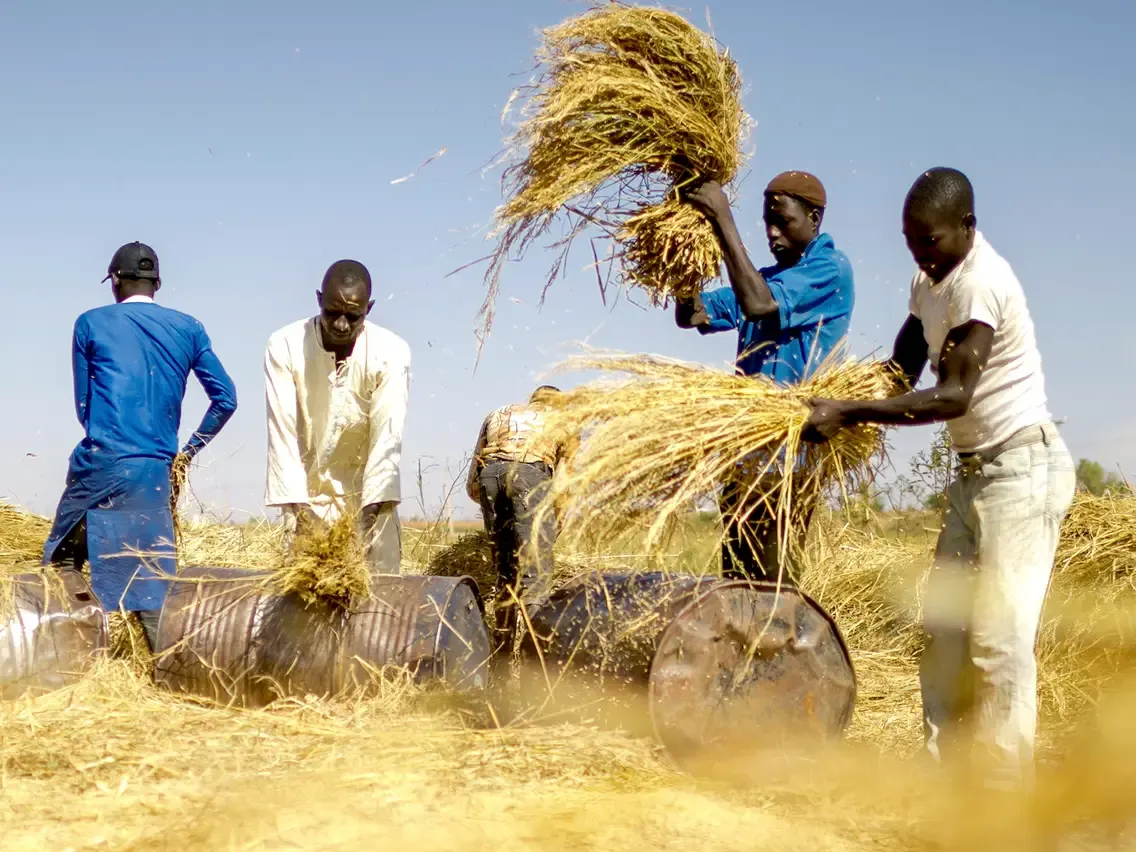
*To make grains, fertilizers available President Bola Ahmed Tinubu has disclosed that in a bid to cushion the biting effect of fuel subsidy removal, the federal government will be releasing the sum of N200 billion will be released to farmers to cultivate rice, maize, cassava, and wheat. President Bola Tinubu, who made the announcement in a national broadcast Monday added that the amount would be taken from the initial N500 billion approved by the National Assembly for the cultivation of 500,000 hectares of land across the country. According to the President in the broadcast monitored by Nigerian Anchor, the economy will overcome the present turbulence occasioned by the petrol subsidy removal. He further said that there will be an immediate release of grains and fertilizers to ease price increase that is hitting the pockets of Nigerians. “Our economy is going through a tough patch and you are being hurt by it. The cost of fuel has gone up. Food and other prices have followed it. Households and businesses struggle. Things seem anxious and uncertain. “I understand the hardship you face. I wish there were other ways. But there is not. If there were, I would have taken that route as I came here to help not hurt the people and nation that I love. To further ensure that prices of food items remain affordable, we have had a multi-stakeholder engagement with various farmers’ associations and operators within the agricultural value chain. “In the short and immediate terms, we will ensure staple foods are available and affordable. To this end, I have ordered the release of 200,000 Metric Tonnes of grains from strategic reserves to households across the 36 states and FCT to moderate prices. “We are also providing 225,000 metric tonnes of fertilizer, seedlings, and other inputs to farmers who are committed to our food security agenda. “Our plan to support the cultivation of 500,000 hectares of farmland and all-year-round farming practice remains on course. To be specific, N200 billion out of the N500 billion approved by the National Assembly will be disbursed as follows: “Our administration will invest N50 billion each to cultivate 150,000 hectares of rice and maize. N50 billion each will also be earmarked to cultivate 100,000 hectares of wheat and cassava,” the President assured.
Fuel Subsidy: Senate urges NLC to shelve planned strike

The Nigerian Senate has appealed to the Nigeria Labour Congress (NLC) to shelve its impending strike on fuel subsidy removal and continue negotiation with the Federal Government. Senate resolution followed the consideration and adoption of a motion at plenary on Monday. The motion titled: ”Urgent Need to Avert the Intending Strike of the Nigeria Labour Congress”, was sponsored by Sen. Kawu Suleiman (NNPP-Kano). Suleiman in his lead debate said the NLC has given the Federal Government a seven-day ultimatum to reverse what the union termed as “anti-poor policies” or face an indefinite nationwide strike from August 2nd. He said the NLC had directed all its affiliates and state councils to immediately begin mobilisation of workers and other Nigerians, including civil society allies for a long-lasting strike and mass protests. Suleiman said the labour, in a statement signed by its National President, Joe Ajaero, alleged that the Federal Government had failed to meet up with the demands it presented to it following subsidy removal on petrol. Not meeting the demand as stated in the statement could cause an astronomical rise in price of the commodity. He expressed worry that the strike would cripple the country as commercial transport operators would withdraw their services, while markets, schools and healthcare facilities would be forced to shut down. According to him, the action could heat up the polity when it occurred, saying that gains from the strike were far below the costs to either of the parties in conflict. The senator said the strike threat by the NLC, if not averted, could plunge Nigeria into deeper economic woes, dislocate businesses, hunger, and frustration. Suleiman said more hardship would lead to unquantifiable financial losses and reduce Nigeria’s Gross Domestic Product (GDP). He said the NLC proposed strike was a bad reputation for Nigerian economy and the educational system, saying that it portrayed the country in a bad light to the external world According to him, it discourages foreigners from coming to do business or study in Nigeria. The senator said that the society always bears the brunt of strikes, adding that an idle mind was the devil’s workshop. He said there was a tendency for an increase in crime rate, social vices like armed robbery, oil bunkering, prostitution, cyber scams, among others, if the strike was allowed to hold. Following support of senators on the motion, Senate accordingly resolved to mandate its leadership to interface between the NLC and the Federal Government to avert the intending strike.