Israel-Hamas War Can Cause ‘Serious’ Global Economic Damages – World Bank

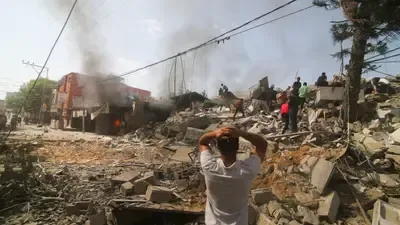
The war between Israel and Hamas could deal a “serious” blow to global economic development, the president of the World Bank told an investor conference in Saudi Arabia on Tuesday. “What just happened recently in Israel and Gaza — at the end of the day you put all this together, I think the impact on economic development is even more serious,” Ajay Banga said, adding: “I think we’re at a very dangerous juncture.” Hamas militants stormed into Israel from the Gaza Strip on October 7 and killed at least 1,400 people, mostly civilians who were shot or burnt to death on the first day of the raid, according to Israeli officials. The militants also took 222 people hostage, among them elderly people and young children, according to the Israeli authorities’ latest count. The hostages include dozens of dual nationals and foreigners. More than 5,000 Palestinians, mainly civilians, have been killed across the Gaza Strip in retaliatory Israeli bombardments, according to the latest toll from the Hamas health ministry in Gaza. Banga was speaking at the annual Future Investment Initiative, often referred to as “Davos in the Desert”. More than 6,000 delegates are registered for the three-day event that will feature appearances by global banking chiefs and the presidents of South Korea, Kenya and Rwanda, organisers say. The shocking violence in Israel and Gaza stands in stark contrast to the vision of a more stable and prosperous Middle East championed by Saudi Arabia, which this year rebuilt ties with Iran and was in talks towards recognising Israel before the fighting broke out. Saudi Arabia has in recent weeks condemned violence against civilians in Gaza and affirmed its support for the Palestinian cause. A source familiar with discussions on possible normalisation with Israel told AFP this month that the process had been paused. The war comes halfway through the Vision 2030 reform agenda championed by the kingdom’s de facto ruler, Crown Prince Mohammed bin Salman, which is intended to transition the world’s biggest crude oil exporter away from fossil fuels. Saudi officials have signalled they intend to forge ahead with their reform plans despite fears of wider regional turmoil. In addition to FII, the capital this week is also hosting its first fashion week and a boxing match between Tyson Fury and Francis Ngannou. On Monday, Prince Mohammed announced plans to host the first eSports World Cup next summer. The FII opening ceremony featured a vocal performance by Britain’s Got Talent contestant Malakai Bayoh as a giant dove flashed on a screen behind him. Yasir al-Rumayyan, governor of the deep-pocketed Saudi Public Investment Fund, referred only obliquely to the Israel-Hamas war in his comments on Tuesday, though he did warn about challenges presented by high interest rates. “As central banks have tightened monetary policy in an effort to slow inflation, business and governments around the world have been adjusting to this new reality. This has been the fastest rate increase since the early 1980s and has caused significant and unpredictable disruptions,” he said. Yet he voiced optimism that “even in a high interest rate environment we can see the acceleration of growth and productivity”.
Crude Oil Theft: Nigeria has lost N16.25trn in 11 years, says Speaker

Speaker of the House of Representatives Tajudeen Abbas on Thursday said that Nigeria lost N16.25 trillion to crude oil theft between 2009 and 2020. The speaker said this while inaugurating the ad hoc committee to investigate crude oil theft and loss of revenue in Abuja. He said the menace of crude oil theft had hampered the growth of the country’s oil production, with between five and 30 per cent of crude oil production lost daily. He said that critical agencies in the oil and gas sector like the Nigeria National Petroleum Company Ltd, Nigeria Upstream Petroleum Regulatory Commission, Ministry of Petroleum Resources among others failed to honour invitation. Represented by the Chairman, House Committee on Petroleum Upstream, Al-Hassan Ado-Doguwa, the speaker said if decisive action was not taken to address the issue, the country may be thrown into a deeper fiscal crisis. This according to him is due to dwindling revenue from the oil and gas sector. Quoting data from the Nigeria Extractive Industries Transparency Initiative (NEITI), Abbas said Nigeria’s oil production declined from 2.51 million barrels per day in 2005 to 1.77 million barrels per day in 2020. He said “NEITI reports also show that 619 million barrels of crude valued at 46 billion dollars were stolen in the period 2009 to 2020″. He added that Nigeria had continually failed to meet its daily production quota as set by the Organisation of the Petroleum Exporting Countries (OPEC). According to him, recently, Nigeria’s OPEC quota was reduced from 1.742 million barrels per day to 1.38 million barrels per day. “Yet, the country is still struggling to meet this quota as daily production output was 1.184 million barrels per day and 1.249 million barrels per day in May and June 2023 respectively. “On the average, current daily production output is a far cry from the budget assumption of 1.69 million per day. The implication is clearly manifest in the economic crisis that the country is facing.” He said the nation had been facing a major fiscal crisis, adding that global recovery from the COVID-19 pandemic and the ongoing war between Russia and Ukraine had continued to cast a cloud of uncertainty on the oil and gas industry. Al-hassa Runrum, the Chairman of the Ad-hoc Committee said the volume of losses occasioned by oil theft in the country and its associated impact on the economy was unacceptable. He said this would not be tolerated by any government, who sincerely loves its citizens. He added that such act of sabotage and breach on the nation’s security and sovereignty makes a caricature of the nation’s pride “It is an affront on the government and its institutions, which must be tackled without further delay,’’ he said. He said the committee was determined to bring the ugly trend to an end otherwise there might be no future for “our children who have not yet “jappered’’ to other countries in search of survival.”