EU To Support Africa’s Infrastructure Drive With €150bn In 4 years

EU To Support Africa’s Infrastructure Drive With €150bn In 4 years

The European Union (EU) through its Global Gateway initiative has promised to disburse 150 billion Euros to Nigeria and other African countries to enhance infrastructure in over eight sectors. The disbursement of the fund which commences from this year to 2027, aims to enhance connectivity, promote sustainable development, and strengthen economic ties between the EU and its partner countries, including Nigeria. The EU Commissioner for International Partnerships, Jutta Urpilainen, who revealed this at the launch of the Global Gateway initiative in Abuja, added that the bloc would support Nigeria to achieve enhanced infrastructure connectivity, including transport, energy, digital networks; support agriculture, economic growth, health and education. She said: “It will also promote sustainable development and environmental protection; and foster cooperation and partnerships with Nigeria and other partner countries. “We are living in an increasingly fragmented world. The war that Russia started against Ukraine last year, the military takeover in Niger in July, and the escalation in Israel-Palestine conflict are just stark reminders of that. “In such a world, the Global Gateway strategy is our positive offer to build resilient connections in the world through strategic partnerships to jointly address the challenges of our times from fighting climate change to improving health systems. “Together, we intend to mobilise 300 billion Euros in investments by the year 2027, and half of them for Africa; it is 150 billion Euros by the year 2027; Nigeria features prominently in the Global Gateway investment package”, the commissioner added. Urpilainen further clarified that the EU would support the 5G rollout in Nigeria, as part of its efforts to support the digital economy as well as also working on a potential loan to support Small and Medium Enterprises (SMEs) in the digital and print sectors. According to her, the EU had committed financial resources to support the energy sector, including the setting up of mini grids and small hydropower plants for productive and public purposes. “In 2022, we launched a digital economic package for Nigeria. With EU and European Investment Banks, investments worth 820 million Euros, it is a lot of money,” she added. The EU commissioner described education as “the most transformative investment anyone could make. So, an empowerment project is being launched in North Western Nigeria in cooperation with government to promote quality basic education in the northern regions.” Urpilainen assured that the EU’s long-term commitment would support investments in key sectors of the Nigerian economy, namely Agriculture (€42,000,000), Energy (€37,000,000), Health (€45,000,000), Digital (€55,000,000), Education (€45,000,000), and Social Protection (€46,000,000). In his remarks, Minister of Communication, Innovation and Digital Economy, Dr. Bosun Tijani, said that the Global Gateway initiative was aimed at achieving collective regional and global prosperity was in full alignment with President Bola Ahmed Tinubu’s Renewed Hope agenda. He explained: “The core of this administration’s agenda is a developed Nigeria that is not only for a few, but for all, providing the Government the opportunity to actualize its plans in sectors that it wants to focus on. “Africa’s relationship with Europe has deep historical roots, and has been built on years of shared values, collaboration and mutual respect. “While we enjoy geographical proximity, we also have increasingly intertwined culture, and more importantly, a shared future,” the minister added. Tijani pointed out that working with the EU gave Nigeria the opportunity to leverage its structure and historical resources for global development, particularly for Africa.

Dangote Celebrates Africa’s Young Global Leaders

Dangote Celebrates Africa's Young Global Leaders

President of Dangote Group, Aliko Dangote has hailed the Forum of Young Global Leaders describing it as a platform to develop the next generation of African leaders.  According to Dangote, the philosophy of Forum of Young Global Leaders aligned with his vision for a continent whose people are healthier, better educated, and more empowered through enhanced opportunities for social change through strategic investments that improve health and wellbeing, promote quality education and broaden empowerment opportunities for individuals and communities.  The Young Global Leaders programme is an accelerator for a dynamic community of exceptional young people from all over the world with the vision, courage, and influence to drive positive change in the world.  Dangote, who said this at the YGL Africa fellowship meeting in Lekki, Lagos said the essence of his partnership with the Forum is to engage young African leaders from small and medium enterprises (SMEs) and non-business entities who might otherwise not be able to participate in the Forum’s Young Global Leaders Community.  The fellowship covers the cost of their participation at World Economic Forum and YGL-led events for 6 years for each Fellow. Now in its 12th year, the Aliko Dangote (WEF Africa YGL) Fellows continue to represent the continent on the global stage and give back to their communities in a multiplicity of impactful ways. Following the partnership with Dangote 12 years ago, the programme has included 15-20 young leaders from sub-Saharan Africa following a rigorous selection process. At any one time, the African YGL Community consists of around eighty active members, 75 per cent of whom are eligible for the Dangote Fellowship. Speaking at the event, the Executive Director Dangote Industries, Fatima Aliko Dangote, expressed pride at the diversity and high proportion of female fellows in the 2023 Cohort, where the nine chosen YGLs represent the media/arts/entertainment, technology & innovation, health, and government sectors. Managing Director/CEO of the Aliko Dangote Foundation (ADF), Zouera Youssoufou, thanked the billionaire businessman for his continuous support of the YGLs, and assured him that his investment is not in vain, as the young global leaders are achieving exploits in their respective fields and living up to the expectations of being true African future leaders. He encouraged them to put in their best in their various fields and not be discouraged when setbacks occur, because those are to be expected. He encouraged them to continue raising their ambition for our continent because “Nothing is Impossible”. Aliko Dangote YGL Alum and Executive Director ofa African Youth Initiative Network, Victor Ochen from Uganda, commended Dangote for the aggressive investment noting that the project is a reflection of his faith in the continent. He further commended the billionaire businessman for his generosity in providing financial means for him to participate in forum events he otherwise would have been unable to do. He said, “I am so happy with what Dangote is doing in Nigeria and Africa as a whole. This is a man that is investing in the youth through his foundation and employing tens of thousands of Africans, in his various plants. I am so humbled to be here, and to learn from the expertise of this man whom God has blessed our continent with…I thank Dangote for his generosity, which has provided many young African leaders, regardless of the country, the much-needed financial means to participate in YGL events. Without the support of ADF, our active participation would not have been possible.”

Africa Social Impact Summit: Entrepreneurs seek $49.6m intervention

Africa Social Impact Summit: Entrepreneurs seek $49.6m intervention

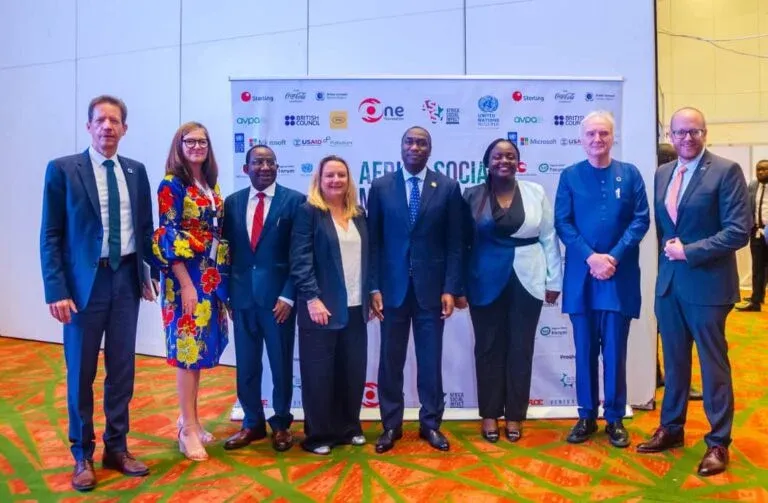
African inventors and entrepreneurs are seeking $49 million from investors at the just concluded Africa Social Impact Summit (ASSIS) to scale up their businesses. This is contained in a statement signed by Mrs Olapeju Ibekwe, Chief Executive Officer (CEO), Sterling One Foundation, made available to newsmen on Tuesday in Lagos. The two-event was co-convened by Sterling One Foundation and the United Nations in Nigeria. The summit had as its theme, “Global Vision, Local Action: Repositioning the African Development Ecosystem for Sustainable Outcomes.” Ibekwe said that the Summit featured a deal room with pitches from 18 businesses shortlisted from over 500 applications from across Africa. She said that the finalists, drawn from South Africa, Kenya, and Nigeria with businesses cutting across health, waste recycling, agriculture and education, had a combined investment bid of about $49.6 million for expansion and production capacity increase. According to her,   the investors are observing due diligence to determine what the successful candidates will access to upscale their businesses. The CEO noted that the gathering of key players from the government, the diplomatic community, civil society and the public and private sectors for the summit, was not a talk shop but a meaningful engagement that would spark the desired impact in Africa. She said that ASIS 2023, being the second edition, was designed to help build partnerships and galvanise investments that would ensure that Africa made rapid progress towards achieving the SDGs. Ibekwe said that with the world halfway through the 15-year timeline set for the actualisation of the SDGs, there had been a call across the globe to review the work done to see what had worked and what had not. He said this was to identify critical areas where additional measures were needed for success to be achieved. She said that the call formed the basis of conversations at ASIS 2023. She said that the call also resonated as former President of Malawi, Joyce Banda; Consuls-General of the British High Commission, USA, Germany and Denmark, including experts in various fields, shared insights into different sustainability strategies. She expressed the hope that several partnerships and innovations would emerge from the summit. The CEO said that she was looking forward to existing social impact initiatives in various rural communities, accessing multilevel resources, to be able to do more and spread their impact from community to community across the continent. She added that she was humbled by the intentionality of the private sector to own the SDGs and expressed gratitude to the partnership of the United Nations as the co-convener of the summit “Across the continent, the people are waiting for action. For far too long, Africa has been tagged the emerging continent, with its potentials a recurring theme of conversation, yet poverty, hunger, climate crisis, and inequality, remain visible; thus, Africa is yearning for action. “I remain confident and incurably optimistic that there is the capacity for the type of action we seek in this room. There is the capacity to build strong partnerships for sustainable solutions to move from plans to action quickly. “I urge everyone to interact and collaborate because the stakes are very high,” Ibekwe said. She said that Mr Abubakar Suleiman, Managing Director and CEO of Sterling Bank Limited, explained that the true essence of the Summit was to ensure that at every level, the issues and challenges resulting in widespread poverty across Africa got tackled rightly. “Six months from now, when we reach out for you, we want to hear that because you came here, you met someone, and you established a relationship, you rethought your approach, therefore, are getting more value from your resources, and are better at solving problems together. “The only thing that matters is the relationships you form today and how these relationships transmit to a much better outcome than you had before you came here,” Suleiman, who is also board member of the Sterling One Foundation, said. Ibekwe said that the UN Resident and Humanitarian Coordinator, Nigeria, Mr Matthias Schmale, said the 2030 Agenda was a clear framework for addressing the challenges facing Africa, which required all to break free from business-as-usual approaches and move together faster. “Governments, NGOs, and civil society cannot tackle our current challenges alone. “If we are to secure a just, sustainable world, we need a whole-of-society approach in which the private sector plays a pivotal role,” Schmale said. While further stating that the promise of the 2030 Agenda was now in peril, he urged more CEOs and investors to adopt the 10 principles of the UN Global Compact. He asked them to hire more qualified women, and ensure that their investments focused on more than just profit, to reflect social impact considerations. He pledged support to the Nigerian Government, citing the Cooperation Framework for Sustainable Development, which both parties had agreed to. He also called on more organisations to embrace Public-Private Partnerships to leverage the strengths and capabilities of both sectors to fast-track and scale up major development initiatives.

Germany to boost Africa infrastructure with €10m

Germany to boost Africa infrastructure with €10m

The African Development Bank (AfDB) said the German Government will provide 10 million Euros, to replenish the  New Partnership for Africa’s Development Infrastructure Project Preparation Facility (NEPAD-IPPF) Special Fund. The support will be done through the KfW. NEPAD-IPPF is a multi-donor Special Fund, hosted by AfDB with a leading project preparation facility in Africa that plays a catalytic role in providing technical and financial assistance for the preparation of regional infrastructure projects and programs. Its mandate is to spur sustainable infrastructure development on the African continent through the preparation of bankable, investment-ready projects. According to the Bank, the fund will help boost the development in the African continent. The fund would be provided by the German Federal Ministry for Economic Cooperation and Development (BMZ). The agreement was signed in Berlin by Helmut Gauges, Head of Financial Cooperation in Sub-Saharan Africa on behalf of KfW, and AfDB Vice-President and Chief Financial Officer, Hassatou N’Sele. According to the statement, Germany’s support will bolster NEPAD-IPPF’s efforts towards priority areas such as green and climate-smart infrastructure. It said it would ensure stronger focus on the second Priority Action Plan of the Programme for Infrastructure Development in Africa for the period 2021-2030 (PIDA-PAP 2). It said it would also support Africa’s transformation under the Africa Continental Free Trade Area (AfCFTA) by boosting intra- and extra-African trade. The KfW Director, Christoph Tiskens, said the partnership would support infrastructure development on the continent. Tiskens said this would focus on areas such as climate change, gender, Agenda 2063, and a stronger focus would be on attaining the Sustainable Development Goals (SDGs). “The KfW, on behalf of the German Government, is a key partner of AfDB and will continue to support facilities that play a key role in economic growth and poverty reduction,”Tiskens said. The AfDB Vice-President and Chief Financial Officer, said the support of partners such as Germany would enable AfDB to deliver on its important development mission. N’Sele said this was especially as economies in Africa navigated new challenges in the face of overlapping global crises. “With the replenishment of NEPAD-IPPF Special Fund, we are determined to further support our clients. “While helping them realise their economic potential through increased infrastructure investments, contributing to green growth, inclusion, and job creation,” she said.

CAF Coaching Instructors’ Course commences in Abuja

CAF Coaching Instructors’ Course commences in Abuja

The first-of-its-kind CAF Coaching Instructors’ Course to be conducted on Nigerian soil was flagged off at the NFF/FIFA Goal Project, MKO Abiola National Stadium, Abuja on Thursday, with President of NFF, Alhaji Ibrahim Musa Gusau expressing a sense of fulfilment with the calibre of instructor sent by the Confederation of African Football to conduct the course. CAF Elite Instructor and FIFA Technical Expert Abraham Mebratu from Ethiopia will take charge of the different aspects of the training programme, which has 15 of Nigeria’s elite coaches participating. “CAF has sent us one of the very best in the field. I urge you to follow this very unique programme and the different modules with rapt attentio, so that you can gain so much to pass on to other Nigerian coaches in subsequent courses,” NFF President Gusau said in a speech read on his behalf by the NFF General Secretary, Dr. Mohammed Sanusi. Sanusi implored the participants to justify the confidence reposed in them by the Federation by being diligent and assiduous in the training programme, and learning enough to impart to fellow coaches “as we hope to have more of these courses going forward.” NFF Technical Director, Coach Augustine Eguavoen, a former Captain and Head Coach of the Super Eagles, is among the group of 15 participants, which also includes Isah Ladan Bosso, former Super Eagles’ captain Daniel Amokachi, Alphonsus Dike, Stanley Eguma, Wemimo Oni Mathew, Henry Abiodun, Sam John Obuh, Edema Fuludu, Bala Nikyu and Lawrence Ndaks. Also at the occasion were NFF Deputy General Secretary, Dr. Emmanuel Ikpeme; NFF Director of Communications, Mr. Ademola Olajire; NFF Director of Competitions, Ms Ruth David; Deputy Director (Technical), Dr. Robinson Okosun and; Assistant Director (Technical), Mr. Abdulrafiu Yusuf.   

S/African Johann Rupert overtakes Dangote as Africa’s richest man

Images

South African Johann Rupert has displaced Nigerian billionaire businessman Aliko Dangote to become Africa’s richest man, Forbes Magazine said. Rupert’s net worth is currently $12 billion according to Forbes Real-time Global Billionaires Ranking, while Dangote trails behind him with a net worth of $10.8 billion as of Friday. Dangote’s net worth dropped due to the recent operational charges on the foreign exchange market carried out by the Central Bank of Nigeria, which led to the depreciation of the Naira against the US dollar. Consequently, Forbes and Bloomberg had to recalculate the fortunes of all Nigerian billionaires leading to the significant drop in the wealth of Dangote, Abdul Samad Rabiu, the founder of BUA cement, and Mike Adenuga, the Chairman of telecommunications giant Globacom Limited. Meanwhile, with the expected kickoff of the $20 billion Dangote refinery commissioned last Month, Aliko Dangote is expected to bounce back.