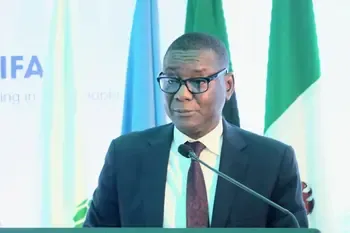
Serving as AfDB President greatest honour of my life –Adesina

Dr Akinwunmi Adesina, says serving as President of the African Development Bank (AfDB) is the greatest honour of his life. Adesina said this at a breakfast meeting held for the media to declare open the AfDB 2025 Annual Meetings in Abidjan. “It has been a decade of relentless purpose, of enduring passion, and of tireless service. I thank you for walking on this journey with me,’’ he said. Adesina, a Nigerian Development Economist and Agricultural Development Expert became president of the bank 10 years ago. This was after serving as Nigeria’s Minister of Agriculture from 2011 to 2015, transforming the sector by attracting private sector investments as well as supporting youth and Small and Medium Enterprises (SMEs). Adesina is dedicated to transforming agriculture in Africa from a subsistence activity to a viable business that attracts investments. He is also passionate about ending poverty, hunger and malnutrition in Africa and lifting millions of people into the middle class. “When I was elected in 2015, I didnot have any grey hair then. Now my hair has turned several shades of grey. “Grey from 10 years of unrelenting drive to push Africa forward. Grey from our tireless efforts to turn the Bank into a globally respected financial institution where it was ranked as the best multilateral financial institution in the world. “Grey from leading the Bank to achieve the largest capital increase in its history, raising the capital of the Bank from 93 billion dollars in 2015 to 318 billion dollars today – an unprecedented achievement. “Grey from leading the Bank to achieve the largest capital increase in its history, raising the capital of the Bank from 93 billion dollars in 2015 to 318 billion dollars today – an unprecedented achievement. “Grey from leading the Bank to achieve the highest replenishment of the African Development Fund in the history of the Fund, as we successfully raised 8.9 billion dollars for its 16th replenishment.’’ He said; “Grey from working side by side with my staff to lead on global financial innovations such as the launch of hybrid capital instruments and synthetic securitization, becoming the first ever multilateral financial institution to do so globally According to him, Grey from our collective work to ensure that we serve the people of Africa with passion, dedication, accountability, to help Africa develop with pride. “Grey from holding nothing back in service of the people of Africa, the president said. NAN reports that the 2025 meetings are being held under the theme: “Making Africa’s Capital Work Better for Africa’s Development.” Key highlights of the sessions include the Presidential Dialogue, the launch of the African Economic Outlook, and in-depth thematic discussions aimed at mobilising capital and building stronger institutions. The 2025 meetings are being held under the theme: “Making Africa’s Capital Work Better for Africa’s Development.” Key highlights of the sessions include the Presidential Dialogue, the launch of the African Economic Outlook, and in-depth thematic discussions aimed at mobilising capital and building stronger institutions. The Annual Meetings opened on Tuesday and it shall come to an end on Friday. 

AfDB, IDB, IFA Inject $1bn To Fund Nigeria’s SAPZs

AfDB, IDB, IFA Inject $1bn To Fund Nigeria’s SAPZs

The Africa Development Bank (AfDB), Islamic Development Bank (IDB) and the International Fund for Agricultural Development have voted $1billion to deliver special agro-industrial processing zones in 24 States of Nigeria. This is in addition to an initial $520 million voted by the development partners for the development of eight special agro-industrial processing zones in the country. Mr Stanley Nkwocha, Senior Special Assistant to the President on Media and Communications, Office of the Vice-President, in a statement said the President of AfDB, Dr Akinwumi Adesina, disclosed this in the United States. Adesina spoke at the Norman Borlaug International Dialogue, World Food Prize 2023, in Des Moines, Iowa. Vice-President Kashim Shettima, who is attending the event in pursuance of the food security and diversification policy of the Tinubu administration, had on Wednesday delivered his keynote address at the ongoing Dialogue. In a speech titled, “From Dakar to Des Moines”, Adesina said that the decision to pump such huge funds into Nigeria’s agribusiness was part of the resolve to develop Special Agro-Industrial Processing Zones (SAPZs) in 13 countries. He said, “We are investing heavily in the development of SAPZs to support the development of agricultural value chains. “Food processing and value addition, enabling infrastructure and logistics to promote local, regional, and international trade in food. “The African Development Bank Group is investing $853 million in the development of the Special Agro-Industrial Processing Zones. “The bank has mobilized additional co-financing of 661 million dollars, for a total commitment of $1.5 billion.” Adesina said that the bank was deploying effective partnerships at scale, adding that currently it is implementing 25 Special Agro-industrial Processing Zones in 13 countries. “The AfDB and the International Fund for Agricultural Development provided $520 million for the development of eight special agro-industrial processing zones in Nigeria. “The second phase of the program aims to mobilize an additional $1 billion to deliver special agro-industrial processing zones in 24 States of Nigeria.” Adesina regretted that while much progress had been made in African agriculture, 283 million people still go to bed hungry, about a third of the 828 million people that suffer hunger globally. He described the Norman Borlaug International Dialogue World Food Prize 2023, as a journey and narrative combining the power of science, technology, policies and politics to ensure that Africa fully unlocks its agricultural potential, and feeds itself with pride. Adesina thanked Vice-President Kashim Shettima, and the President of Ethiopia, Sahle-Work Zewde, for participating in the global event. He said that their presence was an indication that Africa had the political will and was fully ready to tackle food insecurity as well as make hunger history on the continent. Earlier, Shettima, who spoke on the Tinubu administration’s initiatives for food security, said the quality of present leadership in Nigeria and the rest of Africa would drive transformation in agriculture and other sectors. He said, “A nation falls or rises fundamentally due to the quality of its leadership. “Right now, Africa is blessed with quite a handful of quality leaders that have the drive, passion and skills set to redefine the meaning and concept of modern leadership. “President Tinubu, my boss, is a good example, Macky Sall of Senegal and of course, Abdel Fattah El-Sisi of Egypt are doing wonderfully well. “Just to mention a few of the African leaders that are distinguishing themselves in leadership.” Shettima assured the gathering of investors and stakeholders in the agricultural sector that Tinubu was a quintessential 21st century modern African leader who is determined to redefine the meaning and concept of modern leadership. He added, “Be rest assured that there will be a change in the fortunes of the Nigerian nation and by extension, the African continent in the next couple of years because Nigeria is an anchor nation.” On wheat production, Shettima said the target of Nigeria towards wheat production was to achieve 50 per cent self sufficiency in the next three cycles. He said, “It is inconceivable that we are the second largest wheat importer in the world. Luckily, we have already procured the heat tolerant variety of wheat seeds. “And we are going to drive that process by supporting the farmers with the heat tolerant variety, agricultural extension services, fertilizer and also hope to increase the irrigation areas to 1 million hectares in the next cropping cycle. “We need to produce about 2.4 million tonnes of wheat grains in Nigeria. We are going to reach out to our farmers through small irrigation schemes and through digitalisation. “All the actors in the value chain will be sufficiently taken care of through innovative finance, partial credit guarantees and crop insurance.” On rice production, Shettima said the major challenge for Nigeria was the insufficiency of paddy rice. He said that Nigeria had adequate milling capacity, adding, “but, we need to produce three to four million tonnes of paddy rice to meet our requirement of about 2.5 million tonnes per annum. “We have 75 million hectares of arable land and most of it suited for rice cultivation. “We will provide our farmers with certified seeds, fertilizer, extension services, the digitlisation of services, inputs, finance and market information. ”Our target is to achieve self sufficiency in rice latest by 2027.” The vice-president, who spoke on SAPZs, reiterated the Tinubu administration’s commitment to providing an enabling environment for investors in the zones. He said government would create an SAPZ development authority that would operate like a one-stop shop where regulatory and associated issues would be addressed.

AfDB’s Total Portfolio In Nigeria Hits $4.4bn – Burrow

AfDB’s Total Portfolio In Nigeria Hits $4.4bn – Burrow

The African Development Bank (AfDB) says its total portfolio in Nigeria stands at $4.4 billion. The portfolio is for development projects. In his opening remarks at the Joint Country Portfolio Performance Review (CPPR), the Director General for Nigeria Country Department, AfDB, Lamine Barrow, who stated this at the weekend in Abuja, added that there have been significant improvement in the portfolio performance. He said: “Currently, the Bank’s portfolio in Nigeria is one of the largest among the Regional Member Countries (RMCs), with a total commitment value of US$ 4.4 billion. These are 48 operations fairly evenly distributed between public and private sector operations. “Since the 2022 CPPR Workshop, some of the portfolio performance metrics have improved. In particular, operations flagged for implementation challenges decreased from 36% in January 2023 to 32% in September 2023. This is a result of collective efforts from the Federal Ministry of Finance, the Executing Agencies and the Bank to reduce start-up and implementation delays. Indeed, the time taken to meet loan effectiveness and first disbursement conditions tend to be excessive. Let me acknowledge the unprecedented recent development with the FEC approval of the Ekiti Knowledge Zone project! “We are pleased that the share of start-up delays has been reduced from 32% of flagged operations in June 2023 to 28% in October 2023, and is expected to reach 8% by end 2023 with timely and targeted actions for some projects.” Burrow commended the Federal Government for the bold reforms initiated to address macro-economic imbalances and structural issues in the economy. “These reforms, particularly removal of the fuel subsidies and unification of the exchange rates management system, will help reignite higher economic growth trajectory, despite the short-term pains to the population. “This renewed drive for results and impact is clearly noticeable in the Bank’s interface with the Federal Ministry of Finance, and specifically the International Economic Relations Department,” he said.   Since the outbreak of the COVID-19 pandemic, Burrow said the Bank’s annual disbursements increased from UA 93 million in 2021 to UA 143 million in 2022 and projected to reach UA165 million by end December 2023. According to him, fiduciary compliance has also improved with progress observed in the submission rate of audited financial statements by the executing/implementing agencies for financial Years 2021 and 2022. “However, there is scope for further improvements in these and other areas. A more regular scheduling of our Quarterly Meetings will also help ensure that emerging issues in the portfolio management are addressed timely,” the AfDB chief said. To further drive improvement in the implementation of its project, he said the Bank “decided to introduce Project Awards to recognize excellence and strong performance, showcase best practices, and incentivize Executing Agencies and Project Implementation Units to improve performance and delivery of development results. I am pleased to announce that the first Project Awards will be given out today.  We hope that these recognitions will provide Project Teams added motivation to enhance project implementation performance and results.” For his part, Director International Economic Relations Department, Federal Ministry of Finance, Budget and National Planning, Stanley George, said the aim of the workshop is to ensure Nigeria gets value for money.    He said, “If we take a facility we need to know how it is convertible to impact on people. The benefit is to the people that are our concern. We don’t want any delay. We want seamless implementation of these projects so that people on whose behalf this service was called would have immediate impact.” The Director said the review would help proffer solutions to the delays that are encountered in the implementation of some projects. “I want to use this opportunity to highlight some of the issues that may have inhibited the smooth performance of some of the portfolios. One of which is the long period of delay, low disbursement rate, and communication with various MDAs. I believe that some of these issues will be taken up at the very technical level, so that all stakeholders will know their critical roles,” he added.

Shettima Arrives US For AfDB’s World Food Dialogue

Capital Markets Can Bridge Africa’s Infrastructure Deficit – Shettima

Vice President Kashim Shettima has arrived in the United States of America to participate at the African Development Bank (AfDB) World Food Prize-facilitated Norman Borlaug, International Dialogue slated for Iowa. Mr Stanley Nkwocha, Senior Special Assistant to the President, Media and Communications, Office Of The Vice President, disclosed this known in a statement on Sunday in Abuja. He explained that as the special guest, Shettima would deliver a keynote address at the event which would commence on Oct. 24. “In the itinerary of the Vice-President while in the U.S. are high stake meetings across some states of the U.S. with manufacturers, investors and top government officials. “On the Norman Borlaug International Dialogue, Shettima will be joining the late UN Secretary-General Kofi Annan’s organisation, AGRA; World Food Prize laureates; Ghana President, John Kufuor and AfDB President, Akinwunmi Adeshina. “Others are at the event are former President Olusegun Obasanjo; Presidents Felix Tshishiked and Joaquim Chissano; Joyce Banda; Ameenah Gurib – Fakim and IFAD President, Kanayo Nwanze as distinguished African leaders who in the past used the event to canvas support for agricultural development and food sufficiency in Africa.” Nkwocha said the vice president would use the platform to speak on the potentialities and endowments of Nigeria’s agricultural sector. He also said that Shettima would woo investors and push for commitments in achieving President Bola Tinubu’s mandates and programmes for Nigeria’s agro-food sector. 

Set Nigeria on prosperity path, Adesina tasks Tinubu

Set Nigeria on prosperity path, Adesina tasks Tinubu

*Say Nigeria has no reason to be poor African Development Bank (AfDB) President, Dr Akinwumi Adesina, has urged President Bola Tinubu to wake up to his responsibilities and set the country on the path of prosperity. In his keynote address at the Business Day Chief Executive Officers (CEO) Forum on Thursday in Lagos, the AfDB President noted that until Nigeria wakes up from its slumber, the country will continue to stagnate economically. According to his address titled: “The Day the Lion Roared! Making Nigeria a Global Industrial and Economic Giant”, the AfDB helmsman said the country had no reason to be a poor country.   ”’The day that Nigeria wakes up and becomes a lion king, everything will change for its people; and everything will change for all of Africa. ”Nigeria should never be a poor country; and Nigerians are tired of being poor. “For now, Nigeria is developing too slowly and well below its potential. The challenge is for the lion to roar. Then we will have the making of an economic giant. “The key for that is for Nigeria to have an Industrial Revolution,” he said. Adesina said the share of manufacturing in the GDP of Nigeria had hovered around seven percent in the past decades. According to him, the nation has not been able to extricate itself from the comatose of its industrial manufacturing sector to unleash the fullness of its potential. “The performance of the manufacturing sector in the past five years has been poor. Between 2015-2017 the sector declined by -1.5per cent, -4.3per cent and -0.2per cent. ”This is in sharp contrast to the dynamic and rapid performance of manufacturing in Asian countries, such as Singapore, Malaysia, India, and China. The manufacturing sector of Nigeria represents only three per cent of the total revenue from exports, but accounts for 50 per cent of imports in the country. “Instead of being forward-looking in expanding the share of the manufactured goods in its total export revenue, Nigeria focuses on the model of import substitution,” Adesina said. Adesina said further that the country has a manufacturing sector that cannot develop to compete globally, but limits itself to “survival mode” and not a “global manufacturing growth mode”. He said a well-developed and policy-enabled manufacturing sector, with export orientation will spur greater innovation, industrial policy for export market development, and structural transformation of the economy. He said rather than being consumed with conserving foreign exchange, the focus should shift to expanding foreign exchange through greater export value diversification. African countries, including Nigeria,  he said have had policies, templates, and programs for industrialization and expanding industrial manufacturing for decades, but there is a huge gap between policy ideas and actions.

Nigeria’s FDI drops to $469m in 2022 – AfDB

Nigeria’s FDI drops to $469m in 2022 - AfDB

The African Development Bank (AfDB) has said that foreign direct investment inflows into Nigeria fell to $469 million in 2022 from about $8.8 billion in 2011. Describing it as the lowest in a decade, AfDB’s Director General, Nigeria Country Department, Mr. Lamin Barrow, noted in Abuja that Nigeria’s private sector is hamstrung by policy inconsistencies and implicit taxation.  According to him, “many private sector firms in Nigeria are overburdened byimplicit taxes; they provide their own electricity, sink boreholes to get access to water, and repair roads in their towns and neighborhoods.” Speaking on “Trade and Non-Oil: Changing the Narratives for Rapid National Development” at the 2023 Nigeria Employers’ Summit, Barrow said closer collaboration and dialogue between the Federal Government and the private sector is critical to policy making and position Nigeria as an ideal investment destination.  The AfDB chief said that a vibrant and competitive private sector can accelerate diversification of the economy and boost exports. Over the years, successive administrations have mouthed economic diversification without matching it with action.  He said that the unification of the exchange ratemanagement system and the removal of fuel subsidies, has shown that the government was ready to engage in bold reforms that will transform the country into an economic powerhouse.   “If the Federal Government implements bold strategies to take advantage of investment and market access opportunities. Rising labor costs and technological upgrading in countries such as China, India, and Brazil offer an excellent opportunity to developing economies, including Nigeria, to attract FDI and diversify their exports,” he said. Barrow further said that trade offers a great opportunity to further diversify the Nigerian economy. According to him, with the coming into force of the African Continental Free Trade Area, Africa is becoming more integrated, with a larger market for exports from Nigeria.  “Developing regional infrastructure and putting in place the requisite trade policies are a necessary condition for tapping opportunities in the regional and international markets.  “A good starting point is the effective utilization of Trade Agreements to which Nigeria is currently a signatory. However, Nigeria’s trade policies should prioritize the promotion of value-added exports.  “The significance of the non-oil exports in driving inclusive growth, sustainable development job creation, especially for the women and youth, cannot be overemphasized,” Barrow explained.

BUA Cement secures IFC’s $500m facilities

BUA Cement’s Price Reduction Will Boost Affordable Housing –Minister

In a bid to boost production and expand its operations, BUA Cement PLC has secured $500 million in financing from the International Finance Corporation (IFC). In a joint statement, IFC and BUA said the funding would enable the company to part-finance and develop two new, energy-efficient cement production lines at its plant in Sokoto State, in northwest Nigeria. The funding includes $160.5 million from the IFC, $245 million in syndicated loans from the African Development Bank (AfDB), the Africa Finance Corporation (AFC), and the German Investment Corporation, as well as $94.5 million from institutional investors. “The plants will run partly on alternative fuels derived from waste and solar power. Each will produce about three million tons of cement annually when complete, serving markets in Nigeria, Niger, and Burkina Faso,” IFC and BUA said. In a regulatory filing with the Nigerian Exchange Limited (NGX), BUA stated that it intends to utilize this facility to finance the ongoing expansion of its integrated cement plants in Kalambaina, Sokoto. “We are pleased to inform the NGX, our esteemed shareholders and the investing public, in line with our disclosure obligations pursuant to Chapter 17 of the Rulebook, that BUA Cement has achieved financial close in connection with the Financing to be provided by a syndicate of lending development finance institutions, led by International Finance Corporation (IFC), with participation from African Development Bank (AfDB), Africa Finance Corporation (AFC), and Deutsche Investitions – undEntwicklungsgesellschaft (DEG). “BUA Cement intends to utilize this facility to finance the ongoing expansion of its integrated cement plants in Kalambaina, Sokoto State, Nigeria. “The expansion will increase the plant’s capacity to 8.0 MTPA and as well as facilitate the development of other ancillary utilities. BUA has a production capacity of 11 million metric tons, and the new investment will add another 6 million metric tons. The new financing package will also allow BUA to replace some of its diesel trucks with vehicles that run partly on natural gas in a push to cut emissions, the statement said.