By: Romanus Ike Azuka
“I don’t know why people are mortal and fated to die,” muses Harold S. Kushner, “nor why they die at the time and in the way they do. Perhaps we can try to understand it by picturing what the world would be like if people lived forever.” In this contemplation lies a profound truth: mortality shapes our existence, lending it urgency and meaning.
There are but three events in a man’s life: birth, life and death, as Jean de La Bruyère postulates, a stark reminder that we are born to die. Yet, have we ever paused to ask: What if we lived forever? In Homer’s Odyssey, Ulysses encounters Calypso, an immortal divine being untouched by death’s shadow. Fascinated by this mortal man, she envies him, not for his longevity, but for his finitude. His life, bounded by time, brims with significance; every choice he makes bears weight precisely because it is fleeting, a genuine act of will.
Contrast this with Jonathan Swift’s Gulliver’s Travels, where ,in the land of the Luggnaggians, a rare child is born with a red circular mark upon its forehead, a sign it shall never die. Gulliver first imagines these Struldbrugs as the most fortunate of beings, ” exempt from that universal calamity of human nature. “Yet, upon meeting them, he finds them pitiable beyond measure. They age into frailty, their companions perish, and they linger on, burdened by ailments, grievances, and an unrelenting weariness. Bereft of death’s release, they endure a life grown unbearable. Homer reveals an immortal envying our mortality; Swift bids us pity those who cannot die, urging us to see that while the knowledge of our end may be tragic, an endless existence would be insufferable.
Were humanity to live forever,one of two fates would ensue: the world would grow impossibly crowded,or procreation would cesse to prevent it. In either case,we would lose the renewal a child’s birth brings—-the promise of a fresh start,a new dawn under the sun. Indeed,in a world of immortals,we ourselves might never have come to be.
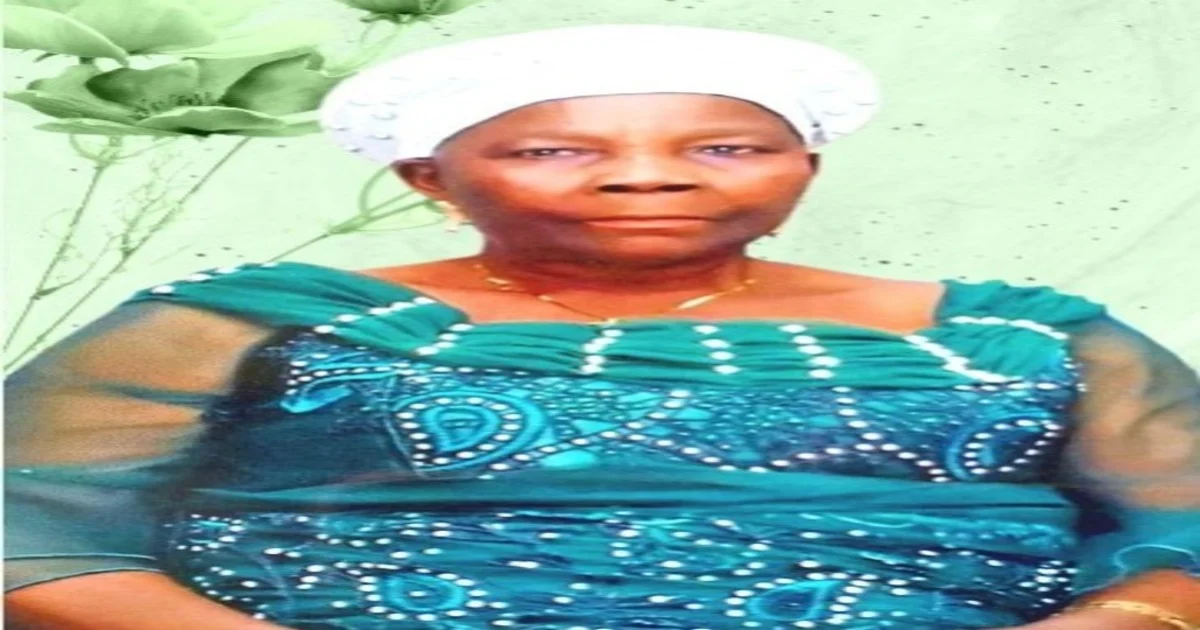
Our mum was not of Homer’s world, nor of Swift’s. Suffice it to say, she was mortal,bound by those three immutable events: birth, life, and death. Her name was Mrs. Florence Ego Azuka, fondly known as Fashion.
Born to humble Ezeoke parents in Ire Village, Ojoto, in present day Anambra state, she entered the world 85 years ago as the eldest of six siblings (four sisters and a brother). Her parents gave her the name Nwakueke, a title later reshaped to Ego, derived from Ego-Oyibo, in the home of her matrimony. With her conversion to Christianity, she embraced the name Florence, a beacon of her faith.
From her tender years, she bore a spirit of determination, compassion and tenderness, ever placing family and others before herself. This disposition was forged by a singular event, her mother, Nne Omesie, fell gravely ill. Thrust into a motherly role for her younger siblings, Florence Ego Azuka ‘s character was moulded amid life’s early vicissitudes, preparing her for the trials to come.
In 1962, she got married to our late patriarch, Chief Okeke Nnaoma Azuka (Kwaji-Kwaji). A union that bore nine children, though two, the second and the third, died during the period of the civil war. With a blend of tenderness, love, and tenacity, Mama raised us, her equanimity a steady light through life’s tempests. She faced each challenge with calm and grace, her faith in love, perseverance, and divine mercy unshaken.
Life’s sternest test came twenty-five years ago with the loss of her beloved husband. Yet,in the shadow of his passing,she did not falter—she rose. With quiet resolve and a heart fortified by love,she became our family’s pillar,carrying our dreams,bearing our burdens,and guiding us forward with unfaltering grace.
Mama was no woman of cant; her words rang true,unmarred by hollow platitudes. She spoke with sincerity and conviction,her lessons wrapped in gentle honesty,her wisdom,a compass for her brood
For decades, she bore a persistent affliction of the leg, a burden known to all in Enugo Village. A silent companion that shadowed her through the years. What began as a trial in the beginning grew graver with time, its weight deepening as her steps faltered. Yet she met this relentless foe with unwavering fortitude, her spirit unbowed. Though it clung to her until her final days, she fought fiercely to live, defiant, resolute, never permitting it to dim the radiance of her love or the fire of her devotion.
For everything there is a season, declares Ecclasiastes, and a time appointed unto every purpose under Heaven: a time to be born, and time to die. If, then, there be but three events in mortal’s life: birth, life, and death, as Jean de La Bruyère observed, it suffices to say that human being is, in essence, a postponed corpse that begets as Fernando Pessoa so starkly noted. Herein lie the twin certainties of humanity: birth, the dawn of existence, and death, its inevitable twilight. This truth finds echo in the words of Julius Caio Caesar, who proclaimed, “Death, a necessary end, will come when it will come.” A stoic resignation to fate’s unyielding decree.
So it was with our mum, whose race in this earthly realm drew to its close on September 14, 2024. Yet, amidst our grief, we find solace in the immortal wisdom of Albert Einstein, “Our death is not an end if we can live on in our children and the younger generation. For they are us; our bodies are but wilted leaves on the tree of life. Thus, the life of the departed is enshrined in the memory of the living, a testament to how the cherished endure through the hearts of those who loved them.
And so, Mama’s spirit abides, radiant and undimmed, within the souls of her children and grandchildren, whom she left behind.
We love you, Mama